Experience
Have a Half Day in Hiroshima? This is How to Visit Hiroshima Peace Memorial Park
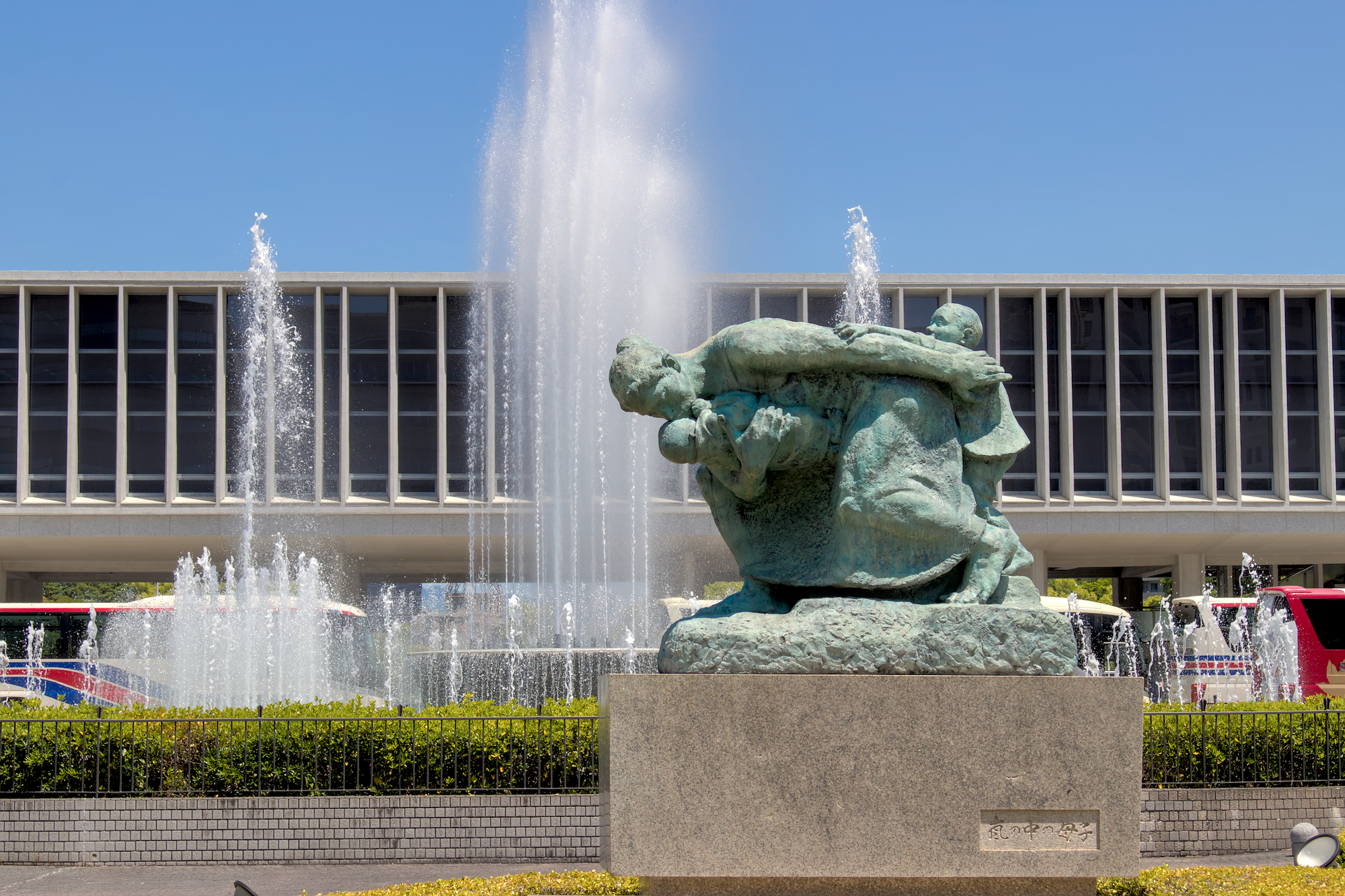
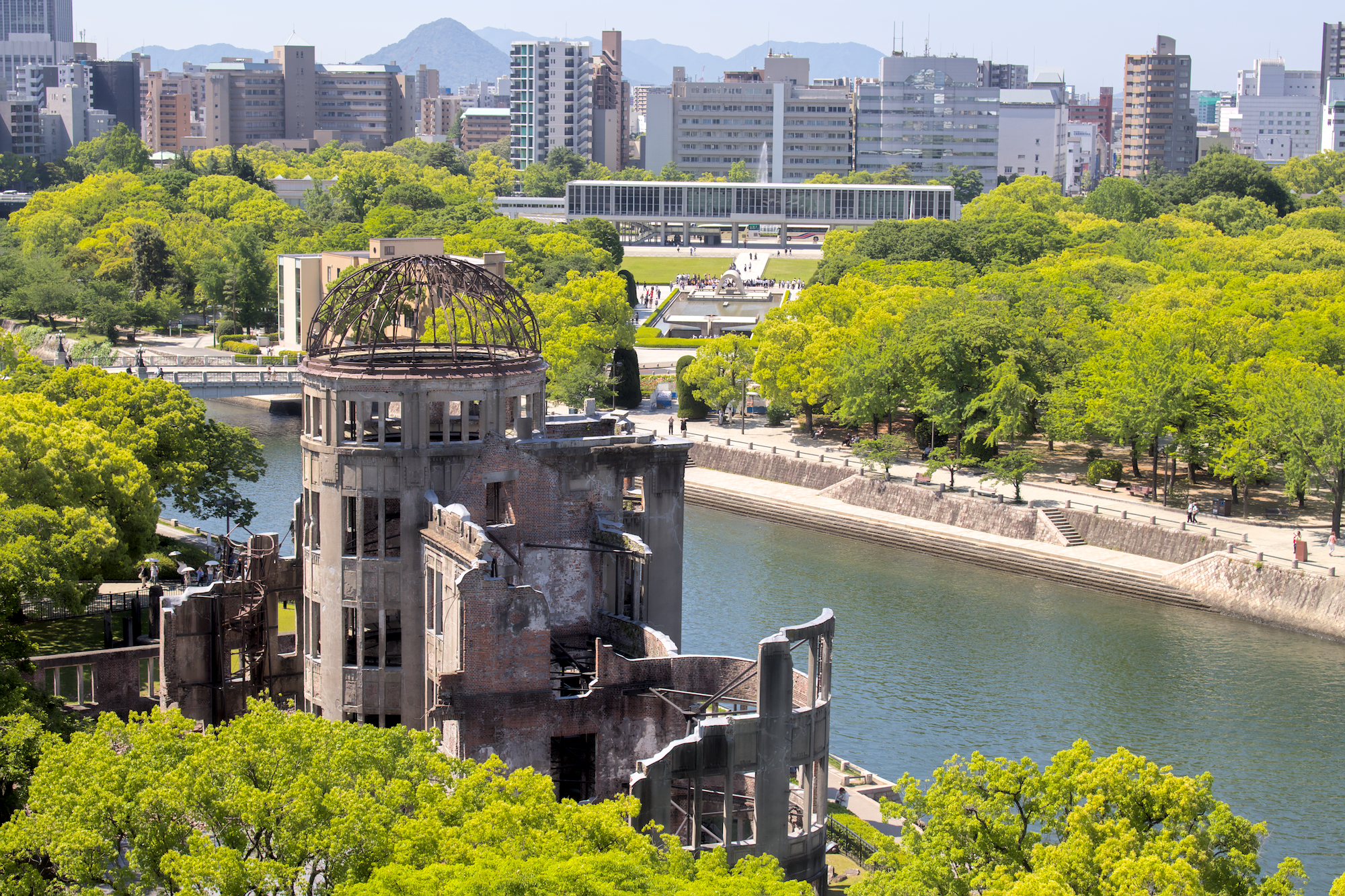
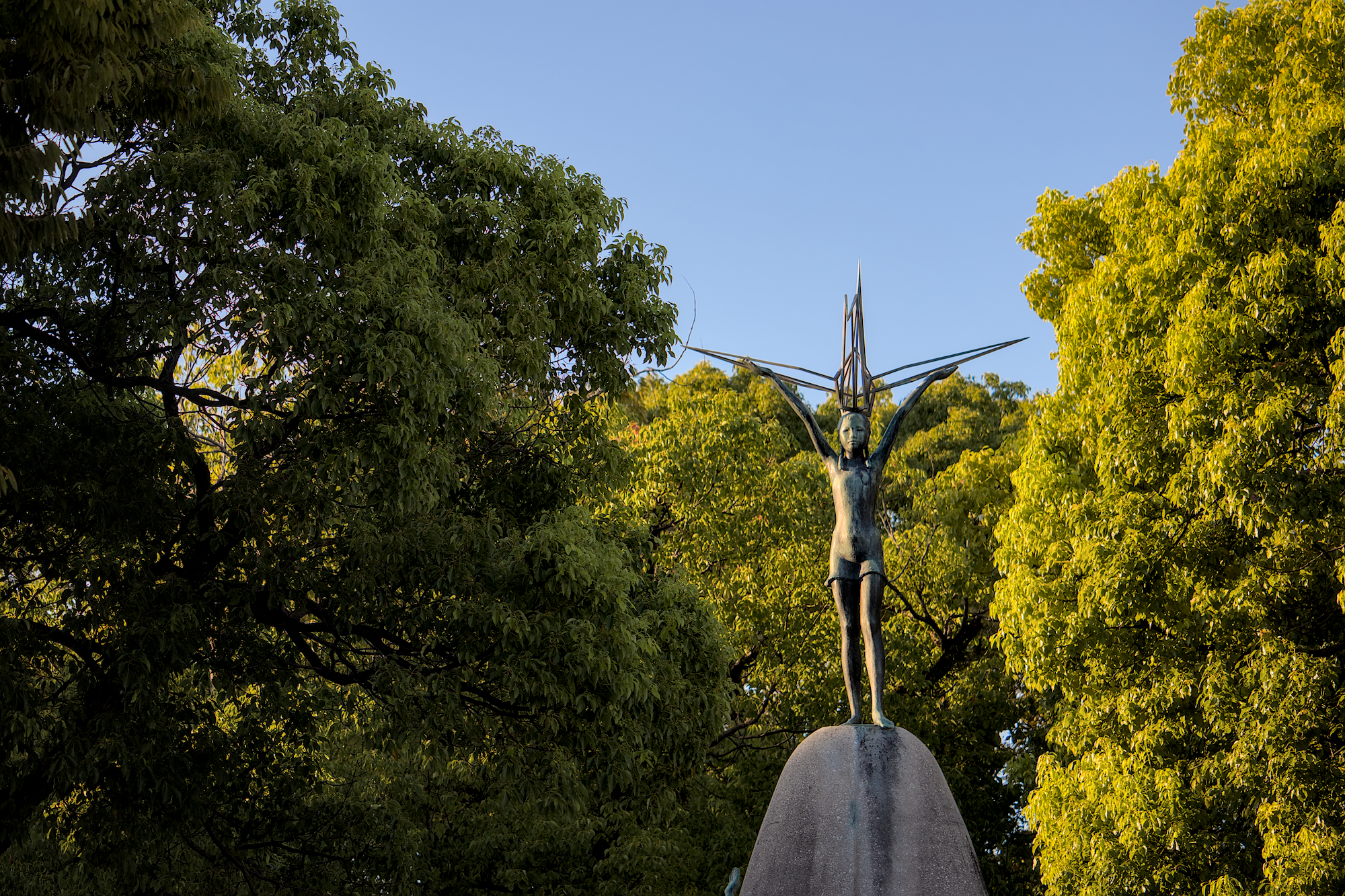
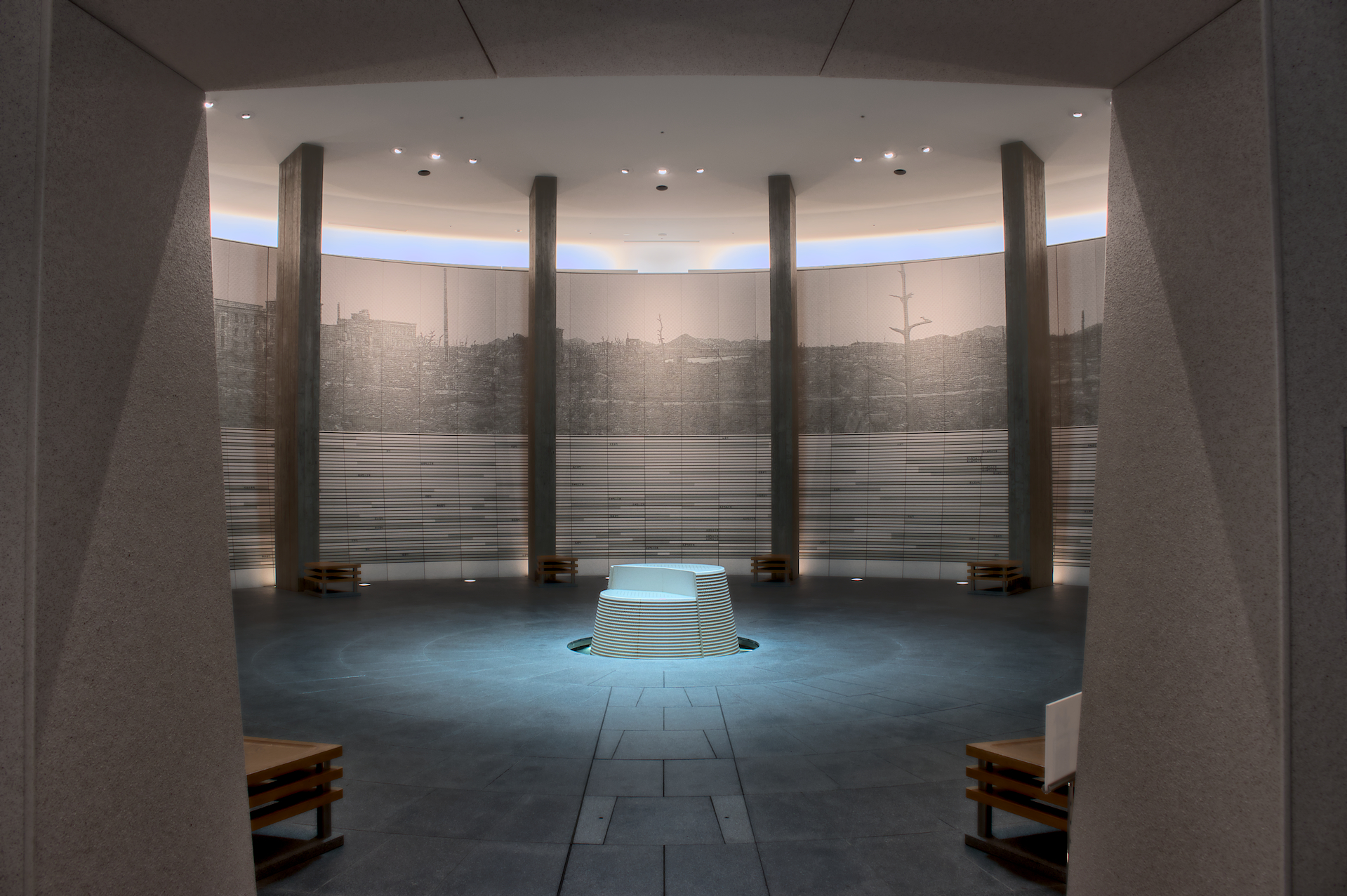
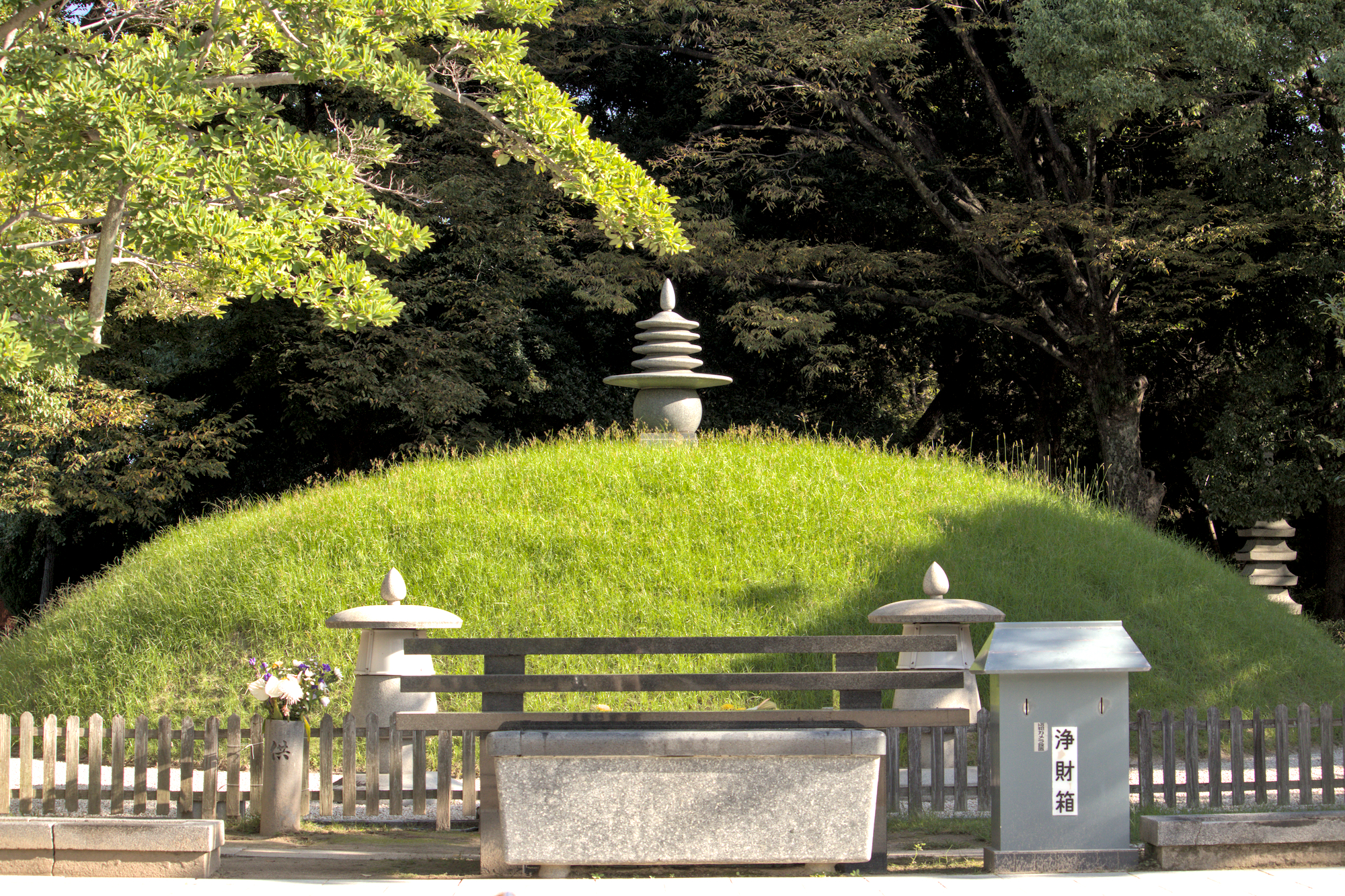
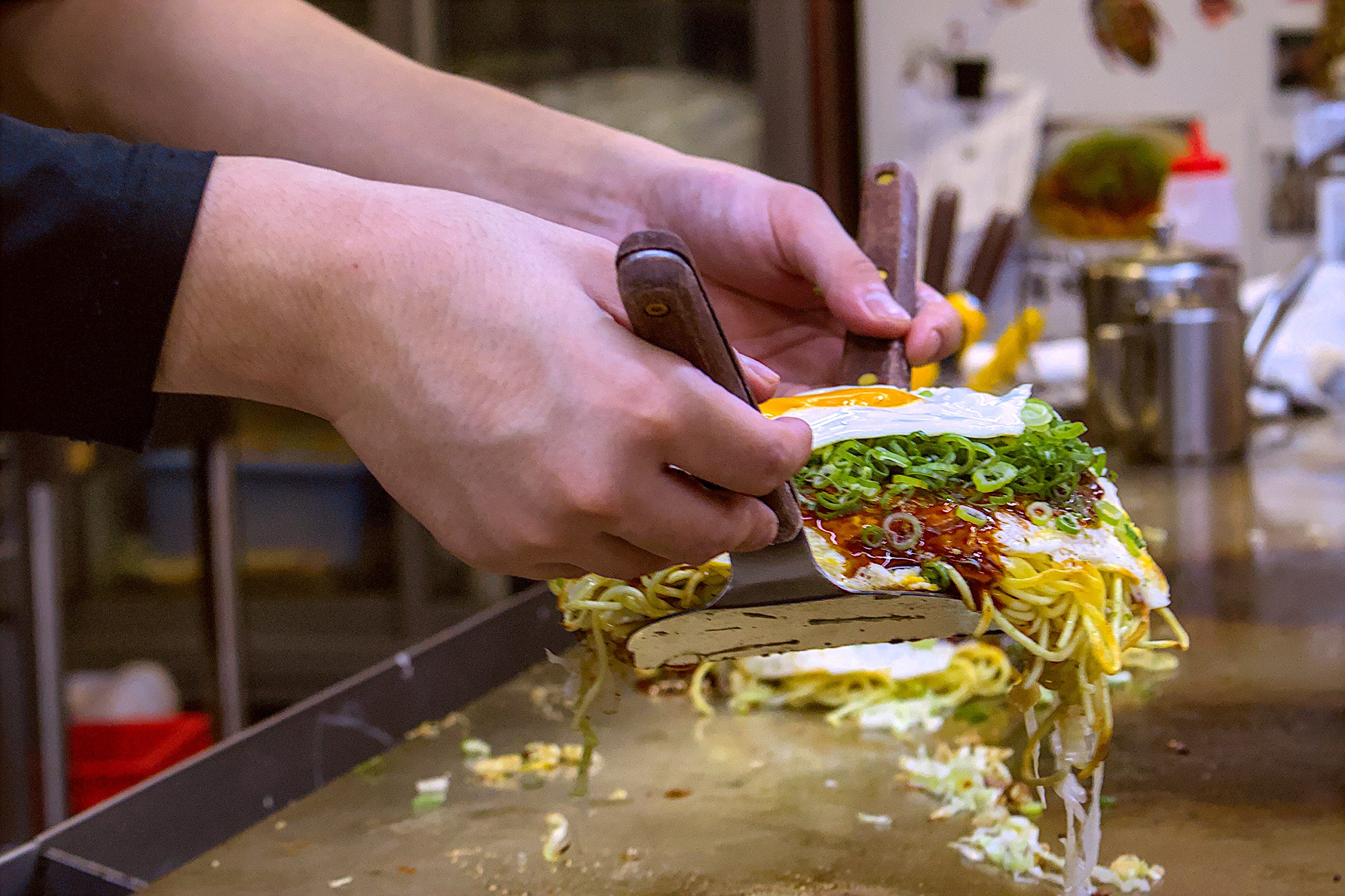
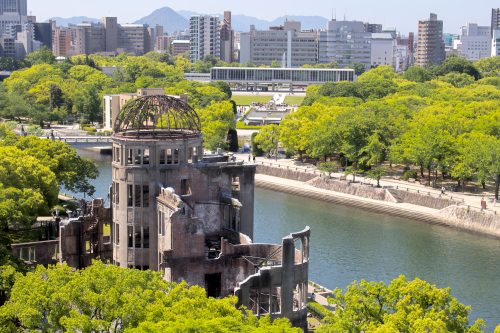
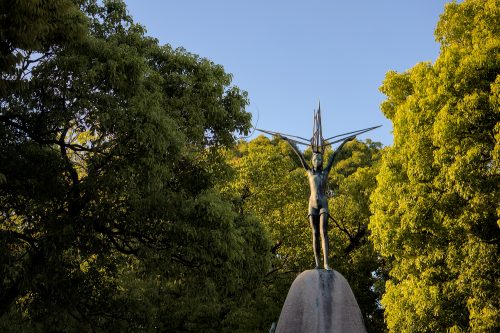
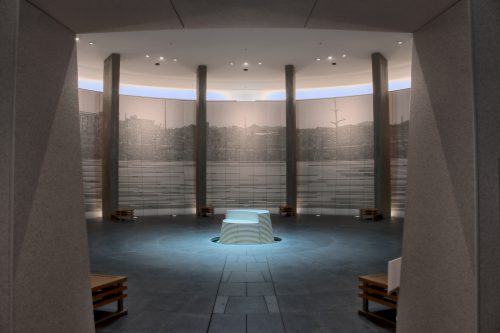
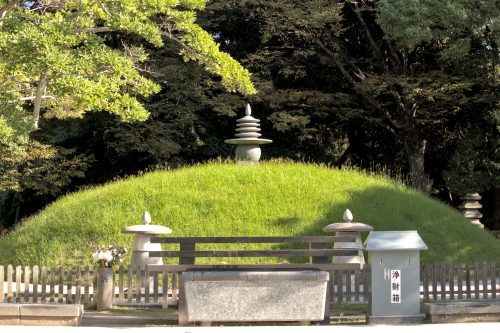
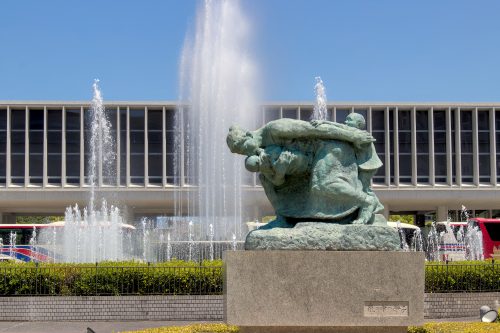
Hiroshima Peace Museum, the Fountain of Prayer, and the statue of Mother and Child in the Storm. (Joy Photo / Michael Farrell)
You just arrived at Hiroshima Station. You have six hours or less to visit Hiroshima’s main attraction, Peace Memorial Park (which includes the Atomic Bomb Dome), before you have to leave. It can take two days to fully take advantage of everything Peace Park has to offer, but you’re not in Hiroshima for selfies. You want to really understand what happened in 1945 and get as deep as you can into the modern city in your limited time. This is what you need to do.
Whether you arrive in the morning, midday or in the afternoon, we have you covered with the essential and hidden spots, what to expect, logistics, and how long these places take to explore beyond a photograph.
This is how you do Hiroshima Peace Memorial Park in under six hours with depth.
Table of Contents
Itineraries
Early Bird Route
Midday Route
Afternoon Route
Build Your Own Itinerary
Stow Your Luggage
Getting to Peace Memorial Park
Choices at Peace Memorial Park
Peace Memorial Museum
Memorial Hall
Sokoiko! Cycling Tours
Guided VR Walking Tour
Explore on Foot
Taking a Break
Fun & Shopping
Where to Eat Okonomiyaki
Itineraries
Early Bird Route (8 a.m. to 2 p.m.)
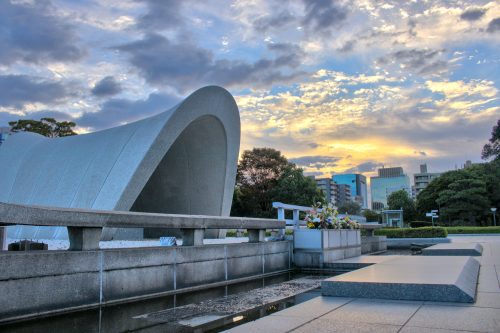
The Cenotaph for the Atomic Bomb Victims in early morning. (Joy Photo / Michael Farrell)
▪️8 a.m. Arrive at Hiroshima Station by Shinkansen
Drop off your bags at the coin locker at the south exit. Prices vary by bag size and length of storage. Then head to the nearby bus platforms.
▪️8:15 to 8:40 Bus to Peace Memorial Museum
From the south exit, take City Bus 24 (Platform 6) or 25 (Platform 3) to get to Peace Memorial Park. Get off at “Heiwa-kinen-koen.” Travel time is 14 minutes, and the standard fare is ¥240.
▪️8:45 to 9:45 Explore Peace Memorial Museum
Explore Peace Memorial Museum with an audio guide so you don’t have to read everything. Plan to finish the Main and East buildings in around 60 minutes. Entry is ¥200. An audio guide is ¥500. Afterwards, walk three minutes to Peace Memorial Hall.
▪️9:50-10:20 Explore Peace Memorial Hall
While Peace Memorial Museum explains the atomic bombing primarily through artifacts, Peace Memorial Hall explains the bombing mainly through eyewitness testimonies. After exploring, walk 3 minutes to Hiroshima Peace Memorial Park Rest House.
▪️10:30 to 11:50 Guided VR Walking Tour
Take the VR Guided Walking Tour to experience Hiroshima before the bomb, when the bomb fell and what it was like afterwards. The course takes 80 minutes. Adults pay ¥5,000. The less graphic children’s version is ¥2,500.
▪️11:50 to 12 p.m. Vending Machine Souvenir Shopping
Walk 3 minutes to enjoy a fresh momiji manju, Hiroshima’s signature sweet, from a vending machine. A double pack costs ¥300. A triple pack costs ¥450. Next, walk four minutes to buy a Hiroshima t-shirt from a vending machine that supports the preservation of the Atomic Bomb Dome. A single T-shirt costs ¥3,000.
▪️12 p.m to 12:20 Return to Hiroshima Station by Hiroden Tram
Depending on the tram’s schedule that day, walk one minute to Hondori Station or walk three minutes to Kamiyacho-Higashi Station. From Hondori, take Hiroden Line 1 to Hiroshima Station. The ride is 13 minutes and ¥240. From Kamiyacho-Higashi take Hiroden Line 2 to Hiroshima Station. The ride is 10 minutes and ¥240.
▪️12:20 to 12:25 Head to Lunch
Walk three minutes to Hiroshima Full Focus Building (just outside Hiroshima Station)
▪️12:30 to 2pm Enjoy Hiroshima-style Okonomiyaki
Okonomi Story Ekimae Hiroba, on the 6th floor, has 15 different okonomiyaki shops to choose from. They are all good. Find a seat and enjoy. Allow 45 to 75 minutes for lunch or order your okonomiyaki as takeout if you are in a hurry.
Midday Route (9 a.m. to 3 p.m.)
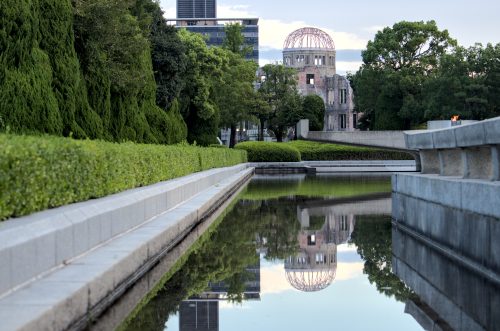
The Atomic Bomb Dome reflected in the Pool of Peace at Hiroshima Peace Memorial Park. (Joy Photo / Michael Farrell)
~9 a.m. Arrive at Hiroshima Station by Shinkansen
Drop off your bags at the coin locker at the Shinkansen Exit (north exit). Prices vary by bag size and length of storage. Then head to the nearby bus platforms.
19:15 to 9:30 Head to Peace Memorial Museum
Take the Lemon Maple Loop Bus to Peace Memorial Museum. The basic fare is ¥240.
9:45 to 10:45 Explore Peace Memorial Museum
At the museum, rent a ¥500 audio guide so you don’t have to read everything. It’s like the audiobook version of the museum and it helps pace the journey. Plan to finish the Main and East buildings in 60 minutes. Entry is ¥200. Afterwards, walk four minutes to Peace Memorial Park Rest House.
11:00 a.m. to 1:00 p.m. Take a Guided Cycling Tour
Explore Peace Memorial Park and Hiroshima City on E-bikes with Sokoiko!, a guided cycling tour company. You’ll be hungry when you return. Walk 10 minutes west across the park to Okonomiyaki Nobumoto or Okonomiyaki Carp.
1:10 to 2:10 Enjoy Hiroshima-style Okonomiyaki
Nobumoto is a Showa-retro style, neighborhood okonomiyaki shop off the tourist radar. It is notable for stubbornly refusing to raise their prices. Okonomiyaki Carp is a baseball-themed shop, one of many restaurants across the city devoted to the city’s baseball team. Allow 45 to 75 minutes to eat, then walk back across the park 12 minutes to Kamiyacho Shareo, the underground shopping mall beneath Genbaku Dome-Mae Station.
2:25 to 2:40 Vending Machine Souvenir Shopping
Walk one minute underground to GatchaCAN, a souvenir shop that sells everything through vending machines including cans of Hiroshima’s air and hand-drawn playing cards decorated with Hiroshima’s major sites and icons. When you are done, walk back the way you came to get to Gebanku Dome-mae Station.
2:45 to 3:10 Return to Hiroshima Station
Take Hiroden Line 2 or 6 to Hiroshima Station. The trip is 15 minutes, and the tram stops almost within view of the JR ticket gate. Just walk straight into the station.
Afternoon Route (11 a.m. to 5 p.m.)
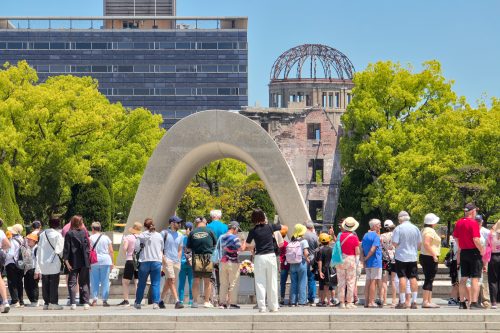
Peace Memorial Park is the most crowded in the middle of the day. (Joy Photo / Michael Farrell)
~ 11 a.m. Arrive at Hiroshima Station by Shinkansen
Drop off your bags at the coin locker at the South Exit. Prices vary by bag size and length of storage. Next, walk three minutes to the Hiroshima Full Focus Building (just outside Hiroshima Station)
11:15 to 12 p.m. Enjoy an Early Okonomiyaki Lunch
Okonomi Story Ekimae Hiroba, on the 6th floor, has 15 different okonomiyaki shops to choose from. They are all good. Find a seat and enjoy. The lunch rush will just be starting so you should be able to have your pick of the shops. Allow 45 to 60 minutes for lunch. After lunch, head to Hiroshima Station’s south exit bus platforms.
12:15 Bus to Peace Memorial Park
From platform 6, take the number 24 city bus bound for Yoshijima Eigyosho. Get off at “Heiwa-kinen-koen.” The trip takes 14 minutes, and the standard fare is ¥240.
12:45 to 2:00 Explore Peace Memorial Museum
Explore Peace Memorial Museum with an audio guide so you don’t have to read everything. Plan to finish the Main and East buildings in 60 to 90 minutes. This is the museum’s busiest time of the day, so the crowds may slow you down. Renting an audio guide for ¥500 helps smooth the experience. Entry is ¥200. Afterwards, walk three minutes to Peace Memorial Hall.
2:05 to 2:35 Explore Peace Memorial Hall
While Peace Memorial Museum explains the atomic bombing primarily through artifacts, Peace Memorial Hall explains the bombing mainly through eyewitness testimonies. After exploring, walk 3 minutes to Hiroshima Peace Memorial Park Rest House.
2:40 to 3:00 Relax, Shop and Explore at the Rest House
The Rest House is packed with experiences from a cafe with local specialties like momiji manju, an exhibit in the basement about the man who survived the atomic bomb there, souvenir shopping, and the home base of the virtual reality and cycling tours.
3:00 to 5:00 Take a Guided Cycling Tour
Learn the story of Peace Memorial Park and Hiroshima City on e-bikes with Sokoiko!, a guided cycling tour company. After your ride, walk north for six minutes to Genbaku Dome-mae Station.
5:10 to 5:30 Head Back to Hiroshima Station
Take Hiroden Line 2 or 6 to Hiroshima Station. The trip is 15 minutes, and the tram stops just steps from the JR ticket gate.
Build Your Own Route
You have six hours in Hiroshima. You’re coming in hot off the Shinkansen — the bullet train. You are mainly coming to explore Peace Memorial Park. You want to go as deep as you can with the time you have, but you want to build your own itinerary. This section is for you.
We have all the information you need to help you plan your visit every step of the way from dropping off your bags to getting back to Hiroshima Station to catch the train to your next adventure.
Where to Stow Your Luggage
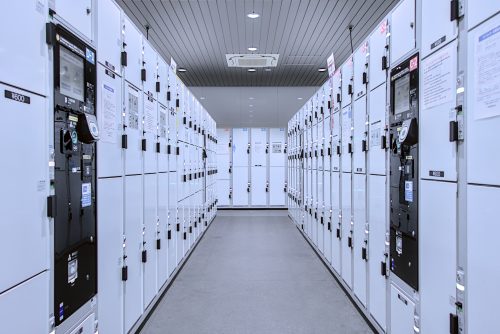
Lockers at Hiroshima Station’s North Exit. (Joy Photo / Michael Farrell)
If you’re not staying in Hiroshima, you need somewhere to store your luggage while you’re exploring Peace Memorial Park.
There is paid luggage storage at Peace Memorial Museum, Orizuru Tower and in nearby Kamiyacho Shareo underground shopping mall and Gate Park. However, the most convenient place to store your luggage is at Hiroshima Station.
There are several paid locker locations in the station. Here is where to find the most convenient ones.
By the Shinkansen Gate
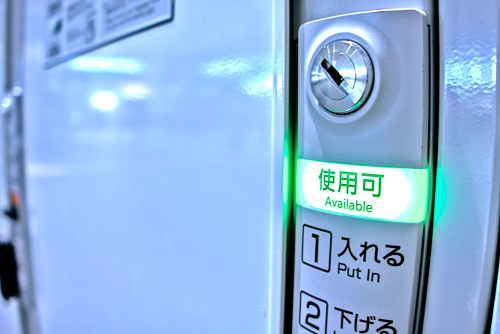
An available locker at Hiroshima Station glows green. (Joy Photo / Michael Farrell)
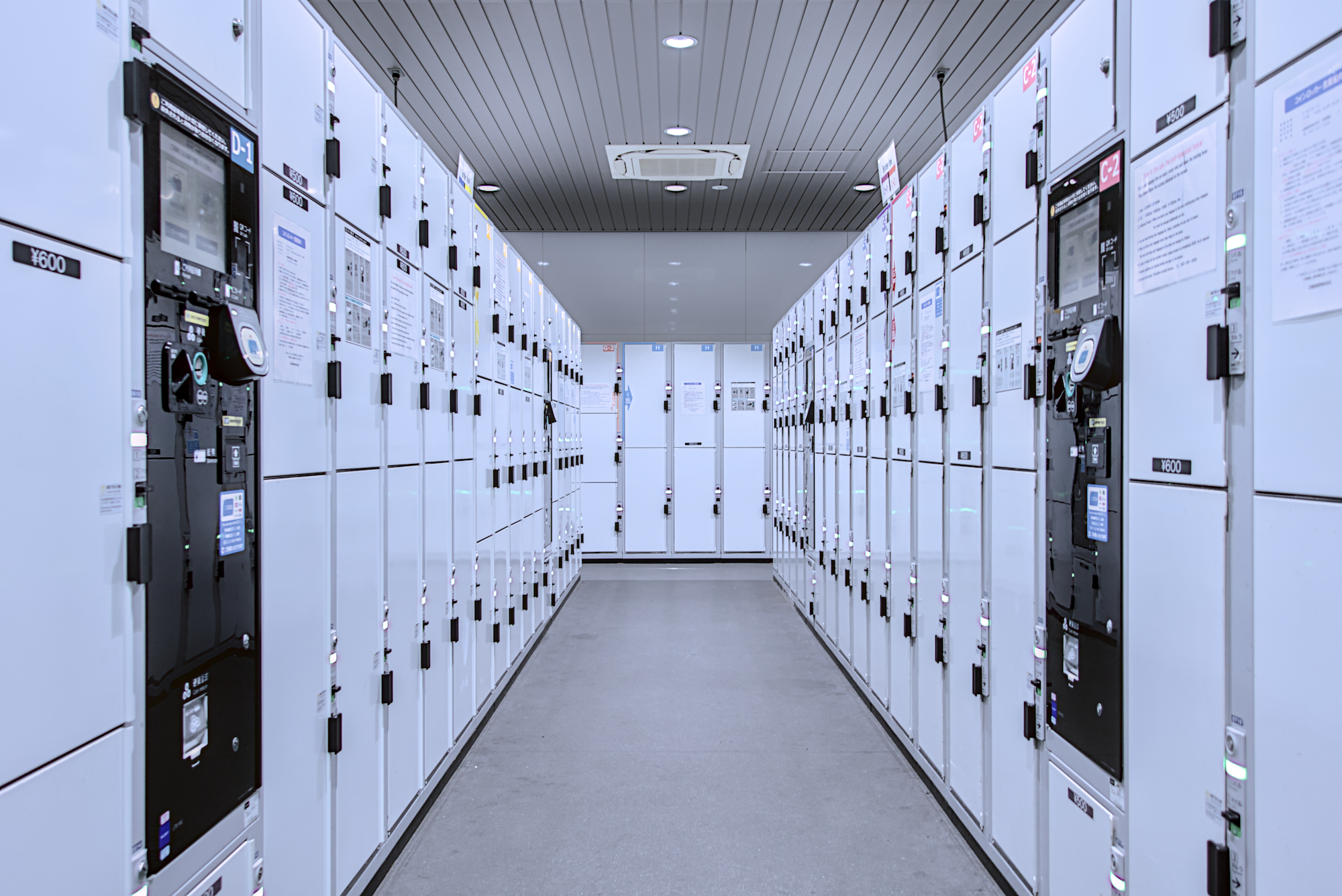
If you are lucky enough to find an empty one, there are 14, large, pay-to-use lockers directly across from the Shinkansen ticket gate. Immediately on the left as you exit the gate, there is a larger collection of lockers with more size options.
Locker prices start at ¥500 for small ones big enough for a kid’s backpack or a large purse. Prices increase up to ¥1,000 per day for the largest size which is about a meter high and half a meter deep. Lockers kept after midnight get charged the full fee a second time.
Also be sure to take everything you will need out of your luggage before closing the locker door. Once the door is closed, it cannot be opened again without paying the full price a second time to close it.
North Exit Coin Lockers
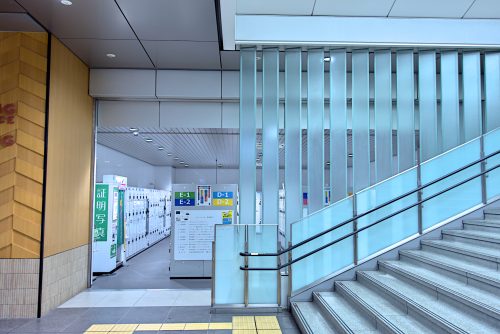
The coin lockers at Hiroshima’s North Exit at right next to the stairway to the first floor. (Joy Photo / Michael Farrell)
If the Shinkansen gate lockers are all taken, there is a locker room at the Shinkansen Exit on the northern side of the station. Walk straight out of the Shinkansen ticket gate and veer right. You’ll find a stairway to the first floor on your left. The coin lockers are immediately on your right at the base of the stairs. There are around 200 coin-operated lockers in four sizes. This locker location is convenient for people departing from the Shinkansen Exit, such as those wanting to take the Maple Loop tourist bus.
South Exit Coin Lockers
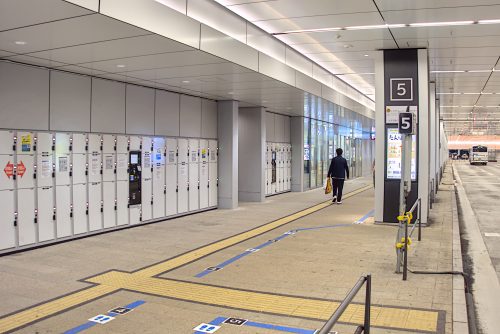
Additional lockers next to Hiroshima Station’s city bus platform 5. (Joy Photo / Michael Farrell)
The South Exit coin lockers are convenient for visitors taking taxis or a city bus. Turn right from the Shinkansen Gate and take the first large set of stairs to the ground floor. A room of lockers is at the base of the stairs immediately on the right.
There are three more sets of lockers at the South Exit. Next to the lockers at the base of the South Exit is a sliding glass door that looks like it is only for staff. It isn’t. It takes you to the basement level. There you will find another large collection of lockers across from Cocokara Fine, a drugstore chain.
Alternatively, turn left at the base of the South Exit stairs and follow the shops at the base of the station. You will find a room of coin lockers on your left next to a Ringer Hut, a national chain that serves Nagasaki Champon. On your right will be the taxi stands if you are planning on taking a taxi.
The most convenient lockers for people taking the city bus to Peace Memorial Museum are to the right of the South Exit stairs. Turn right and follow the shops to the end of the bus platforms. You will find a wall of lockers on your right opposite city bus platform 5.
Hiroshima Cloak
If you are out of luck in the station or have especially large or uniquely shaped luggage, Hiroshima Cloak is your best option. The slogan on their website translates into English as, “If you’re having trouble with coin lockers at Hiroshima Station, head to Hiroshima Cloak.”
It is a three-minute walk from Hiroshima Station to Ekinishi, the old drinking district immediately west of the station. They can store items that don’t fit in lockers like snowboards and double strollers. They are also more affordable than the station’s coin lockers. They charge by the sum of the length, width and height of the luggage to be stored. 120 cm or less is ¥500 per day. Over 120 cm is ¥800 per day.
They take reservations and will also accept luggage by walk-in.
Getting to Peace Memorial Park
By Tour Bus
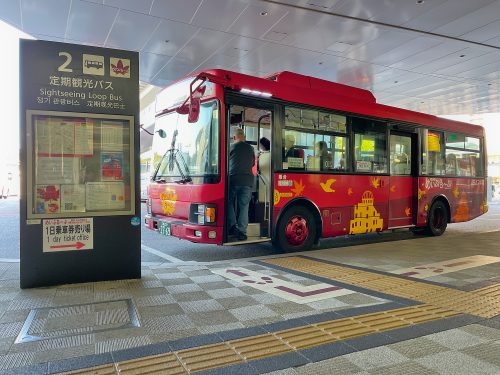
The Maple Loop bus waits for passengers just outside Hiroshima Station’s North Exit. (Joy Photo / Michael Farrell)
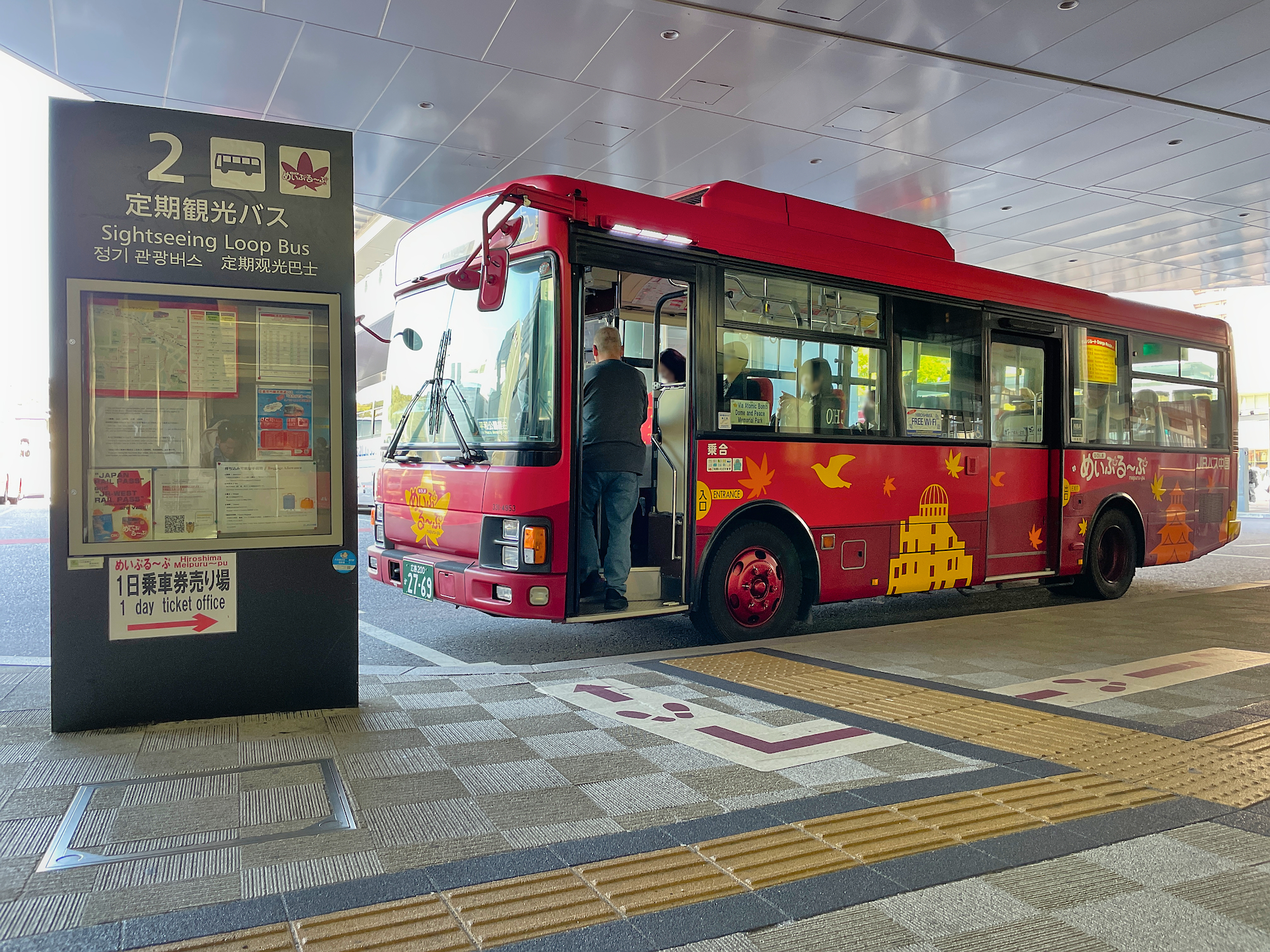
The most reliable public transportation route to Peace Park are the Meipuru~pu (Maple Loop) sightseeing busses. They circle through only eight or nine stops, so they do not stop as much as city buses. Plus, they only stop at tourist locations, so if you do get off at the wrong stop, at least you’ll be somewhere interesting.
There are three routes — Orange, Lemon and Green — but they all travel to Peace Memorial Museum. in about 15 minutes.
The distinctive, red bus departs roughly every 15 minutes from the ground floor of Hiroshima Station just outside the Shinkansen Exit.
The adult fare is ¥240. However, Maple Loop buses are free to ride for holders of the Japan Rail Pass and eligible JR-West regional rail passes, including the popular Kansai–Hiroshima Area Pass. Children five and under also ride for free while children 6 to eleven pay half price.
Get off at “Peace Memorial Park (Hiroshima Peace Memorial Museum).” You’ll be on the southern side of Peace Park just outside the main entrance. Peace Memorial Museum’s main building is impossible to miss with its ribbed structure rising over the entrance to the park on tall columns.
By City Bus
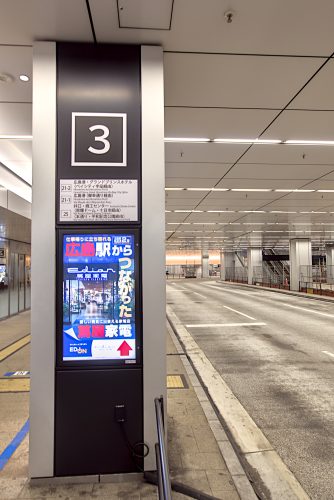
Hiroshima Station’s Platform 3 is the departure point of the number 25 bus that stops at Peace Memorial Museum. (Joy Photo / Michael Farrell)
If you miss the Maple Loop or arrive before service starts at 9 a.m., the city bus is the next best option if you want to go directly to Peace Memorial Museum at the front of Peace Park. Leave Hiroshima Station from the South Exit to take city bus 24 at platform 6 or bus 25 at platform 3. The trip is around 15 minutes. The fare is the same as the Maple Loop.
By Hiroden Streetcar
The most direct route to Peace Park is by Hiroden streetcar. However, it does not take you to the front of the park. It takes you to the back. So, it is not ideal for people who want to start at the museum. However, it is preferable if you plan to explore the park first or can’t wait to ride the city’s iconic public transportation system.
Hiroden streetcars depart from the new second floor tram station on the south side of Hiroshima Station, just a minute’s walk away from the JR ticket gate. Take Line 2 or 6. You can take Line 1, but it takes a different route and the closest stops are an additional five to 10 minute walk. Each line departs Hiroshima Station every 10 to 15 minutes.
Please note, JR passes are not accepted on Hiroden trams. The companies are not affiliated. However, Mobiry Days, the local pass company, sells e-passes that you can set up online and use on your phone.
From Hiroden Line 1 or 2, get off at Genbakudome-mae Station. You’ll see the Atomic Bomb Dome on your left as you come into the station. Cross the street and you arrive at the northern end of Peace Park.
Public Transportation Fees
The Maple Loop, city bus and Hiroden all have the same fee if you’re traveling around the city center, and Peace Park is solidly in the center of the city. Without travel passes, the normal fare is a flat rate of ¥240 for adults and ¥120 for children ages 6 to 11. 5-year-olds and under ride free. A passport is sufficient to prove ages.
By Taxi
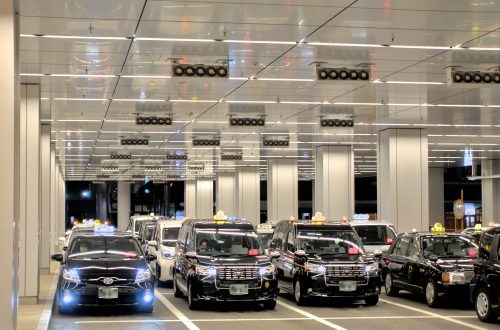
Taxis wait for customers at the taxi stand at Hiroshima Station’s South Exit. (Joy Photo / Michael Farrell)
If you’re really concerned about time, a taxi will get you to Peace Park in 11 minutes if traffic is clear. The taxi stand at Hiroshima Station is outside the South Exit. However, a taxi will cost you around ¥1,300 to get to the main entrance of the park.
Read more about: Getting Around Hiroshima
Choices at Peace Memorial Park
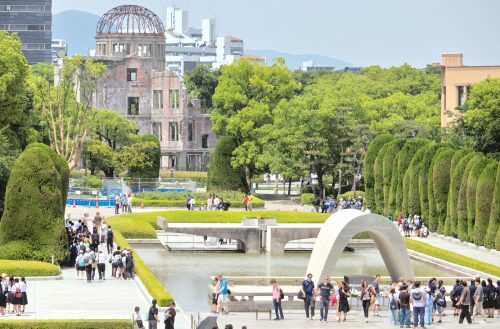
The view of Peace Park from the north facing gallery windows of the Main Building of Peace Memorial Museum. (Joy Photo / Michael Farrell)
When you get to Peace Park, you have some decisions to make. The park takes up 122,100 square meters (~30 acres) in the center of the city. It contains two museums, a conference center, a rest house, six major monuments including the Atomic Bomb Dome, and over 60 smaller monuments, memorials, displays and works of art.
You can easily spend two days exploring everything in detail. But since you don’t have two days, we broke the park down into the most impactful experiences.
Read more about: Peace Memorial Park
Peace Memorial Museum (1 to 3 Hours)
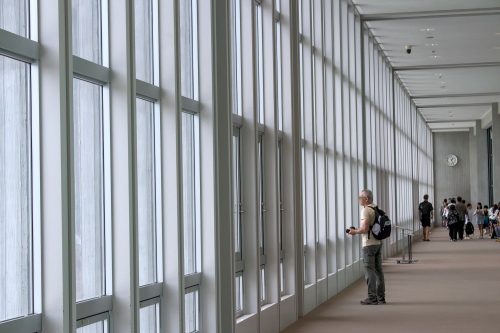
A man looks out at Peace Memorial Park in the north-facing gallery at Peace Memorial Museum. (Joy Photo / Michael Farrell)
Hiroshima Peace Memorial Museum is the Rosetta Stone through which the whole park is understood. Every first time visitor to Peace Park should prioritize the Peace Museum.
The museum is spread over two buildings, the East Building, which includes the entrance, and the Main Building, which straddles the main entrance to the park.
Admission is ¥200 for adults. High school students pay ¥180 and younger students get free admission. 100% discounts are also available for large groups.
The exhibit uses artifacts from the atomic bombing along with survivor testimonies, photographs and artwork to tell what happened the morning of 1945. The suffering of Hiroshima’s people is examined in poignant detail from the explosion of the atomic bomb through the consequences endured over the intervening decades.
Like the park, the museum is dense with meaning. With around 500 artifacts and plenty of reading for context, one can easily spend the better part of a day in the museum.
Some tour operators will speed through the whole museum in 30 minutes. At that pace, you can see the museum, but you can’t experience it. To truly experience it, you need at least 60 minutes. According to the museum, the Main Building and the East Building each take around 30 minutes to complete. That said, visitors can easily take longer.
You don’t have to do everything to get the full impact of the museum, but the experience can be optimized. To help the experience flow faster, we recommend renting an audio guide. With 90 minutes of recorded commentary, visitors can use the guide to pace themselves and emerge roughly one and a half to two hours later with a much deeper understanding of the tragedy than when they arrived.
The Peace Museum can be one of the most crowded spaces in the park. To save time, it is best to avoid peak hours between 11 a.m. and 3 p.m.
Read more about: Hiroshima Peace Memorial Museum.
Memorial Hall (30 Minutes to 1 Hour)
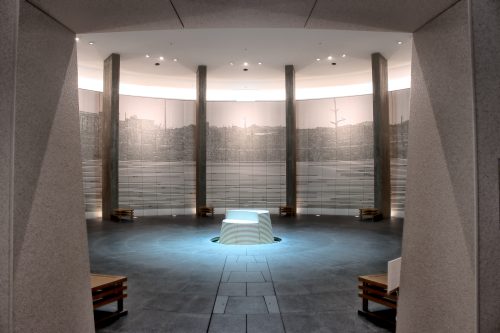
The Hall of Remembrance at National Peace Memorial Hall. (Joy Photo / Michael Farrell)
Hiroshima National Peace Memorial Hall for the Atomic Bomb Victims is one part shrine to the dead and one part national archive. It was established by the Japanese national government to keep records about the victims of the atomic bombings of Hiroshima and Nagasaki. It was also tasked with preserving the voices of the victims for future generations. So while the Peace Museum covers everything, Memorial Hall is laser focused on the human testimony of the people who suffered from the atomic bombs.
The facility is not very large and so can be walked straight through in 10 minutes. However, it is also a solemn and prayerful space layered with symbolic meaning. This slows people down as they meditate on the tragedy.
Memorial Hall is also deeply challenging as the content there humanizes the victims far beyond casualty numbers. The building hosts poetry readings and survivor testimonies. It also has an extensive catalog of video testimonies for visitors to peruse in their library. On top of that, it has a changing special exhibit that focuses in-depth on a single story from the tragedy.
If you stay to explore, you can easily spend 30 minutes to an hour there.
Read more about: Peace Memorial Hall for the Atomic Bomb Victims.
Sokoiko! Cycling Tours (2 to 3 Hours)
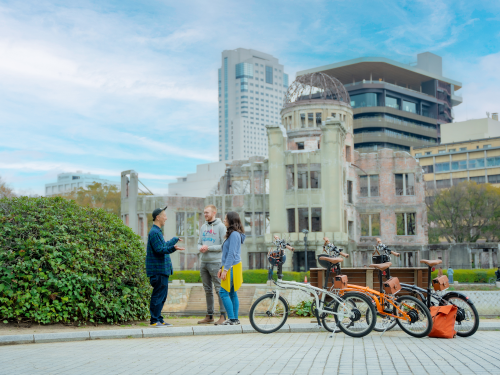
(Sokoiko Photo)
There are many ways to tour Peace Memorial Park; however, the most efficient and relaxing way is on a bicycle. Sokoiko! operates a guided cycling tour out of Peace Memorial Park. Their guides map the story of the atomic bombing over the main monuments in the park before continuing the story through excursions into the city.
Peace Park is not the only part of the city with monuments. The entire city is dotted with monuments of the atomic bombing, making Hiroshima like a city-wide museum. Sokoiko gives visitors easy access to impactful monuments they might never have seen plus the benefit of insider commentary on the event and the monuments visited.
They offer two tour packages: a two hour tour and a three hour tour. The two hour tour takes visitors south into the city while the three hour tour also takes them north to Hiroshima Castle.
The first tour of the day departs at 11 a.m.
Book a tour with Sokoiko!
Read more about: Sokoiko!
Guided VR Tour (80 minutes)
Early birds will appreciate Peace Park Tour VR. It starts daily at 10:30 a.m. and finishes at 11:50, giving you just enough time to get back to Hiroshima Station, have lunch, and be ready for a 1 p.m. Shinkansen bullet train.
Visitors are guided to five stops around Peace Park where they are invited to look into the past through VR goggles. Each stop offers 360 degree views of the park. Visitors get to experience what the park looked like when it was a major commercial district, when the bomb exploded, and during reconstruction. You can even witness the B-29 Superfortress Enola Gay fly over the city and the glint of the atomic bomb before it explodes and radically changes the scene in an instant. The tour ends with hopeful views of the city returning to life during Hiroshima’s reconstruction era.
There are two versions of the tour: a graphic one for adults, and a revised one for children. However, while both experiences provide a deeper appreciation for the tragedy, they are still sanitized versions of what actually happened.
Hiroshi Harada, a hibakusha (atomic bomb survivor) and former director of the Peace Memorial Museum, tried the tour and said, “It wasn’t like this. It was worse.”
Exploring on Foot (0.5 to 3 Hours)
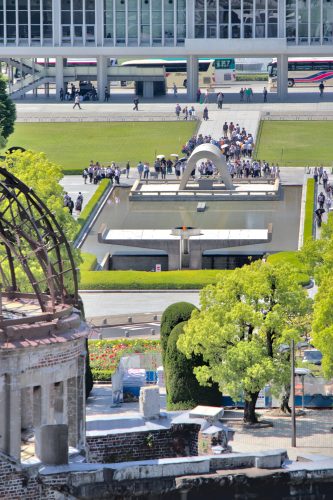
A view south down the center axis of Peace Memorial Park. (Joy Photo / Michael Farrell)
The most common way to explore Peace Memorial Park is on foot. Most monuments have explanatory plaques. The major monuments have English translations though many of the smaller monuments do not. However, modern technology makes this less of an issue today.
Peace Park is a serene and beautiful park to explore on foot, but it can take some time. If you don’t stop for anything and walk with intention you can walk down the center and around the outer paths of the park in about 40 minutes. However, the very nature of the park encourages taking it slow while visitors meditate on the serious topics it elicits. Depending on your interests, personality and fitness level, it can take two or more hours to completely tour the park on your own.
If you’re in a pinch, stick to park designer Kenzo Tange’s central north-south line through the park. This center axis is the heart of the park. In the words of the plaque near the main entrance, the center axis is “a prayer for the souls of the victims of the atomic bombing and a wish for everlasting world peace” expressed visually. The most important monuments like the Cenotaph, the Children’s Peace Monument, and the Atomic Bomb Dome are there. A thoughtful stroll down the center axis will take around 30 minutes, but if you have more time, consider the following routes through the park.
There are three directions that people typically start exploring from: the south, the north, and the eastern entrance from Hondori.
The Southern Route
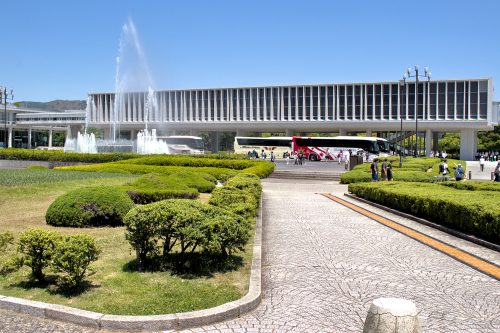 The most orderly route starts in the south. This is the route created by Kenzo Tange, the park’s lead architect. It starts at Peace Boulevard, goes on to Peace Memorial Museum and then leads straight up the middle of the park on the way to the Atomic Bomb Dome. Instead of crossing the Motoyasu Bridge to get to the dome, we recommend taking in the sites on the western side of the river as you move north. This includes the Bell of Peace and the Clock Tower of Peace. At the northern tip of the park, you’ll find the T-shaped Aioi Bridge. This bridge was the intended hypocenter of the atomic bomb. From there, circle to the right to get a closer look at the dome. If you’re strapped for time, this is a great spot to end on. The Hiroden streetcar station is right there and will take you directly to the second floor of Hiroshima Station, a one-minute walk from the ticket gates. The travel time from station to station is around 17 minutes.
However, if you can spare another half hour, keep following the path south from the Atomic Bomb Dome. Walk along the eastern or western bank of the Motoyasu River to see sites like the tortured shape of Hiroshima Atomic Bomb Victims Monument as seen on the river’s east side or the insightful A-Bomb Ruin Exhibition Hall on the west side. Cross Peace Boulevard and cut westward along the southern border of the park to pass through the Gates of Peace. This is the next key transportation area where you can jump on the Maple Loop or city bus 24 or 25 to get back to Hiroshima Station. Cross the street again to get to the bus stop for the busses. The Maple Loop bus returns to Hiroshima Station in 20 to 30 minutes depending on the line, with the Orange line taking the longest. Meanwhile, the city bus provides the quickest bus route back with a 12-minute ride.
Yet again, if you have another half hour or more, explore the western side of the park. Head north again but this time along the Honkawa River side of the park. On that side you can see the Korean Atomic Victims Cenotaph, and you can pray for the 70,000 mostly unnamed dead who are laid to rest at the A-Bomb Memorial Burial Mound. By the end of the route, you’ll be close to the Hiroden again.
The Northern Route
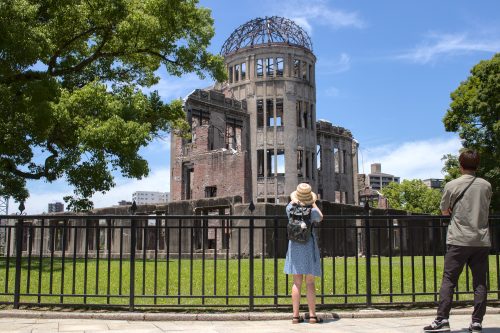
A tourist takes photos of the Atomic Bomb Dome. (Joy Photo / Michael Farrell)
The northern route starts at the Atomic Bomb Dome. We recommend following a roughly inverse path of the southern route if you want to see almost everything. From the dome, head west across the T-shaped Aioi Bridge and turn left halfway across the bridge to enter the central path of the park on the way to the Peace Museum. From there, you can hop on the Maple Loop or circle around to the west or east to get to the outer monuments.
The Hondori Route
The Hondori entrance hits the eastern side of the park right in the middle of the action. There is a lot to take in here and one’s interests can easily be led in any direction. We recommend turning right to get up close to the Atomic Bomb Dome before following the northern route around the park. That way you get to the major monuments in the first third of your walk. If you want to end your tour with the major sites, turn left and follow the river south, cut across the base of the park to the Honkawa side, move north again to the Aioi Bridge then finish by going down the central path.
Read more about: Kenzo Tange’s Route
Back to Table of Contents
Taking a Break
Hiroshima Peace Memorial Park Rest House (15 minutes to 1 Hour)
Halfway between the Atomic Bomb Dome and Peace Memorial Museum lies Hiroshima Peace Memorial Park Rest House. Restored to its 1929 design as the Taishoya Kimono Shop, the Rest House is one of the few buildings to survive the bomb and Hiroshima’s reconstruction. It is also a great place to take a breather between monuments.
It serves a number of functions at once. It is the meeting place for all the tour operators in the park such as Sokoiko! The first floor operates as a tourist information center and gift shop. The second floor has a cafe and rest area. The third floor is a museum that uses models and photos to illustrate the bustling commercial district that the park was before the bomb. Lastly, the basement contains an exhibit about Eizo Nomura, the only person in the building to survive the atomic bomb — escaping because he happened to be in the basement looking for papers when the bomb exploded.
If you do not need to rest, you could breeze through the building in 15 minutes. If you take the time to explore deeply, you will need at least 30 minutes. Add an extra 15 minutes if you expect to relax at the second floor’s Piano Café. You may find that you need even more time there as you enjoy local flavors such as “Hiroshima hassaku citrus squash,” a refreshing drink similar to a sparkling lemonade; or momiji manju, nearby Miyajima’s signature sweet.
Orizuru Tower (1 to 2 Hours)
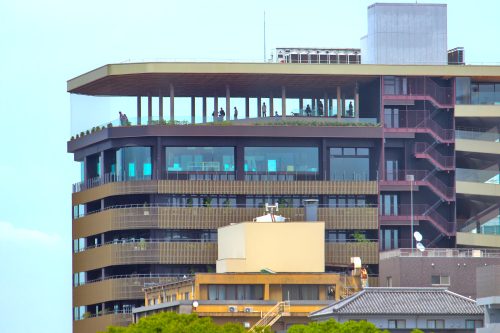
Looking up at Orizuru Tower from Peace Park, you can see visitors looking down from the Hiroshima Hills observation deck. (Joy Photo / Michael Farrell)
Orizuru Tower is three parts premium city views, two parts food and drinks, one part art museum and two parts amusement park. If you have the resources, you can spend a lot of time — and money — at Orizuru Tower.
The tower’s main appeal is its ever changing views of Hiroshima City as you ascend a curling, sloped ramp up 14 floors. The inner wall is covered with artwork. The outer wall is a window onto the city.
At the top of the tower is the wooden, open-air observation deck called “Hiroshima Hills.” It pairs stunning views of the park with handcrafted drinks from the Roof Top Cafe and Bar.
The 13th floor hosts Orizuru Square, where visitors can enjoy interactive digital games and activities themed around paper cranes. On the 12th floor is a 70 meter slide that curls all the way down to the first floor.
Back on the first floor, peruse local goods at Hiroshima IPPIN, a souvenir shop. Also on the first floor are more places to eat: Akushu Cafe, an organic café serving sweet drinks and desserts made with local, organic produce and no processed sugar; and Mitchan Sohonten, one of the oldest okonomiyaki brands in the city.
The tower also has paid, coin-operated lockers for luggage and bags. It is located next to the entrance gate on the first floor.
Admission to the tower is ¥2,200 for adults 18 and over. A range of discounts exist for children. An additional ¥100 is charged for those who want to fold a paper crane and drop it into the 13-story, glass cavity at the front of the building.
Read more about: Orizuru Tower
Caffé Ponte
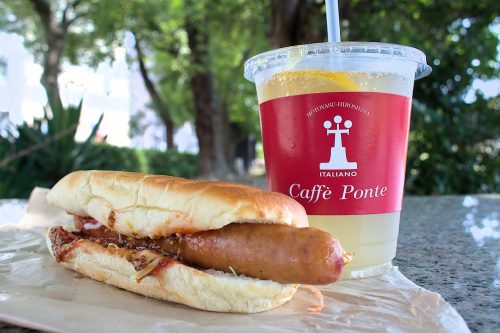
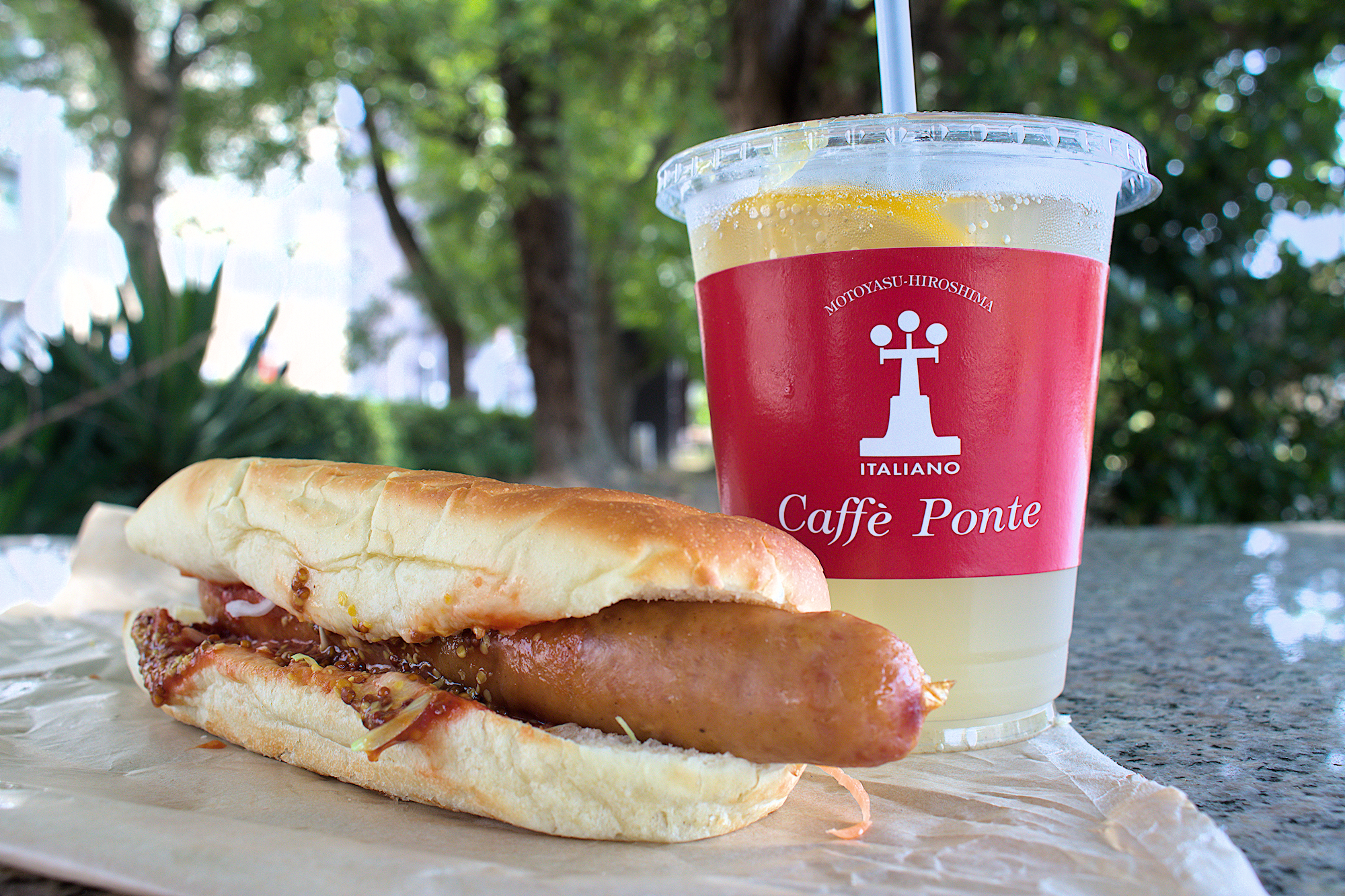
A brick-oven panini hotdog and a handmade Setouchi lemon ginger from Caffé Ponte on the eastern side of Peace Memorial Park. (Joy Photo / Michael Farrell)
Caffé Ponte is an Italian restaurant near the historic Motoyasu Bridge on the eastern side of Peace Park. It is iconic among the locals for its terrace seating, park views, and crates upon crates of fresh oranges (Hiroshima is a major citrus grower in Japan). The food is well reviewed, but the store is often packed.
If you are in a rush and only need light refreshment, they have a takeout window on the side. There you can order a variety of handcrafted drinks like fresh-squeezed orange juice and Setouchi lemon ginger ale. It serves brick-oven panini hotdogs with a good snap. Plus, Caffé Ponte is a popular stop for gelato and sherbet. In addition to royal vanilla, chocolate and strawberry, it offers local flavors like moshio sea salt and Hiroshima lemon.
You can enjoy your takeout next to the café in the shaded public rest area complete with tables and benches. However, many dig right in across from the takeout window, seated on stools made from wooden stumps.
Fun & Shopping
Vending Machines Near Peace Park
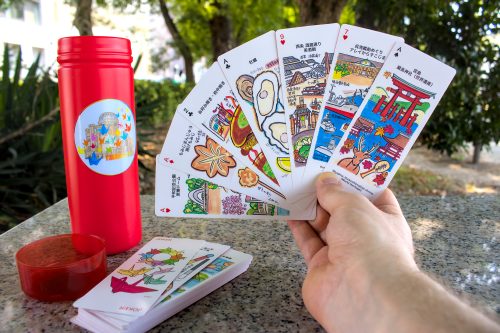
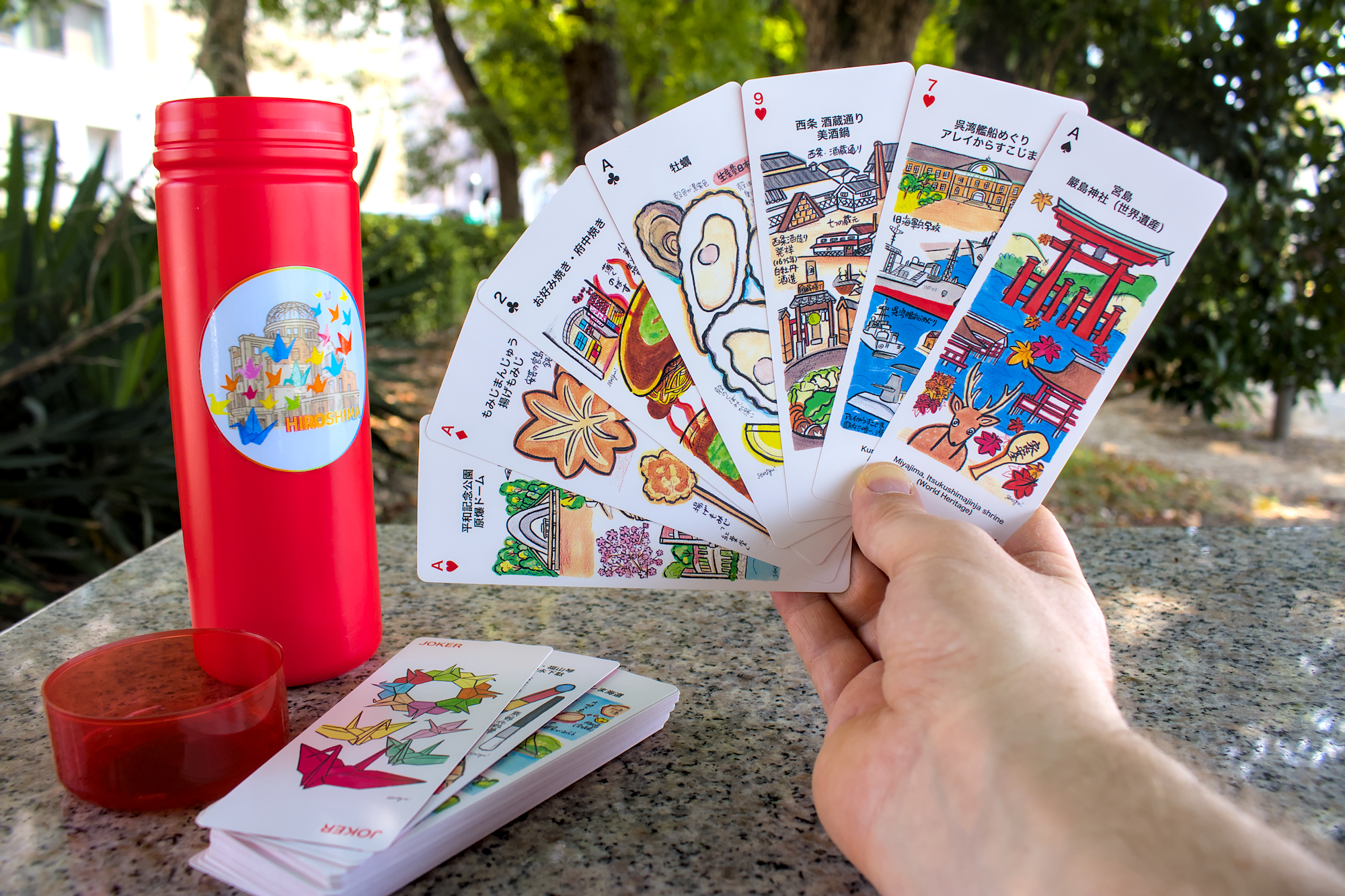
This 54-card deck of Hiroshima Prefecture-themed playing cards is available from a vending machine near Peace Memorial Park. (Joy Photo / Michael Farrell)
Nearby vending machines make finding the right gift or souvenir when strapped for time a lot easier.
Buy a pack of Hiroshima-Prefecture-themed playing cards in the subterranean shopping mall under Genbaku Dome-mae Station. These hand-illustrated cards double as a travel guide to the whole prefecture with a different, distinguishing aspect of Hiroshima illustrated on each card in the 54-card deck. The deck, a mini art collection by illustrator and calligrapher Sensyu Yasuko, comes with a bonus playing-card sticker.
Tickle your sense of whimsy a few steps away. Buy a can of Hiroshima’s air. For ¥500 (~$3 / €2.7), you can own approximately 110 ml of pure Hiroshima air. According to the vendor, Jihanki BASE (aka: GatchaCAN), Hiroshima Canned Air was created as a novel souvenir — something “a little unusual” and “the kind of thing you can’t help but want to tell someone about.”
On a side street off the eastern end of the park, a vending machine sells Hiroshima-themed T-shirts. The local brand Nomisuke, offers three designs: the Atomic Bomb Dome, a collage of Hiroshima icons, and a simple motif of the city’s name. The shirts are soft, substantial and 100% cotton. A portion of the ¥3,000 (~$18/€16) cost, goes to the fund that preserves the Atomic Bomb Dome.
The last machine on this list is an ideal stop for those who can not make it all the way to Miyajima. On the corner of the Hondori entrance to the park, a vending machine sells the island’s signature sweet: momiji manju. And far from selling a cheap, generic brand, the machine sells one of the top brands from Miyajima — Momijido, a pastry shop that has been making the maple-leaf-shaped castellas since 1912.
The machine stocks a variety of filling options in various arrangements of packs. Fillings include originals like chunky or smooth anko but also newer flavors like hoshizora matcha and Setouchi lemon. However, unlike the other souvenirs on this list, this one has a shelf life. Consequently, the machine, which is updated frequently, displays the most recent expiration date on the bottom right corner.
Read more about: The Top 5 Vending Machines Near Peace Park
Where to Eat Okonomiyaki Nearby
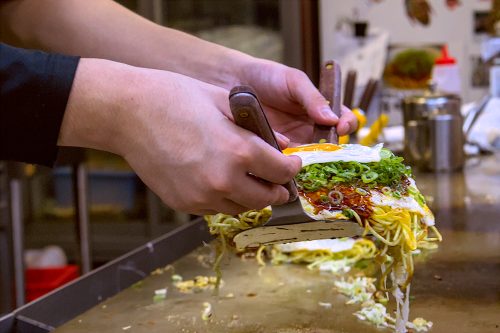
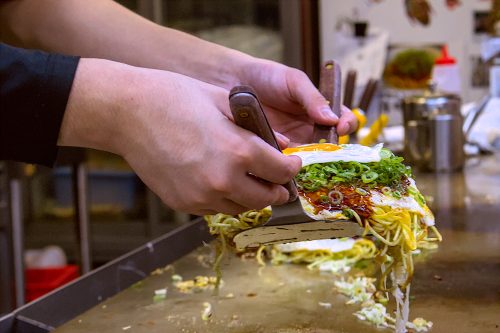
A cook prepares okonomiyaki at a shop in Okonomiyaki Story Ekimae Hiroba, the traditional-style okonomiyaki market across from Hiroshima Station. (Joy Photo / Michael Farrell)
The restaurants next to Peace Park are often touristy, crowded, or both. However, the delicious places that the locals frequent are just a couple blocks away.
Community Hiroshima Okonomiyaki
For a true local’s experience, try Okonomiyaki Carp or Nobumoto off the western side of the park.
Hiroshima is a notoriously under-explored city. You won’t find either shop in Western travel media lists or trending influencer “Top 10” videos. Nevertheless, they have been quietly satisfying Hiroshima locals for decades. This is precisely why they are worth visiting.
These are respected eateries that have been feeding their local communities without flash or hype in a city where even good restaurants can shut down after just a couple years. Yet these shops have been cooking up Hiroshima style okonomiyaki that keeps locals coming back year after year. In the case of Carp, it was originally based in the famed Okonomimura, but moved to its current location around the year 2000. All together, it has been in business for 40 years.
Carp is a five-minute walk from Honkawa Bridge, mid-way up the western side of Peace Park while Nobumoto is a four-minute walk from the south-west corner of the park. However, they only have nine seats. If they are full, Carp has a larger space. The walk between them takes four minutes.
Fuchuyaki: A Local Twist
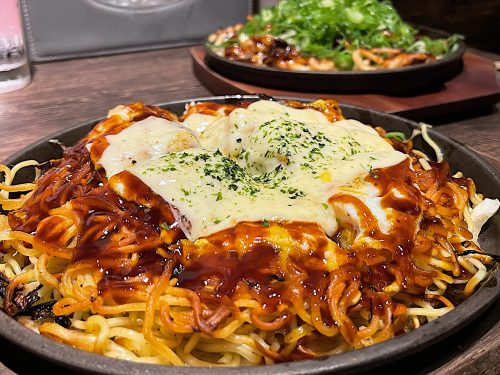
Atchan’s “Mochieese” Fuchuyaki cooked with mochi, cheese and fried squid. (Joy Photo / Michael Farrell)
For a little known but delicious twist on Hiroshima-style okonomiyaki, visit Okonomiyaki Junior or Teppanyaki and Fuchuyaki Atchan.
Located off Hondori, Junior and Atchan serve a style of Hiroshima okonomiyaki called Fuchuyaki. Normally, Hiroshima-style okonomiyaki is made with a layer of sliced pork belly. Fuchuyaki, named after the nearby town of Fuchu where the dish originated, innovates by replacing the sliced pork with ground pork. This seemingly small change has a dramatic impact on the dish’s texture, making the outside of the dish crispier and the overall taste richer and deeper.
Both shops are very highly rated. Atchan is notable for its personable chef who enjoys going table to table toasting the mayonnaise on patron’s okonomiyaki with a blow torch. Junior, meanwhile, was selected in 2025 as one of the top 100 okonomiyaki shops in Japan by Tabélog.
Junior and Atchan are a 10 to 12 minute walk east from Peace Park. Both Junior and Atchan are about a 2 minute-walk from Hatchobori Station where you can grab the Hiroden to Hiroshima Station. Cars arrive every five minutes, and the trip is around eight minutes.
Best in a Hurry
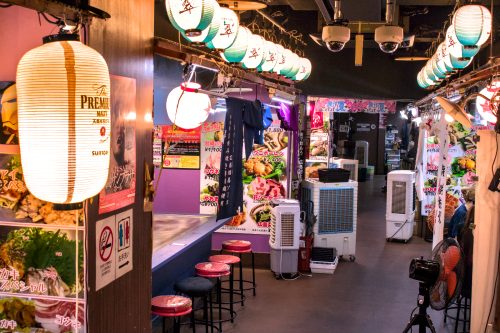
A look down one of the alleys at Okonomi Story Ekimae Hiroba. (Joy Photo / Michael Farrell)
If you’re concerned about the time before your next train, take the bus or tram back to Hiroshima Station and grab some okonomiyaki there. The station is one of the dishes’ historic strongholds with some shops tracing their origins to Hiroshima okonomiyaki’s beginnings.
There are two okonomiyaki hubs at Hiroshima Station. The first is a kind of “okonomiyaki alley” on the first floor dining hall at Hiroshima Ekie, the shopping plaza on the north side of the station. It has six okonomiyaki shops, including Mitchan, one of the restaurants instrumental in the development of Hiroshima-style okonomiyaki, and Rei-chan, another historic shop and winner of a Michelin Bib Gourmand award.
The second okonomiyaki hub is across the street from Hiroshima Station’s Exit 5 on the south side of the station. Okonomi Story Ekimae Hiroba, recreates the atmosphere of the city’s Showa-era okonomiyaki street food stalls on the 6th floor of the Hiroshima Full Focus Building. 15 shops cook up Hiroshima’s signature dish, each following their own traditions and innovations.
Read more about: Ekimae Hiroba
Pro-Tip For Okonomiyaki on the Go
Okonomiyaki is a dish made entirely from fresh ingredients. As such, it can take 15 to 20 minutes to cook. However, if you do not have time to sit down and eat, most okonomiyaki shops offer takeout, so you can enjoy your meal on the platform or on the bullet train.
If you want to eat on the train, please consider Japanese train etiquette regarding food. The Japanese hardly ever eat on local transportation and if they do, it is small and controlled like a resealable bottle — unlikely to make a mess or cause trouble in tight quarters. Long distance transportation like the Shinkansen bullet train is a different matter. When it comes to being polite, the Japanese consider every possibility, and this includes food odors intruding on the nostrils of other people in the cabin. For this reason, ekiben (train bentos) are specifically designed to not only be eaten with minimal mess but also with minimal smells. Fresh okonomiyaki may not smell as strongly as a bag of McDonalds or Chinese takeout, but some may still find the odor strong enough to be unwelcome.
If you want to eat okonomiyaki on the Shinkansen and fully avoid offending your Japanese neighbors, we recommend waiting until the okonomiyaki has fully cooled before opening the package. This will reduce odors to the level of an ekiben — which are served cold. And while cold okonomiyaki is a different experience from hot okonomiyaki, like pizza, the dish is great either way.