Experience
The Miyajima Ferry Guide: Choosing the Right Ferry for Your Trip
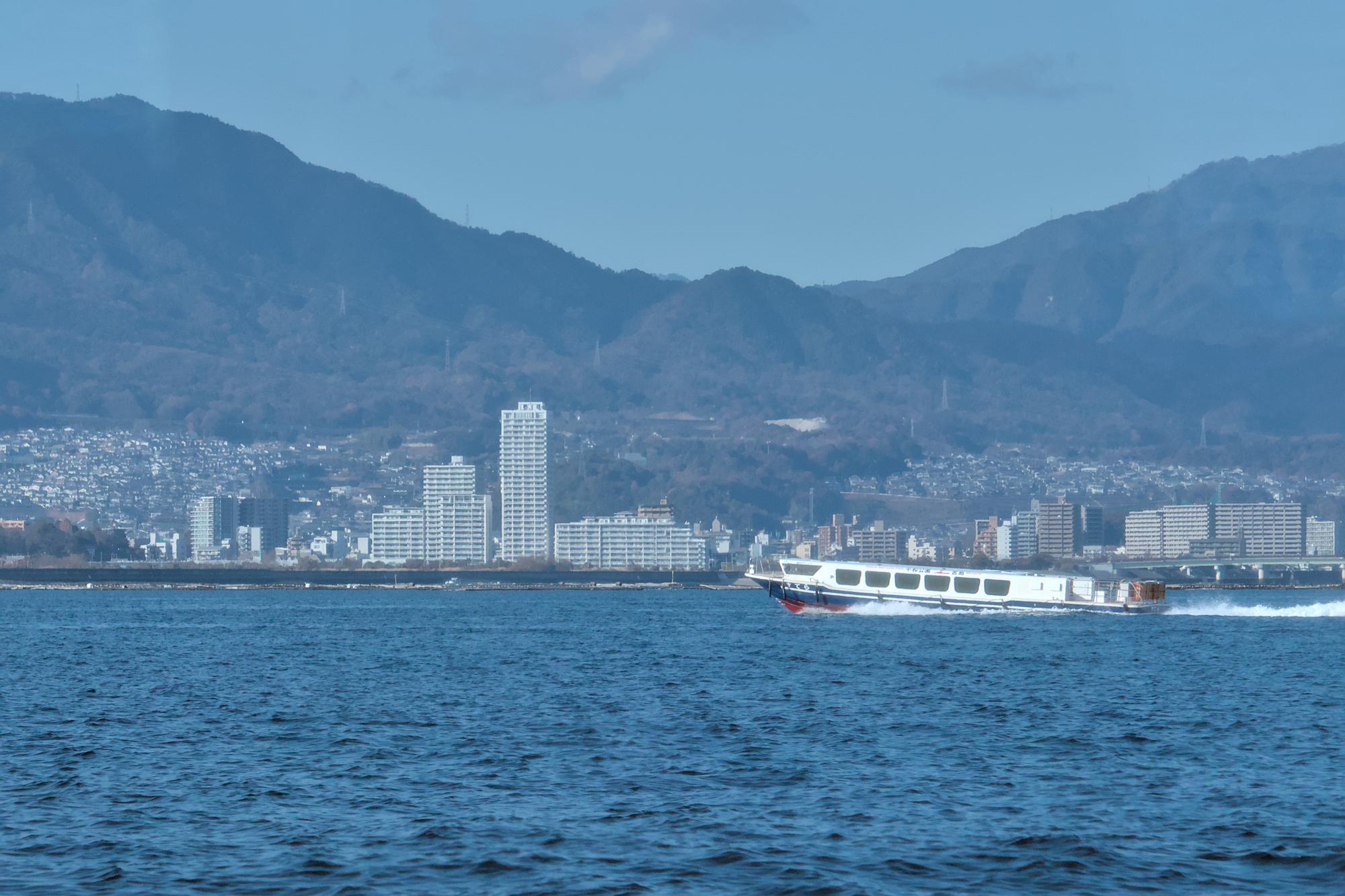
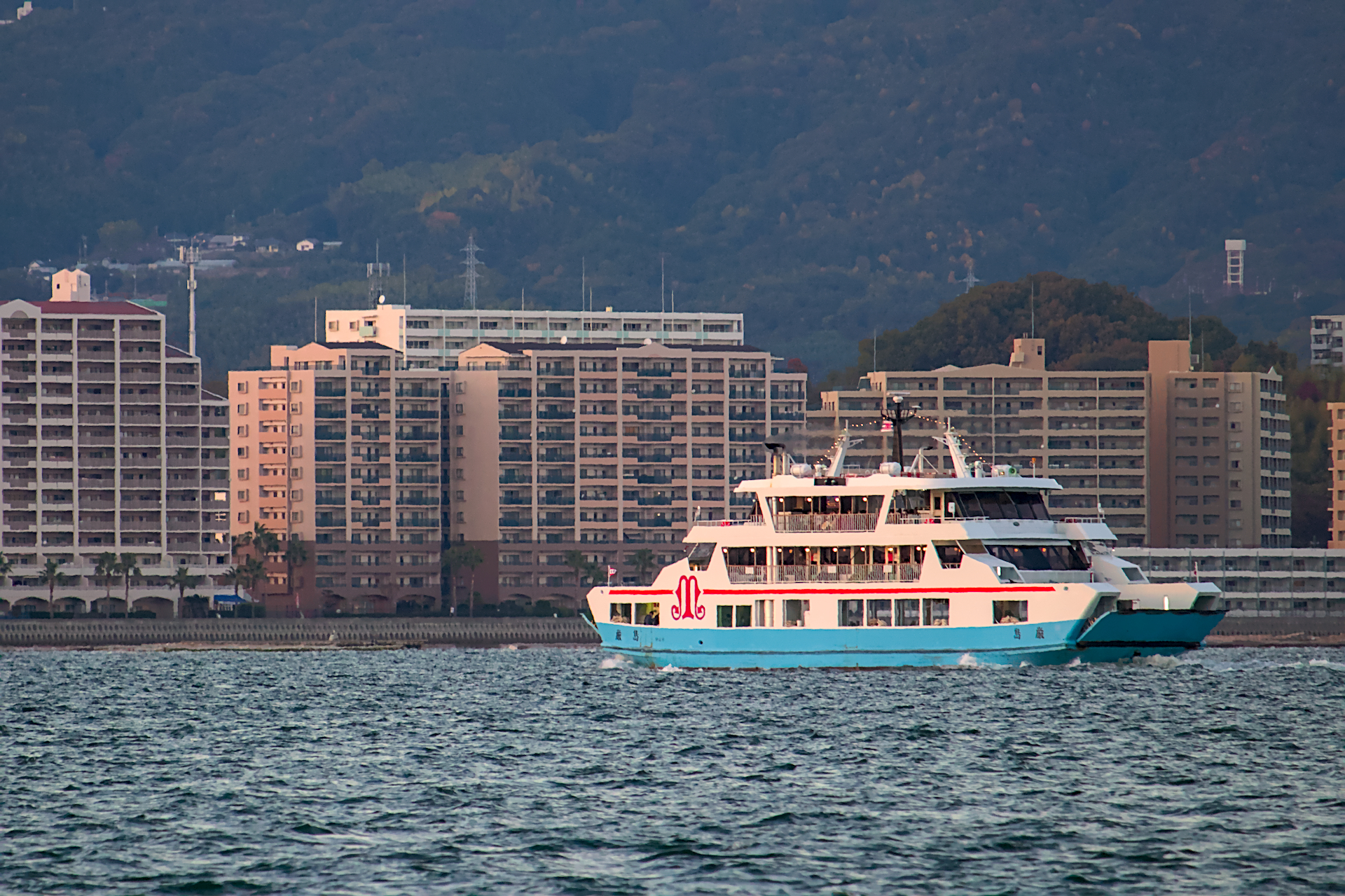
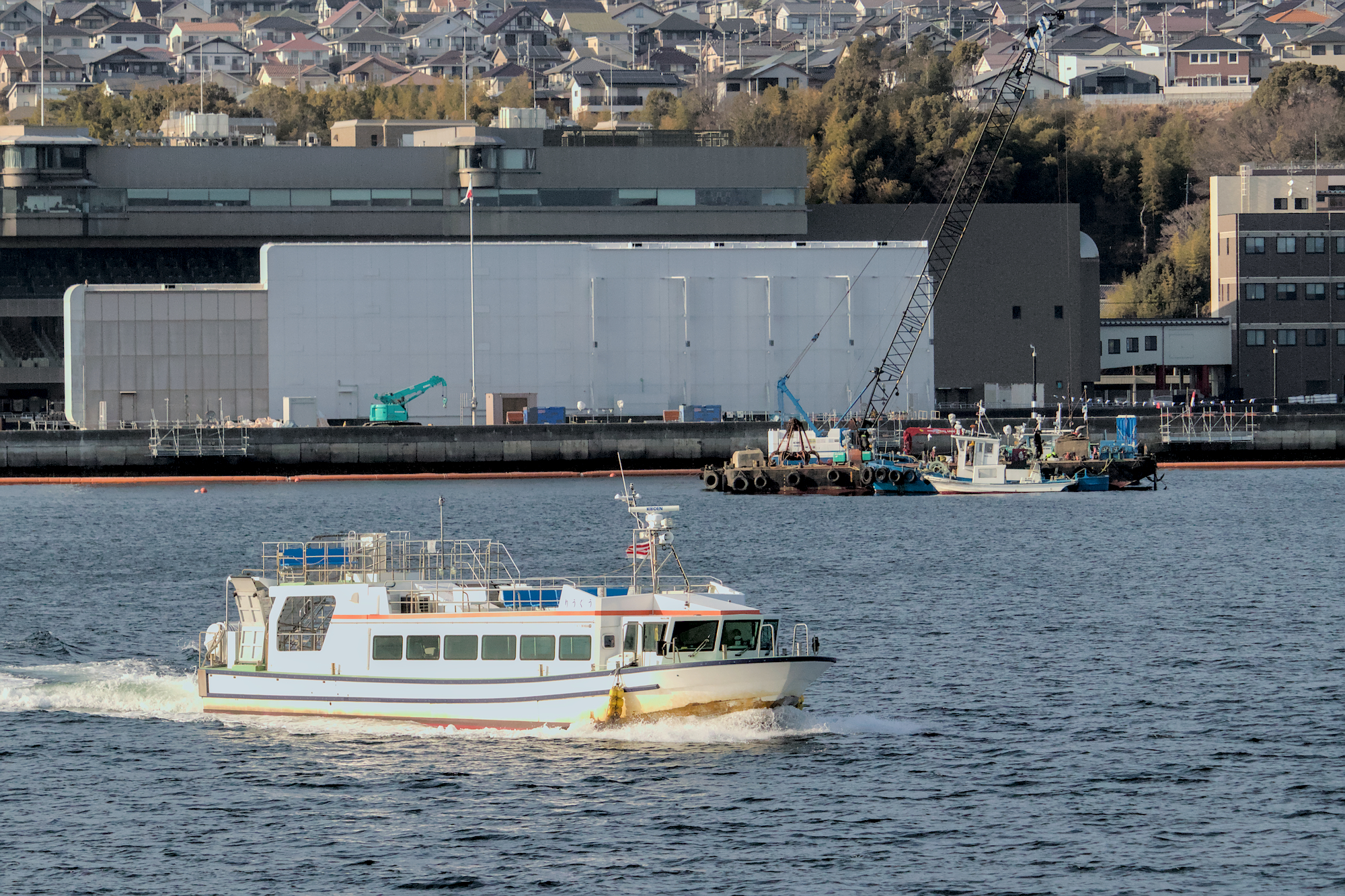
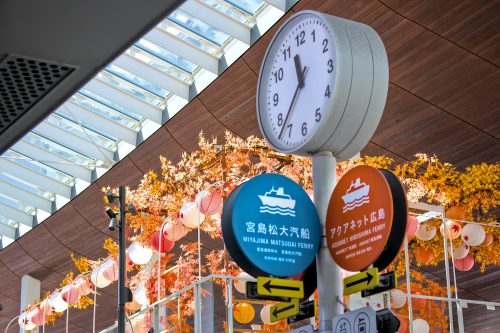
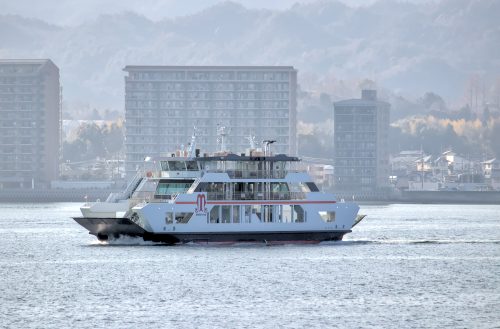
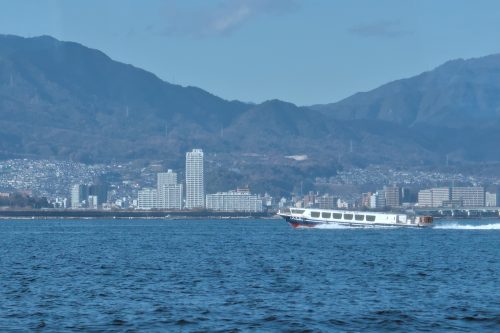
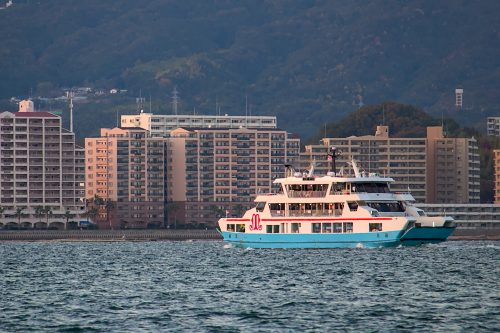
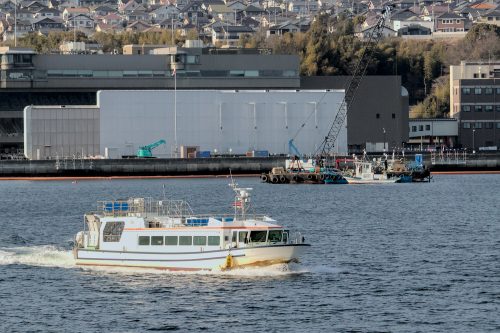
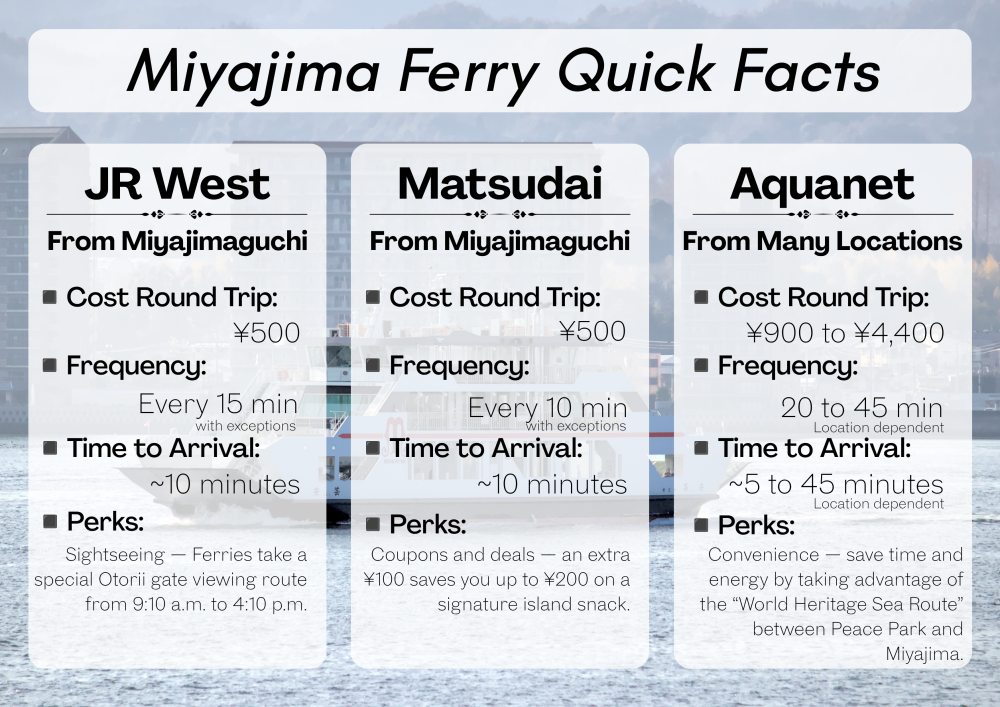
You’re on your way to Miyajima, home to Itsukushima Shrine, one of Japan’s most revered cultural heritage sites. You figured out the JR Sanyo train from Hiroshima Station to Miyajimaguchi Station and now you are standing inside Miyajimaguchi Ferry Terminal. That’s awesome, but there are three different ferries to get to the island, and there is a lot more to the choices than meets the eye. Which service do you choose?
This guide details the differences to help you choose the best ferry for your trip.
The Ferry Operators: Two Local Businesses and a Regional Company
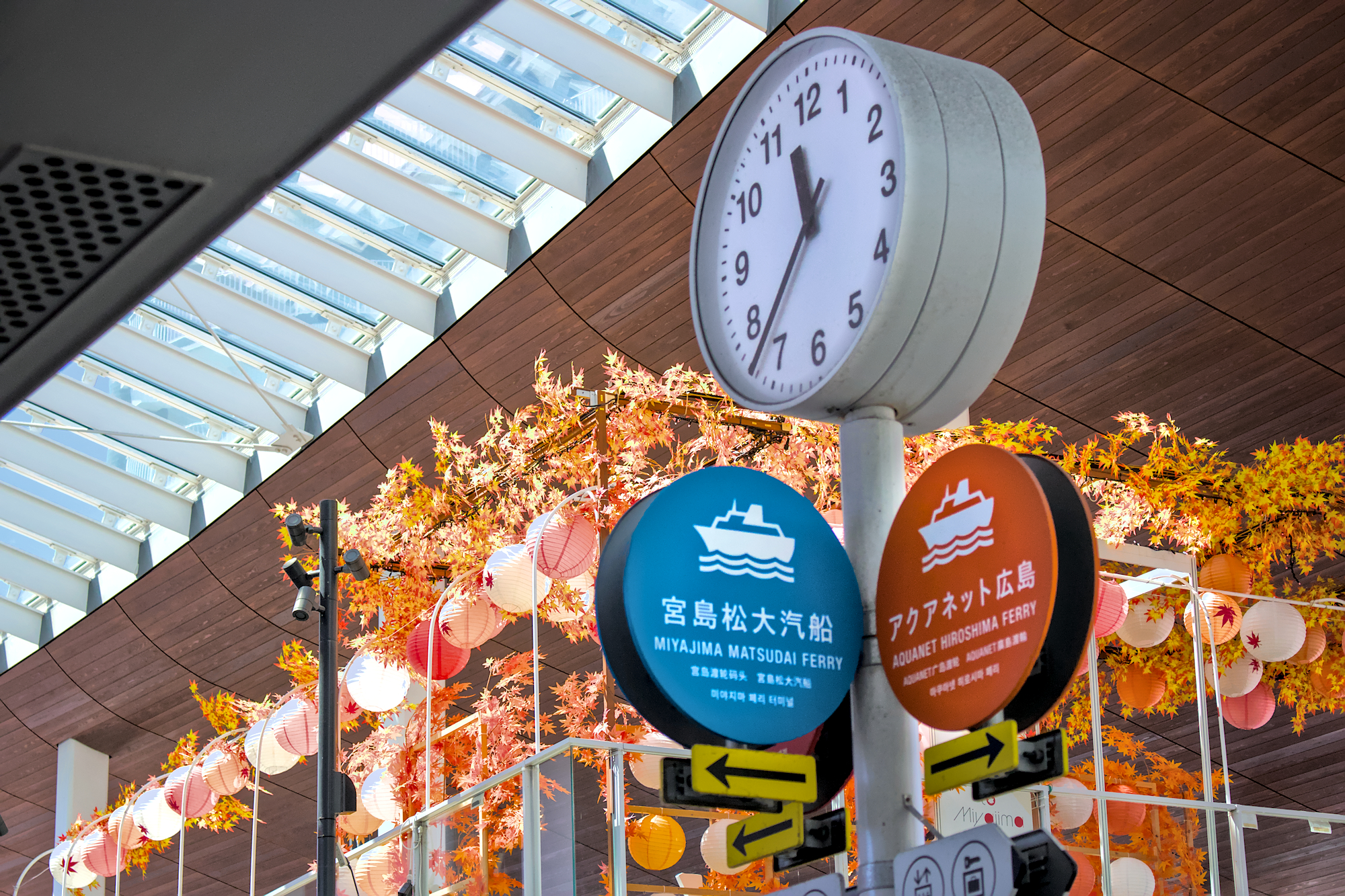
There are three different ferry companies that take visitors to Miyajima Island: JR West Japan Miyajima Ferry (JR西日本宮島フェリー), Miyajima Matsudai Kisen (宮島 松大汽船) and Aquanet Hiroshima (株式会社アクアネット広島).
While the JR ferry is operated by Japan Rail West, the railroad giant that provides service all the way from Osaka to Shimonoseki, the other companies are completely local. Miyajima Matsudai Kisen is a part of Hiroden Group, the company that runs Hiroshima’s iconic trolley system. Aquanet Hiroshima, formally known as Kabushiki-gaisha Aquanetto Hiroshima, is also locally owned and provides ferry services to Miyajima from Hiroshima Peace Memorial Park (広島平和記念公園), Miyajimaguchi (宮島口), and Ono (大野町) with charters available from Iwakuni (岩国市).
Why Choose JR West, Matsudai or Aquanet?
Because the basic performance and costs are the same for JR West and Matsudai, many locals don’t quibble about which ferry to take and simply board whichever ferry leaves next. While that’s fine from a utilitarian perspective, each ferry service has unique selling points besides the ticket prices and basic services. Depending on the kind of traveler you are, JR West, Matsudai and Aquanet each offer something special that might persuade you to travel with them to Miyajima.
JR West Ferry: The Sightseers’ Choice
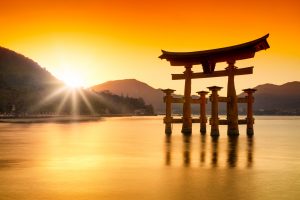
JR stands out with sightseers looking for seaborne views of Itsukushima Shrine and the famed Otorii, or Great Torii Gate. The JR ferry has the most westerly route of the three ferries, with the closest views of the shrine and gate from the sea. And if you board the JR ferry at Miyajimaguchi Ferry Terminal between 9:10 a.m. and 4:10 p.m., the ferry gets even closer. It travels a special “Otorii Route” that takes visitors roughly 200 meters away from the Otorii, providing Instagrammable views and selfie opportunities to wow the family back home. Please note, however, that the return trip from Miyajima to the mainland does not get as close. Nevertheless, it is still closer than Matsudai and Aquanet’s return routes.
Matsudai Ferry: Catnip for Bargain Hunters
Matsudai, meanwhile, appeals to bargain hunters with coupons and puns. They sell a special ticket called “Miyajima Otoku-ja ken” (宮島お得じゃ券). Otoku-ja ken has a double meaning in Japanese. On the one hand, it means “Miyajima bargain ticket” in standard Japanese. On the other hand, in Hiroshima dialect, it means, “Because it’s a great Miyajima deal!”
The ticket is ¥600. That is ¥100 more than a normal round-trip ticket with tax included. It includes round-trip ferry service, the island’s visitor tax, and your choice of one of three coupons for sweet treats on the island:
1) You can choose a coupon for one free deep-fried momiji manju from Momijido, the treat’s inventor. Richly flavored and served hot on a popsicle stick, this local specialty is called “a-ge-momiji” (揚げもみじ) in Japanese.
2) Alternatively, you can get a coupon for a stuffed “momiji croissant” from Toriiya. These popular, crispy treats look nothing like real croissants, but there is a connection. Sweet fillings like apple, caramel, anko paste, and custard cream are sandwiched between crispy layers of croissant dough before being baked into the shape of a maple leaf.
3) The third option is for a ¥200 shopping voucher at Yamadaya, one of the largest momiji manju makers in the region. Momiji Manju are maple-leaf-shaped castella cakes with over a century of history on the island.
For price comparison, Momijido sells agemomiji for ¥250. Momiji croissants cost ¥300 a piece. Lastly, a single Yamadaya momiji manju sells for around ¥160 to ¥180.
So you can save up to ¥200 on a signature pastry from Miyajima. That’s not bad, but Matsudai is not finished with their bargains. They also offer a special ticket that doubles as a ticket for the Ropeway, the gondola that glides up the side of Mt. Misen in about 30 minutes. This double ticket is called the “Enjoy Ticket.” It includes round-trip service on Matsudai Ferry and Miyajima Ropeway (宮島ロープウエー) and costs ¥2,100 for people 12 and older. For ¥1,100, there is also a combined ticket for elementary school students. As with the ferries, children under 6 ride free, so there is usually no charge for them. However, a charge can be applied if there are not enough adults to accompany the minors. The rule is that each child needs to be paired with an adult. If a couple has three kids under 6, one of the kids will need a half-price ticket.
Without Matsudai’s Enjoy Ticket, an adult Ropeway ticket costs ¥2,000. Since a normal ferry round-trip ticket is ¥500, the Enjoy Ticket pass saves you ¥400. Meanwhile, the child Enjoy Ticket saves ¥200.
Neither the Enjoy Ticket nor the Miyajima Otoku-ja Ken are available from Matsudai’s electronic ticket machines. So if you want to take advantage of these deals, you need to go to Matsudai’s ticket counter and talk to a real human being. The ticket counter is just to the left of the ticket machines.
Aquanet: Convenience & Ease
Honestly, Aquanet’s service from Miyajimaguchi can’t compete with JR West and Matsudai. The service is too infrequent. It is more expensive, and it only shaves five minutes off the ten minute travel time. However, that does not mean Aquanet is not worth your attention. The speedboat ferry service attracts visitors with logistical problems. Maybe you’re fed up with getting in and out of multiple public transportation services and walking 10 to 15 minutes to get anywhere in Japan. Or perhaps you’re on a tight schedule. You want to visit Miyajima and you need direct transportation to or from Hiroshima City. For these kinds of problems, Aquanet is the best choice.
Aquanet’s solution is flexibility of departure point. By far the most popular departure is from Peace Memorial Park. Their pier is literally inside the park, right next to Motoyasu Bridge. A round-trip ticket on the most comfortable and direct route to Miyajima from Hiroshima City is ¥4,400 for adults and half that for elementary school students. An additional ¥100 Miyajima visitor tax per person is paid separately. The trip through Hiroshima City speeds along river routes to the sea and then onward to Miyajima past small islands, fishing boats and oyster farms. Called the “World Heritage Route,” it gets passengers to the island in about 45 minutes.
A new ferry comes every 45 minutes, subject to the tides. If you miss the ferry, you can relax with a royal vanilla gelato or a fresh squeezed orange juice on Caffé Ponte’s (カフェ ポンテ) nearby terrace while you wait for the next one.
Moreover, if you are standing at Miyajimaguchi Ferry Terminal wondering how you are going to get back in time for your omakase dinner reservation downtown, Aquanet has a “Package Ticket” for quick returns to Hiroshima from Miyajima. This ticket combines ferry service to Miyajima from Miyajimaguchi with return service to Peace Memorial Park. The Package Ticket costs ¥2,500, just ¥100 more than a one-way ticket on the “World Heritage Route.” So not only does the package ticket get you back to central Hiroshima City faster than the alternative, it saves passengers ¥700 compared to the normal Miyajimaguchi to Miyajima route’s fare.
Bonus: Aquanet Night Cruises Around the Otorii
If you fancy staying late on the island, whether you took Aquanet to Miyajima or not, Aquanet has a 30-minute night cruise around the Great Otorii Gate, which lights up 30 minutes after sunset — a 60 vermilion ton vision of solid wood standing against the night sky. There are six cruises a day starting at 5:55 p.m. The last cruise leaves at 9:15 p.m., giving passengers time to take the last ferry off the island — run by JR West — to Miyajimaguchi Ferry Terminal at 10:14 p.m.
Miyajimaguchi Ferry Terminal: Buying Tickets and Boarding

(Joy Photo / Michael Farrell)
Miyajimaguchi Ferry Terminal (宮島口旅客ターミナル) is by far the busiest transit hub to Miyajima (宮島). In 2024, more than 4.8 million people visited the island. More than 90 percent of them came through Miyajimaguchi Ferry Terminal.
As you walk in the main entrance, you can immediately spot JR West’s ticket counter, machines and gates on the right side of the terminal. Matsudai’s ticket counter, machines and gates are visible on the left side. To find Aquanet’s ticketing area, look back over your left shoulder and you’ll see Aquanet’s ticket counter and machines. Their departure gate, however, is not inside the main building. It is located on the far side of Shamoji Park on the east side of the building. Present your Aquanet tickets at the ticket gate then proceed to the pier.
Aquanet’s base fare from Miyajimaguchi is ¥400 in one direction with a round-trip costing ¥800. Add ¥100 to each ticket for the Miyajima Visitor Tax. As is typical of public transportation in Hiroshima, elementary school students are half price, and kids under 6 years old are free. However, on Aquanet each child under 6 needs to be accompanied by an adult to ride for free.
Most visitors, however, take the JR West or Matsudai ferry. The standard fare to Miyajima with JR West and Matsudai is ¥200 with a round-trip costing ¥400. Children between 6 and 12 years of age pay half while kids under 6 are free.
When you buy a ticket, an additional ¥100 is added to the price to cover the island’s visitor tax, bringing the total to ¥500. However, if you are under 6 years old, you can visit the island tax free.
JR West passengers that have an active Japan Rail Pass, Hiroshima Tabipass (広島たびパス) or Tabiwa Pass (tabiwaパス) do not have to pay for a ticket. The fare is covered by their passes. However, unlike little kids, they still have to pay the visitor tax. There is a separate machine for pass holders to pay the tax. It is on the far right of JR West’s main ticketing area with a sign in English clearly marking its use. Moreover, JR West passengers with an IC card like ICOCA or Suica can skip the process of buying a formal ticket and just scan their card at the gate. The fare and tax are automatically deducted.
JR West has only one departure gate. However, Matsudai has two. The one to the left of the ticket counter is just for people paying with IC cards. The IC gate works just like the gates at Japanese train stations. The gate to the right of the booth is for people with paper tickets. It is staffed with a human being who can help you scan the barcode on your ticket at the window.
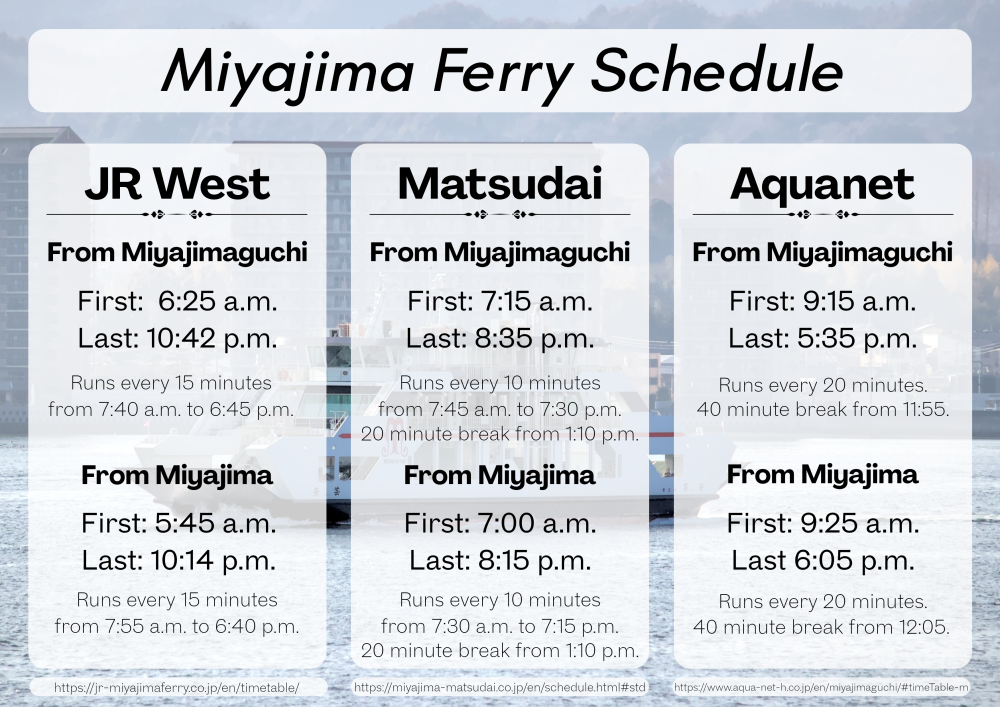
Once you are through your gate, walk down to the quay to wait in line until boarding begins. The quay is protected from the sun, but seats are extremely limited. There are only eight on the Matsudai side and none on the JR West side. The wait before boarding, however, is not long. JR West’s ferry departs every 15 minutes, and Matsudai departs every 10 minutes. Aquanet’s ferry, meanwhile, leaves every 20 minutes except for a 40-minute pause around lunchtime.
What if I Need to Kill Time at the Terminal?
(Joy Photo / Michael Farrell)
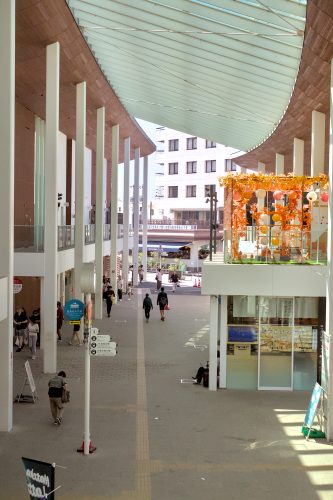
Maybe you are meeting a friend who is arriving later or you just want to take a breather before moving on. Miyajimaguchi Ferry Terminal has three areas where travelers can comfortably rest, wait, and enjoy a coffee, local treats or a meal.
There is a small observation deck on the second floor to the right of the JR departures area. The stairway and elevator will be on your left before you get to the 7-Eleven. It is quiet and has a bird’s-eye view of departing JR West ferries.
Across from the JR West gate is Hatsukoi Market (はつこいマーケット). It sells famous products made in Hatsukaichi, the town the ferry terminal is located in. If you look up, you’ll find an open-air rest area above the market. Hatsukoi’s rooftop hosts programs and events throughout the year. It also has a Kawai brand upright piano that visitors are encouraged to play.
If you need a hot drink or a prepared meal, wander left of Matsudai Ferry Gate. Before long you’ll find Hiroden etto. Inside this connected shopping center you can find various ways to relax, recharge and kill time. Sit on a rooftop terrace with an espresso and croissant from Miyajima Itsuki Coffee The Terrace (伊都岐珈琲 the terrace). On the ground floor, you can indulge your sweet tooth with a matcha soft-serve ice cream from Organic Matcha Miyajima (オーガニック抹茶宮島). And if you need lunch, consider a bowl of oyster ramen at Hiroshima Ramen Momiji Miyajima-guchi Shop (広島ラーメン 椛 宮島口本店).
JR and Matsudai Ferries: What to Expect on Board
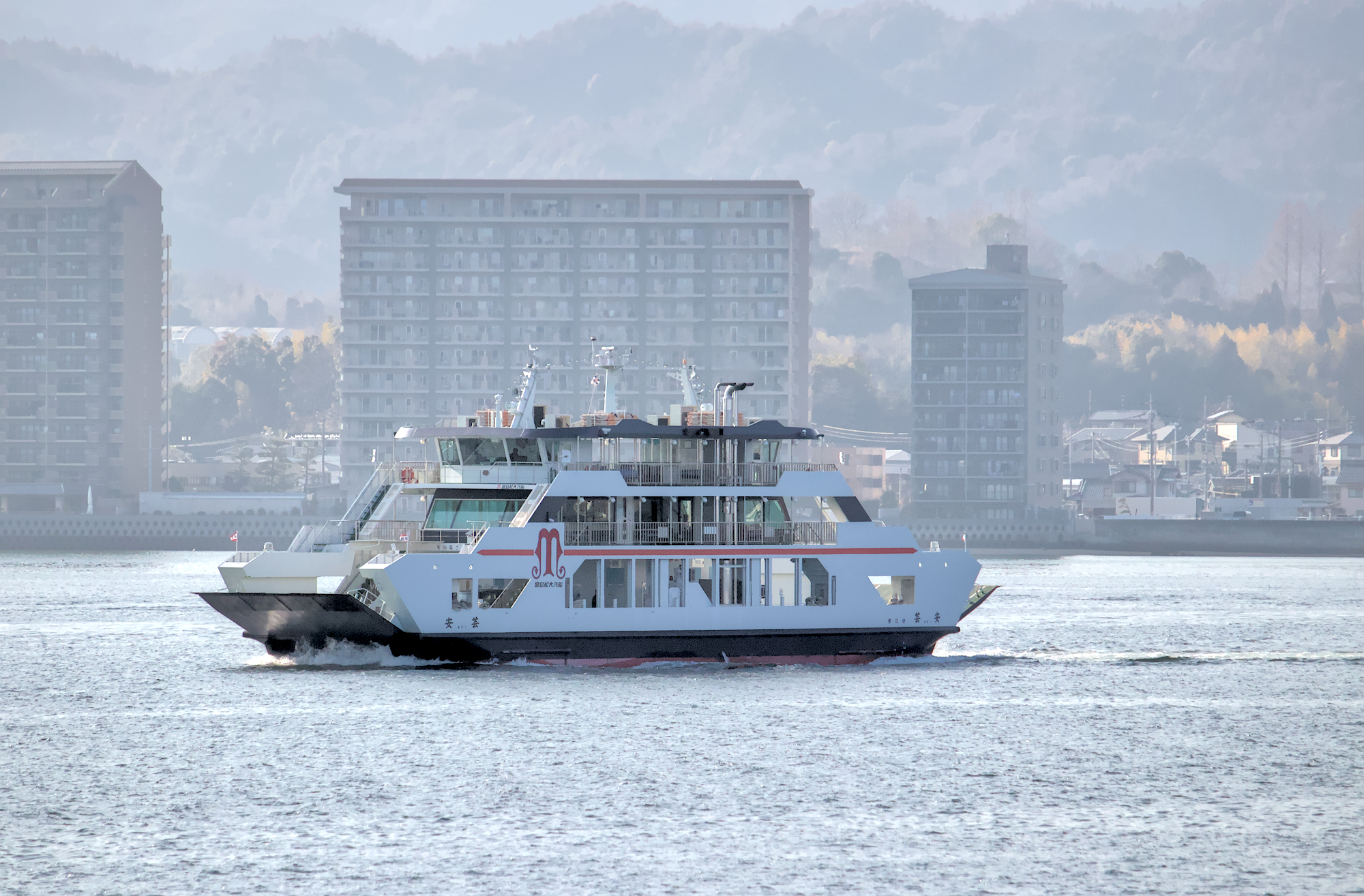
Both JR West and Matsudai operate fleets of 200-to 300-gross-ton, double-ended, passenger and car ferries that chug across the channel at around eight knots. That is under 16 kph (10 mph). Despite the leisurely pace, the 1.8 km (1.2 mile) journey takes roughly ten minutes. The trip is also quite smooth. The ferries do not rock or sway during the crossing, making them comfortable even with people who suffer from motion sickness.
The bottom deck carries automobiles, but it also has a cabin with wheelchair access. This space is commonly used by seniors and families with small children in strollers. It is also convenient for passengers lugging heavy suitcases. The alternative is to haul your baggage up a steep, metal staircase to the main passenger cabin and then later struggle with your heavy bags on the way down the stairs as passengers crowd the exit routes. Passengers on the bottom deck, meanwhile, can board and disembark the easiest.
The second deck has outdoor seating along the sides of the main cabin with additional seating inside. Depending on the ferry, one can find a mix of seating in rows, restaurant-style booths around tables, and bar tables with stools. With environmental controls and television screens, the passenger cabin on the second deck is the most objectively comfortable space on the boat.
The top deck appeals to outdoorsy types and those wanting to take pictures. The seating on the top deck is sometimes park bench style and other times features heavy-plastic bucket seats. Some ships have unique additions like metal bars to sit on. If you are in reasonably healthy condition, the metal bars are surprisingly comfortable. The space is covered so the rain does not get in. With no glass blocking the view, visitors can walk right up to the rail to take clear photos of passing boats, oyster farms and the approaching island while enjoying the sea breeze.
The Miyajima Maru: Japan’s first “Super Eco Ship”
One advantage of JR West’s fleet is that it includes Japan’s first small, “electric-powered” ferry. The Miyajima Maru, a double-ended passenger ferry with a catamaran hull, uses an electric engine specially designed by Nishishiba, an electric power systems company. While the ship is ultimately fueled by diesel, the unique engine system makes it more efficient with fewer emissions. In comparison to conventional ships, the Miyajima Maru emits around five percent less carbon dioxide and 35 percent less nitrogen oxide. At the same time, the electric engine system causes less vibration and noise than typical systems, making the journey more comfortable for passengers.
If it is fueled by diesel, how is that an electric engine? Traditional diesel engines mechanically turn the propellers directly. However, in electric engine systems the diesel engine powers an electric generator which then turns the propellers. That sounds like it would be less energy efficient. However, according to JR West, the Miyajima Maru has “significantly lower fuel consumption.”
The Speed Boats: Capabilities of the Aquanet Fleet
Aquanet’s high-speed passenger boats are quite different from the double-ended ferries used by JR West and Matsudai. On the open water they reach cruising speeds between 20 and 27.5 knots (~37 to 51 kph / ~22 to 31 mph). Aquanet will get you to Miyajima from Miyajimaguchi Ferry Terminal in just five minutes. From Ono Pier, the trip is around 25 minutes, and from Peace Park it takes around 45 minutes. A charter from Iwakuni takes 40 minutes.
On the outside, the boats have a low profile so they can pass safely under Hiroshima’s bridges. They also have a low draft that allows them to travel up and down the city’s estuary rivers except at low tide. Inside, with the exception of the boat Kagura (かぐら), the seating resembles a school bus. Kagura’s seating, though, is optimal for taking in the scenery around the boat as you look out the windows. The seats are organized around the center axis of the boat with a circle of chairs facing the windows and an inner circle of chairs around a central bar table.
All the boats have an aft deck that passengers can go up on to get some fresh air. The boat Riuguu (りうぐう), which is mainly seen on the route from Miyajimaguchi, has an open-air rooftop deck where passengers can enjoy the ride with the wind blowing through their hair.
Moment of Joy
Convenient Luggage Storage
Written by

Michael Farrell is a reporter and editor who began traveling the world in 2010. His publishing career started in New England, first at the Gloucester Daily Times and later as a copy editor with boutiq…More


- Open
- ~ 6 a.m. to 11 p.m.
- Price Range
- ¥200 ~ ¥500