Experience
Chasing Autumn: When and Where to See Leaves in Hiroshima
(Updated 9.16.2026)
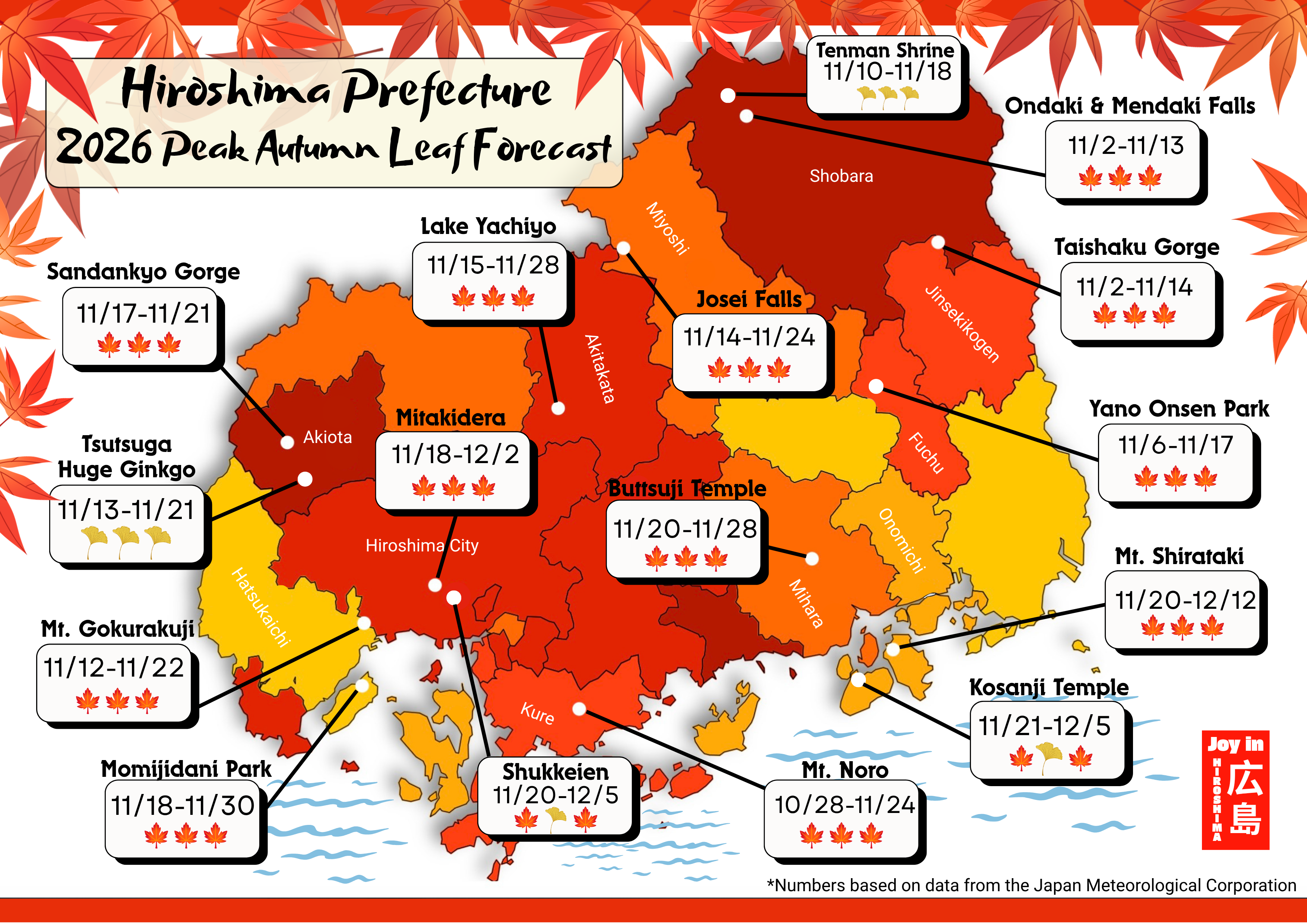
We’ve assembled 16 of Hiroshima Prefecture’s most famous places to enjoy autumn foliage and organized them according to when you are most likely to enjoy peak colors.
The region is especially notable for maple leaves — a symbol of the prefecture. Here you can find a diversity of species such as iroha-kaede, o-momiji and urihada-kaede, each with distinct coloration and leaf shapes. The prefecture also has hidden ginkgo gems including giant trees older than the colonization of the Americas.
Please note, however, that Hiroshima Prefecture does not change uniformly. It has a diverse geography ranging from towering mountains in the north to coastal islands in the south. Typically the higher elevations change first with the coastal areas changing last. However, some coastal areas have fairly high mountains that start changing color earlier than expected.
This year, the autumn leaf season is predicted to start in late October to early November. By mid to late November, the cascade of colors will reach Hiroshima City and the southern islands.
Even if you miss the November window, however, you may still have a chance to enjoy Japan’s autumn leaves in Hiroshima. Unseasonably warm weather pushed the Japanese Meteorological Corporation’s annual forecast far later than in previous years’ forecasts. As a result, many locations are expected to still have color into December.
Leaf Viewing Early to Mid-November
Mt Noro
At 839 meters high, Mt. Noro is the second tallest mountain in Setonaikai National Park. It is peppered with historical shrines and temples to explore, and its slopes and observation decks feature sweeping views of the island-dotted Seto Inland Sea. It is around 5 degrees cooler at the summit, causing the leaves at the top to change color before the trees at the bottom. Because of this, it is a great spot for early leaf viewing in the area.
Read more about Mt Noro
Ondaki and Mendaki Falls
This romantic getaway high in the mountains of Shobara, Hiroshima Prefecture translates to “Male and Female Waterfalls.” These two waterfalls are fed by the same water source. The male waterfall plunges straight down 21 meters into a deep pool that local tradition claims is home to a dragon. Meanwhile, the female waterfall diverts less water but transports it further away. The falls drop about 15 meters then meander over gentle slopes until the waters collect at the waterfall’s bottom situated a little in front of the base of the male waterfall. In autumn, these waterfalls are framed in red by Japanese maples and wax trees.
Taishaku Gorge
Located between Shobara City and Jinsekikogen Town, this limestone karst ravine is a formally designated National Place of Scenic Beauty from the Japanese government. In autumn, this 18-kilometer gorge is lined with vibrant wax trees and iroha-kaede, a Japanese variety of maple tree. Discover a natural limestone bridge 90-meters long and 40-meter-high, a 200-meter deep limestone cave and boat tours of Lake Shinryu as it reflects the orange and red trees along its banks.
Read more about Taishaku Gorge
Yano Onsen Park Shiki no Sato
There are 15 hectares of Japanese nature and a maple leaf haven to explore at Yano Onsen Park Shiki no Sato. Nestled in the mountains of Fuchu City in Hiroshima Prefecture, in autumn, people travel to Yano Onsen Park to surround themselves with maple leaves. On the grounds is a specially designed Japanese garden featuring both momiji and kaede varieties of Japanese maples plus beech trees. The trees are paired with dodan-tsutsuji azalea bushes which turn fiery red along with the maples. When you’re done, visit nearby Soba Dokoro Shiki to enjoy handmade soba, or, if you make a reservation, you can make it yourself.
Sandankyo Gorge
(Joy Photo / Michael Farrell)
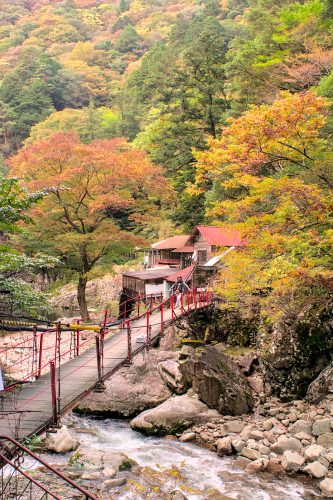
This 16-kilometer gorge is considered one of the most beautiful places in Hiroshima Prefecture along with Miyajima Island. Easy hiking paths cut along hillsides glowing with the crimson leaves of uonome-kaede and iroha-kaede maples as well as native beech trees and oaks. Below you in the valley, rapids cascade down waterfalls and collect in deep, emerald streams. This natural collision of dramatic stone faces, rushing waters and brilliant autumn leaves is among the reasons why Sandankyo has the rare title, a “Special Place of Scenic Beauty” — a title currently held by only 23 sites across the nation including Miyajima and Kyoto’s Kinkakuji.
Read more about Sandankyo Gorge
Tenman Shrine
This nearly 1,300-year-old shrine is guardian of one of the oldest ginkgo trees in Japan: the Chichisagari Giant Ginkgo Tree of Kamitakano Mountain. At least 1,000 years old, this tree is the oldest of its kind in Hiroshima Prefecture and potentially much older. According to the shrine’s records, the ginkgo was planted in the year 729 A.D., making it only two centuries younger than the oldest in Japan. The massive trunk is 9.6 meters in circumference, big enough for six to seven average-sized adults to hug it hand to hand. And because of its great age, it has hanging aerial roots. These pendulous appendages reminded the locals of human breasts, thus inspiring the name “Chichisagari” — sagging breasts. In former days, women who had trouble with nursing would pray to the tree for help. Today, people are more likely to bask in the glory of its many golden leaves in autumn.
Leaf Viewing Mid to Late-November
Tsutsuga Huge Ginkgo
In Akiota Town, on the opposite side of Hiroshima Prefecture, stands a similarly ancient and revered ginkgo. Otoshi Shrine’s Tsutsuga Huge Ginkgo is estimated to be 1,100 years old. When this tree was in its 30s, the Vikings were ravaging the North Atlantic. When it was around 250 years old, local tradition says that a man by the name of Ikeda Saemon cultivated a rice field near the tree feeling guided to the spot by a crane. The field produced a good harvest, so Saemon built a shrine under the tree out of thanksgiving. Today the tree stands at 48 meters tall and 8.2 meters in circumference. In autumn it creates a thick, golden carpet of leaves over the shrine grounds, creating a particularly striking combination of ancient tree, traditional architecture and autumn color.
Mt. Gokurakuji
On Mt. Gokurakuji, you can avoid the crowds of Miyajima without avoiding the depth of history and the autumn scenery. Located right across from Miyajima Island in Hatsukaichi City, at 693-meters-high, Gokurakuji provides sweeping views of Miyajima and the surrounding islands. On the summit lies Gokurakuji Temple, one of the oldest Buddhist temples in Hiroshima Prefecture. While the main hall dates to a 1562 reconstruction, local tradition holds that the temple was founded in 731 by the Buddhist saint Gyoki. The temple grounds turn red in autumn with 30 yama-momiji trees while the steep hike passes primeval fir trees and akagashi oaks. Though the oaks are broadleaf evergreens and so remain green year-round, the temple preserves an enormous 300-year-old akagashi in front of the main hall. At 20-meters tall, it is the largest akagashi in the prefecture. The base, moreover, has a hollow large enough for several people to step into it.
Josei Falls
Vermilion, gold and emerald leaves outline Josei Falls in autumn, a site formally recognized as one of Japan’s top 100 waterfalls. Visitors come from around the country to meditate on the beauty of the 126-meter drop organized poetically into three stages: Aranami (rough wave) at the top followed by Shiraito (white thread) and culminating at Tamamizu (beautiful water), at the bottom.
Lake Yachiyo
Formed by Haji Dam in Akitakata, Hiroshima Prefecture, Lake Yachiyo is a reservoir bounded by maple trees reflecting autumn colors off the waters. Visitors can rent a variety of bicycles, including tandem bikes, to enjoy the colors while cycling around the lake. Haji Dam Cycling Terminal, which rents the bikes, also offers canoe lessons by reservation and has a 250-meter pedal-powered train course.
Momijidani Park
(Joy Photo / Michael Farrell)
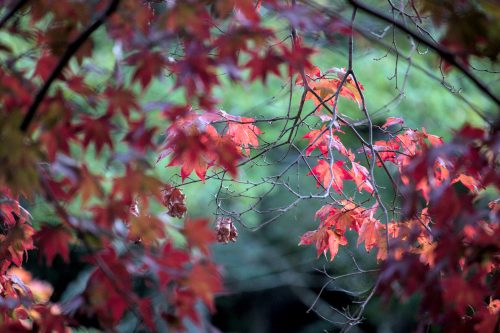
At the foot of Mt. Misen, a 10-minute walk from Itsukushima Shrine lies a park filled with around 700 maple trees. A variety of maples — including the wide-leafed urihada-kaede, the saw-toothed yama-momiji and the classic iroha-kaede — line the mountain valley. The path through the park follows a stream up the mountainside, over traditional wooden bridges, past a Ghibli-esque ryokan and near chaya restaurants where you can enjoy the local fare outdoors amid the foliage. “Maple Valley” in English, Momijidani’s trees were first planted in the Edo period, but underwent significant repairs in the late 1940s after it was destroyed by a typhoon. Today it is one of the most famous destinations for autumn leaf viewing in Hiroshima Prefecture.
Read more about Momijidani Park
Leaf Viewing Late-November to Early-December
Mitakidera Temple
(Joy Photo / Michael Farrell)
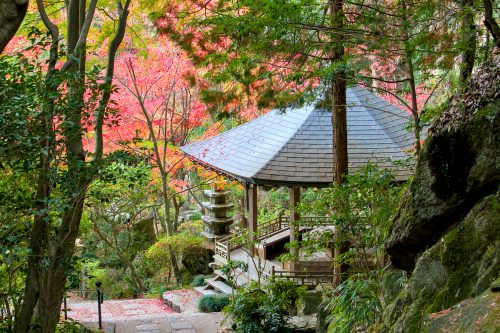
“Three Waterfalls Temple” in English, Mitakidera rises up the side of Mt. Mitaki weaving a meandering stairway around calming forest depths, mountain streams, mossy statues of Buddhist saints and historical Buddhist buildings. One of the few temples that survived the atomic bombing, Mitakidera is a popular leaf-viewing location for Hiroshima City locals — a quiet stop when Shukkeien Garden is overflowing with tourists. The temple site is said to have been founded in 809 by the monk Kukai. The oldest original buildings remaining date to the Edo and Meiji periods, with the remainder being rebuilt after the atomic bombing. Curiously, the very oldest building, the Tahoto pagoda, was originally built in Wakayama during the late Muromachi period (1336 to 1573). It was donated to Mitakidera in 1951 as a memorial to the atomic bomb victims.
Read more about Mitakidera Temple
Shukkeien Garden
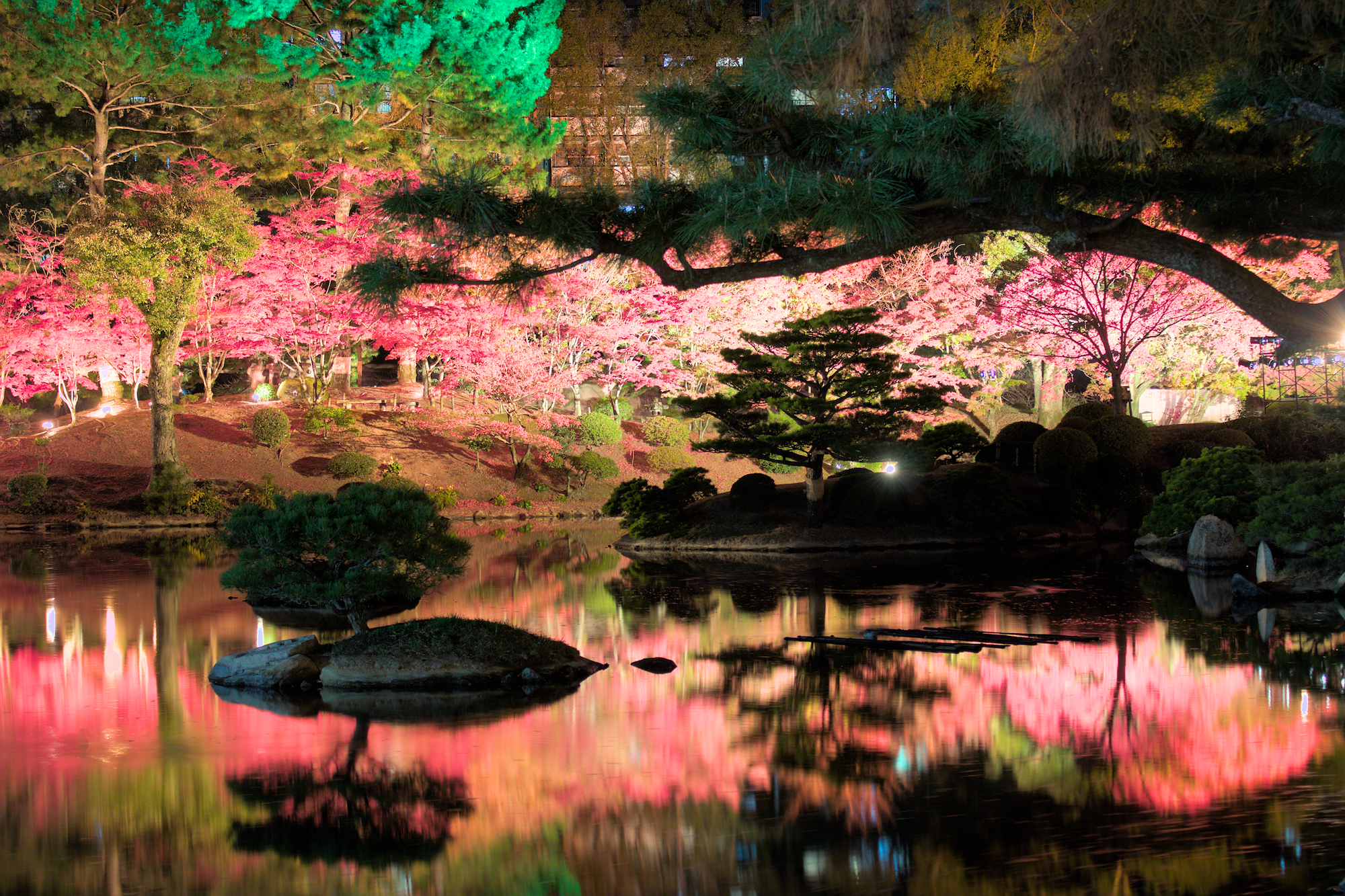
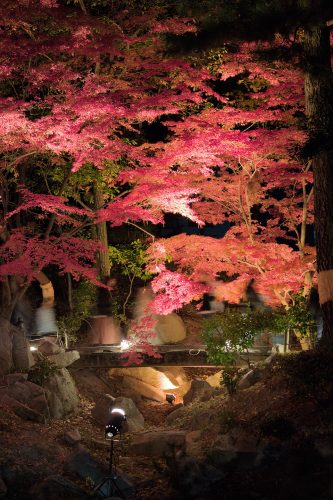 This 400-year-old daimyo garden is one of Hiroshima City’s most celebrated spots to enjoy autumn scenery. It was designed to compress the varied landscapes of the region — mountains, sea, rivers and islands — into one miniature representation. The result is a picturesque landscape lined with winding dirt paths, stepping-stone crossings, rolling hills, unique bridges, sheltered pavilions and little tea houses amid a wide variety of manicured trees, bushes and flowers. In autumn, the garden’s many trees — including maples and a 200-year-old ginkgo that survived the atomic bombing — exhibit a range of fiery hues which take on a new intensity during Shukkeien’s annual autumn foliage illuminations after sunset. As of September 16, Shukkeien had not yet released its 2026 autumn foliage illumination schedule.
Read more about Shukkeien Garden
Buttsuji Temple
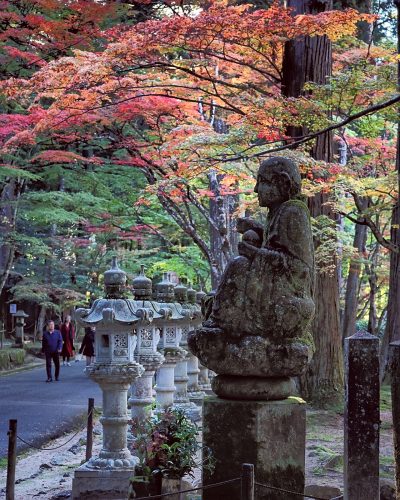
(Joy Photo / Michael Farrell)
Tucked away in a Mihara mountain valley amid dense cedar trees is a Buddhist temple that was one of the region’s largest and most influential temples in medieval Japan. Buttsuji (pronounced “Bu-tsu-ji” with a hard stop after the “Bu”), once held 88 subtemples on its grounds and led a network of 3,000 temples spread across Japan from the Kanto region to Kyushu. Today, though far humbler, Buttsuji draws November admirers of the temple ground’s autumn transformation. While their website tentatively sets the autumn foliage viewing period this year from November 7 to the 29th, the Japan Meteorological Corporation’s preliminary report predicts peak foliage at Buttsuji toward the later end of that time period. Both organizations may revise their estimates as autumn gets closer.
Kosanji Temple
While the other temples on this list are ancient complexes set amid nature, Kosanji Temple is a carefully orchestrated 20th-century Buddhist compound whose landscape and architecture were designed as a unified whole. The autumn foliage here is part of the temple’s crafted image — an image that intentionally reproduces or reinterprets elements of Japan’s most celebrated religious sites. Among these are reproductions of the Phoenix Hall of Kyoto’s Byodo-in Temple and the brilliantly ornate Yomeimon Gate from Nikko Toshogu Shrine’s in Tochigi Prefecture. What inspired the meeting of Japan’s most iconic religious structures on Ikuchi island in the Seto Inland Sea? A son’s love for his mother. In 1934, the Osaka welding industrialist Kanemoto Fukumatsu lost his mother. He was 42. In response to her death, he entered the Buddhist priesthood, took the religious name Kozo and began the temple’s more than 30-years of construction in her honor.
Read more about Kosanji Temple
Mt. Shirataki
In autumn, the summit of Shirataki Mountain on the island of Innoshima bursts red and orange between roughly 700 stone statues. The statues exhibit a wide range of emotions, and vary in size from half a meter to two meters. Called the “Five Hundred Rakan” — despite there being more than 500 statues — these stone statues of Buddha’s disciples and others were carved in the 1800s by the followers of Kashiwabara Denroku, a wealthy merchant who ended up founding a new religious movement. In addition to autumn leaves amid monumental stone figures, the 227-meter high mountain provides sweeping views of the surrounding Seto Inland Sea.
Read more about Mt. Shirataki
Written by

Michael Farrell is a reporter and editor who began traveling the world in 2010. His publishing career started in New England, first at the Gloucester Daily Times and later as a copy editor with boutiq…More