
Itineraries 1day
Hiroshima City Center
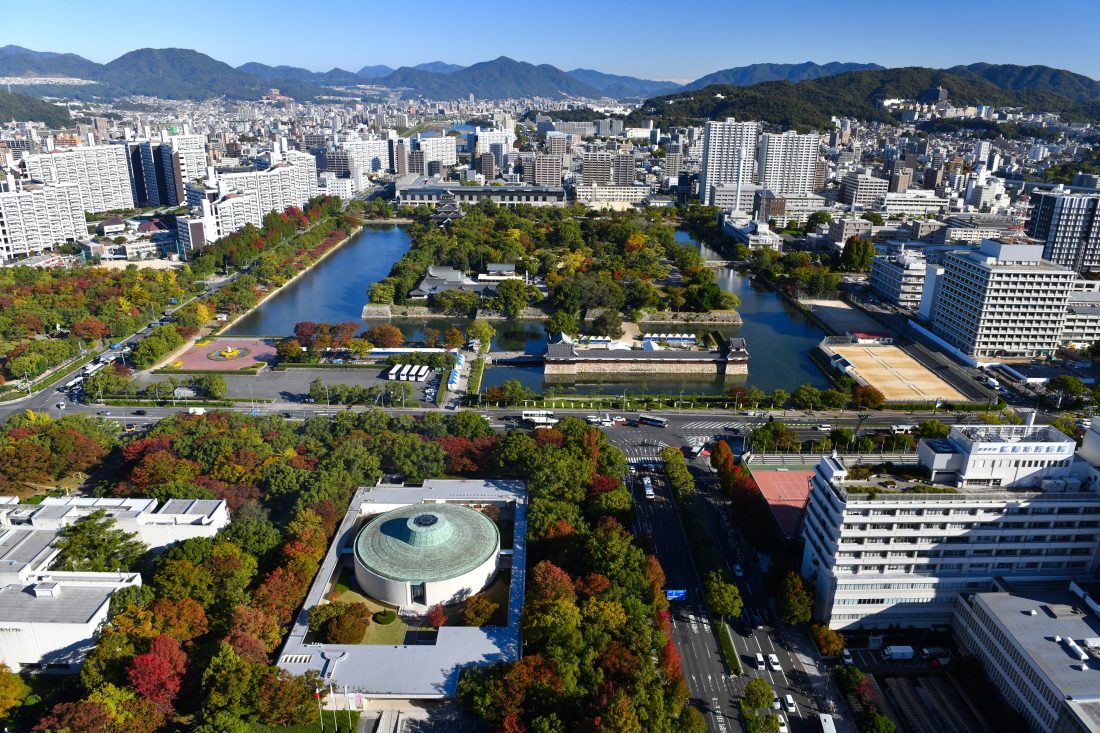
A one-day itinerary focused on the city center itself. See the heart of Hiroshima via the peace park and Atomic Bomb Dome and also enjoy some shopping and local restaurants.
Day 1
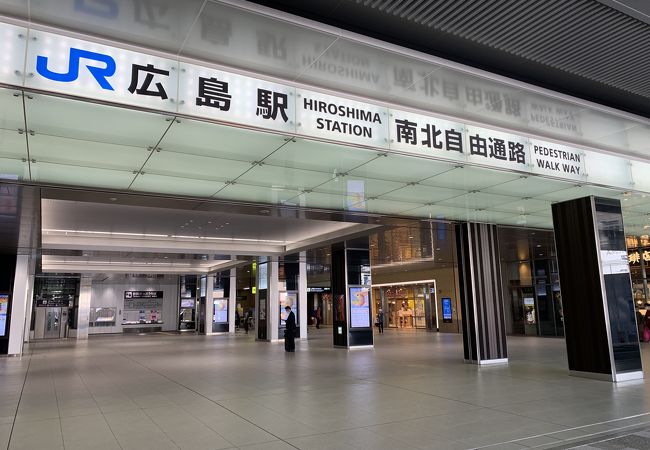
01 Hiroshima Station (広島駅)
Hiroshima Station is the bustling transportation hub of our peaceful city, and one of the principal entertainment hubs as well. All JR lines in the city stop here, and from here, people can take numerous buses and streetcars anywhere in the city, or even out of town. The ekie shopping complex located inside the station building also has no shortage of restaurants and souvenir shops to keep visitors busy for hours.
- Address
- 2-37 Matsubaracho, Minami Ward, Hiroshima City, Hiroshima Prefecture, JAPAN
Transportation: Genbaku Dome Entrance [Meipuru~pu Bus Green Route, ~11 minutes; Hiroden Streetcar #1, 2, or 6, ~15 minutes]
02 Hiroshima Peace Memorial Park: A Walk Through
Located in the heart of the city, Hiroshima Peace Memorial Park stands at the intersection between radical loss and unimaginable suffering, but also astonishing forgiveness and hope for the future.
Peace Park is Hiroshima’s monument to the use of the first atomic bomb against a human population on the morning of Aug. 6, 1945. It honors the 140,000 who were dead by December. It memorializes the lost city. It celebrates peace and boasts the city’s amazing revival. At the same time, it educates visitors about the horrors of nuclear weapons in the hope that the epitaph written on the Cenotaph for the Atomic Bomb Victims can be realized:
“Let all the souls here rest in peace; for we shall not repeat the evil.”
The Monuments & Symbolism
Walking through Peace Park is like walking through a cemetery, a war memorial, a museum and a sacred religious site all at once. The park’s 122,100 square meters (~30 acres) are dotted with museums, preserved buildings that endured the blast, funerary structures and a variety of monuments focused on the park’s central message of peace.
The Main Entrance
While most people arrive from Genbaku Dome-mae Station on the northern side of the park and move south, the rhetorical design of the park is meant to be experienced from the south moving north.
The park’s designer, Kenzo Tange, organized the key structures of the park along a central north-south axis, with the main entrance on the southern side of the park.
Tange expected people to arrive at the park along Heiwa Odori (Peace Boulevard), the tree and peace-monument-lined east-west road that cuts across the city.
(Joy Photo / Michael Farrell)
The Statue of Mother and Child in the Storm
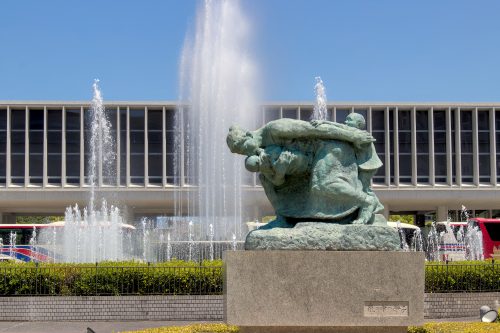
From there, one comes to a wide courtyard facing the street. Here you encounter the Statue of Mother and Child in the Storm. A woman with one arm clutches a small child to her chest while she hunches over to help an older child get on her back.
The Fountain of Prayer & Hiroshima Peace Memorial Museum
Behind the woman, the Fountain of Prayer sprays 11 tons of water per minute up to a height of 10 meters (~33 feet). Water is a common theme in the park for multiple reasons. One of the major intentions behind the water is tied to the thirst of the victims. Symbolically, the fountain offers victims something many desperately sought in their final moments. The intense heat of the bomb left countless people severely burned, dehydrated and pleading for water. After watching badly injured victims die soon after drinking, some survivors mistakenly came to believe the water itself had killed them and withheld it from the thirsty. Many later carried deep guilt over those decisions.
Beyond the fountain, the ribbed structure of Hiroshima Peace Memorial Museum spreads out before you. The museum is a great example of postwar Modernist Japanese architecture. Designed by Tange, the influence of Modernist architects like Le Corbusier can be seen in features like the concrete pillars (pilotis) that hold up the building. In the postwar period, many Japanese architects embraced Modernism as part of a broader national reconstruction effort tied to ideas of peace, internationalism and technological progress.
(Joy Photo / Michael Farrell)
Cenotaph for the Atomic Bomb Victims
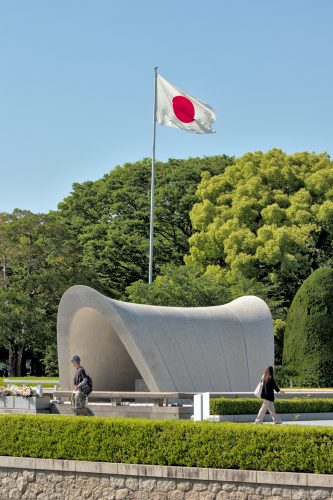
Pass under the museum’s reinforced concrete pilotis and you come to a large lawn with a central path north along the main park axis. This path takes you to the Cenotaph for the Atomic Bomb Victims. The cenotaph operates like a gravestone for all the victims. Designed under Tange’s park plan, the cenotaph’s saddle-shaped arch evokes ancient Japanese funerary forms, particularly the house-shaped haniwa associated with Kofun-period tombs in the fifth century.
Under the Cenotaph is a stone chest that houses the 130 volumes that make up the Hiroshima Atomic Bomb Victims Registry. The list includes American POWs, Koreans, Taiwanese and other non-Japanese residents present during the bomb. It contains 349,246 names. One volume is intentionally left blank for all the unknown victims.
Ceremonial Center
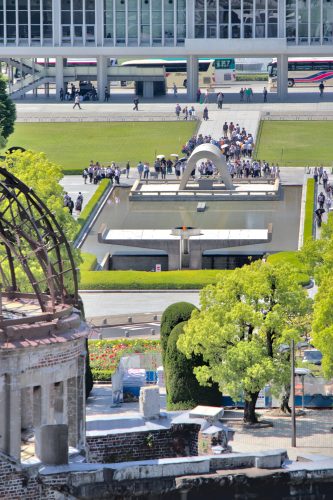
The lawn and cenotaph are the ceremonial heart of the park. This is where the city solemnly gathers every Aug. 6 to remember the bombing. It is also where visiting dignitaries pay their respects. For example, in 2019, Pope Francis prayed for the dead, listened to survivors and condemned nuclear weapons in a Peace Gathering at the cenotaph. In 2023, when Hiroshima hosted the Group of Seven (G7) Summit, the G7 leaders offered flowers and prayed at the cenotaph before planting cherry trees along the eastern side of the lawn.
(Joy Photo / Michael Farrell)
Pond of Peace & Flame of Peace
Looking through the arch of the Cenotaph, you’ll see the still waters of the Pond of Peace leading up to the Flame of Peace—symbols rich with meaning. In Japanese religious and funerary traditions, water symbolizes the dividing line between the living and the dead. It is also used for ritual purification before entering holy places. Consequently, the Pond of Peace can be interpreted as a ritual boundary between the land of the living and the dead while also providing purification for the souls forced to cross. The Flame of Peace, meanwhile, represents the threat of nuclear war. It is kept perpetually burning until global nuclear disarmament is achieved.
Atomic Bomb Dome
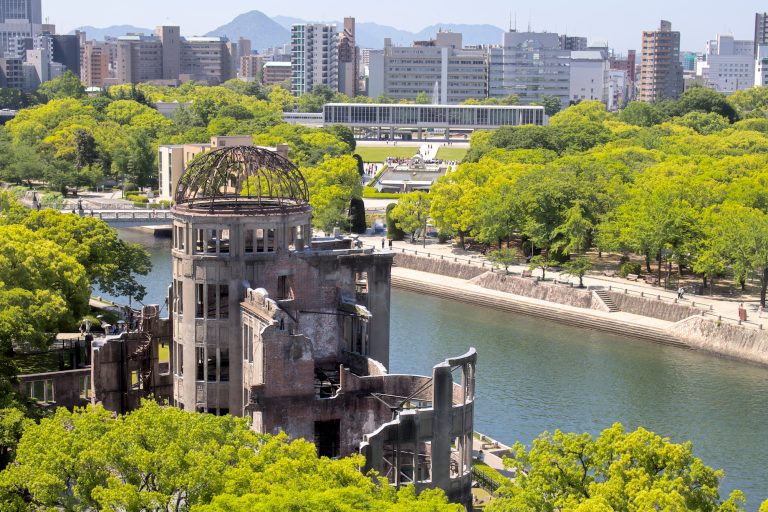
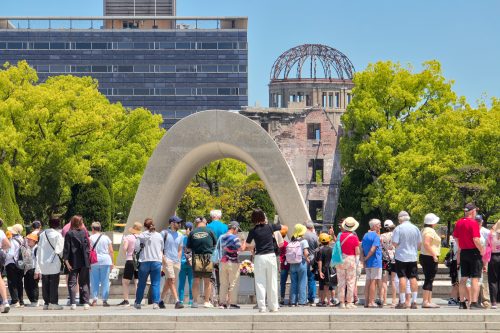
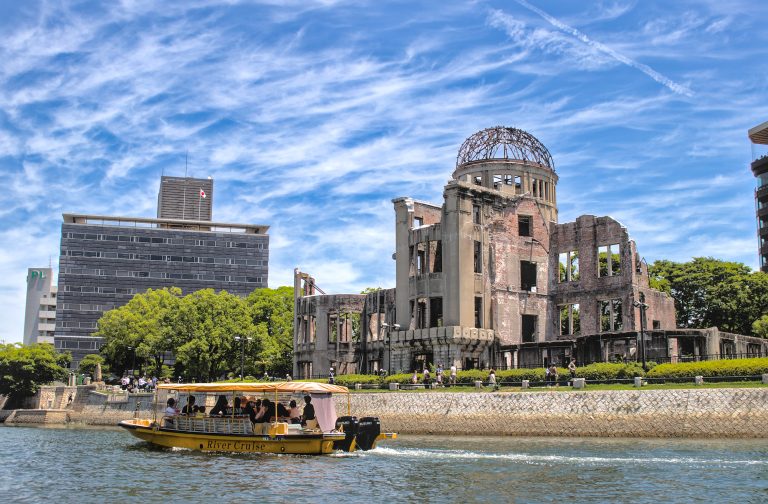
Lastly, looking beyond the pond and the flame, one sees the twisted ruin of the Atomic Bomb Dome preserved as it was just after the bomb exploded. Before the bomb, it was called the Hiroshima Prefectural Industrial Promotional Hall. Though clearly visible from the cenotaph, it lies on the other side of the Motoyasu River. The steel-frame and masonry building was designed by Czech architect Jan Letzel and built between 1914 and 1915. First called the Hiroshima Prefectural Commercial Exhibition Hall, it was originally used to promote new commercial and industrial products.
For example, one of the most popular baked goods in Japan today is baumkuchen. You can find this German cake in most supermarkets, and it is commonly bought as a gift for special occasions. Karl Juchheim, the future founder of Kobe’s famous Juchheim Co., Ltd., introduced the sweet to Japan in 1919 at an expo held at Hiroshima Prefectural Commercial Exhibition Hall. In stark contrast, today’s ruin serves as a reminder of the devastating power of nuclear weapons.
Hiroshima National Peace Memorial Hall for the Atomic Bomb Victims
To the right of the center axis, a memorial for the atomic bomb victims lies under the earth. Descend the stone stairs and move counterclockwise, as if backward through time, down a sloped passage mixed with the ground soil. Inside Hiroshima National Peace Memorial Hall for the Atomic Bomb Victims, visitors are invited to learn more about the victims and the terrible power of the atomic bomb while being given space to digest and pray.
At the very bottom, inside the Hall of Remembrance, one finds a 360-degree diorama of what Hiroshima looked like from the hypocenter right after the bomb. The image is made out of 140,000 tiles, each one representing one of the victims who died by the end of the year. Other facilities include a Special Exhibition Area, a library where you can read over 140,000 survivor memoirs and obituaries, and a wall display that continually rotates through portraits of the victims and their names.
Hiroshima Peace Memorial Rest House
Just north of Memorial Hall lies another surviving structure from before the blast. Built in 1929, Hiroshima Peace Memorial Rest House was Taishoya Kimono Shop at the time of the bombing. It was restored and reopened in July 2020 as a tourist information center and rest area. Inside, one can find a gift shop, a café and a piano that survived the atomic bombing. Two major park tours also operate out of this building: a VR tour where people can see what the park looked like before the bomb as they explore the park, and a cycling tour that connects the park to atomic bomb sites around the wider city. There is also a museum display in the basement where the late Eizo Nomura, the closest known survivor to the hypocenter, survived the atomic blast.
Children’s Monuments
(Joy Photo / Michael Farrell)
Children’s Peace Monument
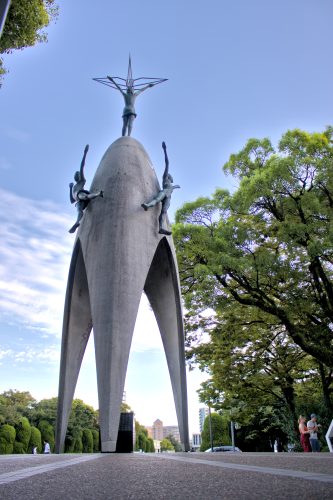
Just to the left of the south-north line connecting the Atomic Bomb Dome to the Statue of Mother and Child in the Storm is the Children’s Peace Monument. It stands just across the road from the Flame of Peace.
On top of the monument, above a small bell tower, a little girl holds a large paper crane above her head. Flanking the figure, a boy and a girl fall to the sides with their hands held out as if to catch something. Under the bell tower, the Japanese inscription reads, “This is our cry, this is our prayer: for building peace in the world.”
The girl at the top represents Sadako Sasaki, a 12-year-old who died in 1955 from radiation-induced leukemia. Hoping for recovery, Sasaki followed a Japanese folk tradition that if you folded 1,000 paper cranes, you would be granted a wish. Sadly, despite completing more than 1,000 cranes, she passed away.
Today, paper cranes are folded by children across Japan and the world in honor of child victims like Sasaki. These cranes are displayed in glass cases behind the monument as a plea that no child should ever have to endure nuclear war. An estimated 10 million paper cranes are offered every year.
While visiting, you can also fold your own cranes and donate them to the case as a prayer for peace.
Memorial Tower Dedicated to Mobilized Students
On the route to the Atomic Bomb Dome, after crossing the Motoyasu Bridge, lies another memorial to children killed in the war. The Memorial Tower Dedicated to Mobilized Students lists the names of 6,874 students age 12 and older who died in the war both from the atomic bomb and from air raids across Japan. They died while mobilized by the government to fill vacant jobs as the country ran out of adults who could work.
According to city records, at the time of the atomic bombing, at least 9,111 children were deployed in the city demolishing buildings to make firebreaks in case of conventional bombing. Around 6,300 of the deployed students died in the blast.
Adjacent Monuments
Circle around to the west after visiting the Atomic Bomb Dome. Cross the T-shaped Aioi Bridge, the bomber’s original target, and enter the wooded side of the park to see the Clock Tower, ring the Peace Bell, pray for the dead at the Cenotaph for Korean Victims and the Atomic Bomb Memorial Burial Mound. This last monument contains the ashes of 70,000 unidentified victims who were discovered all across the city. Some have since been identified, currently leaving 67,566 individuals still unknown.
Before and After the Bomb
Before the atomic bombing, the area now known as Peace Memorial Park was known as Nakajima District. It was a lively and bustling place filled with homes, shopping, industry, clinics, restaurants, a theater, temples, government offices and more. It is estimated that 6,500 people lived in Nakajima at the time the atomic bomb exploded. At the time, the population of Hiroshima as a whole was estimated to be around 350,000 people.
On Aug. 6, 1949, the “Hiroshima Peace Memorial City Construction Law” was enacted, and the land that was Nakajima District was dedicated to become Peace Memorial Park.
Shortly after this, architect Kenzo Tange’s design for Peace Memorial Park was selected out of 145 proposals. His pivotal idea was aligning the museum, cenotaph and the Atomic Bomb Dome on a central axis. Construction began in the early 1950s and was completed April 1, 1954.
Over the decades, additional monuments were added by various groups seeking consolation, peace and the repose of the dead.
One of the most recent additions is a bust of Mahatma Gandhi donated by India in 2023. The bust can be found on the path down the eastern side of the Motoyasu River on the edge of the park.
(Joy Photo / Michael Farrell)
Beat the Crowds and the Heat
Peace Park receives over a million visitors every year. In 2025, Peace Memorial Museum, a part of the park grounds, broke records with 2,003,718 visitors in one fiscal year.
To skip the large crowds and enjoy the best weather, note that the park is busiest on weekends and during the week between 11 a.m. and 3 p.m. This is also when the sun is especially intense in summertime.
Getting There
To experience the park as Tange imagined, you need to arrive at the southern entrance. This is not as easy on public transportation as taking the Hiroden tram from Hiroshima Station to Genbaku Dome-mae Station. But to experience the park as originally intended, it is worth the extra effort.
The easiest route to Peace Park’s main entrance is via the red Maple Loop (Meipuru-pu) bus. The tourist-focused bus leaves Hiroshima Station and arrives at “The Peace Memorial Park (Hiroshima Peace Memorial Museum)” stop in 15 minutes. The basic fare is ¥240, and buses leave approximately every 15 minutes from 9 a.m. until 6 p.m. You can read more about the Maple Loop and see its exact schedule on our transportation guide.
What to Do After
The park presents serious themes and evokes hard questions and emotions that take time to process. You can spend a whole day exploring and meditating in Peace Park. Some take two.
Here are some things you can do to decompress during your journey.
Get a traditional Japanese bento lunch at Kuroben, just a five-minute walk away, and eat it silently beside the river while listening to the sounds of nature. The Motoyasu River is lined with benches on both banks, giving visitors a place to sit and enjoy a light picnic—a perfect space to decompress in nature.
For those who prefer vegan or halal options, a block and a half east from the statue of Gandhi is Chidiya Kanak, one of the city’s most beloved Indian restaurants. You can order your food to go and eat it at the park or eat in at the restaurant. The gentle earth tones, rich wooden flooring and calming lighting make a relaxing atmosphere to enjoy a meal and contemplate.
If you need a break from the heaviness, have some fun finding souvenirs for the people you love on nearby Hondori, the city’s most famous covered shopping street. The street is lined with souvenir shops like Country Cat and lately has become a hot spot for gachapon shops.
Alternatively, blow off steam at Cafe Hybrid, a retro gaming café, or enjoy a yogurt frappe at Chichiyasu Parlor, a café built around the 140-year-old local yogurt brand.
- Address
- 1-1 Nakajimacho, Naka Ward, Hiroshima City, Hiroshima Prefecture, JAPAN
03 Atomic Bomb Dome: From Commercial Center to Peace Icon
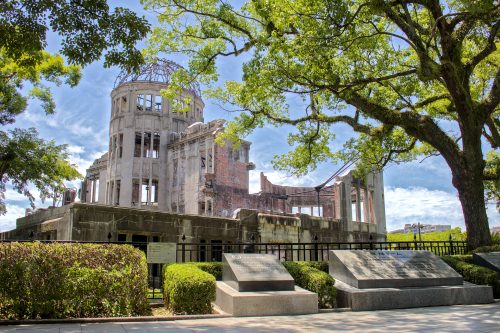
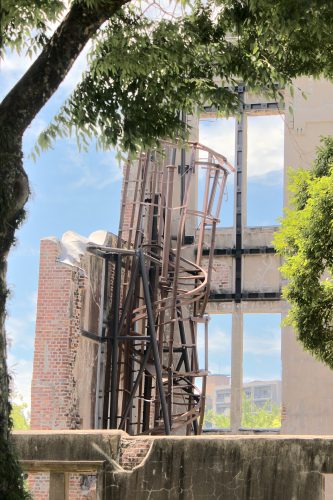
More than a ruin, Hiroshima’s Atomic Bomb Dome is a surviving fragment of the city that existed before Aug. 6, 1945. On that day at 8:15 a.m., Little Boy, a uranium bomb, exploded 160 meters (525 feet) southeast of the building and 600 meters (1,970 feet) above the ground. The blast from the bomb came down through the building’s roof and all three floors. Everyone inside was killed. However, its downward trajectory allowed some of the stone walls and steel frames to remain intact.
The Dome survived the bombing, but its survival afterward was far from certain.
(Joy Photo / Michael Farrell)
Before the Atomic Bomb
Built in 1915 by Czech architect Jan Letzel, the Atomic Bomb Dome was known by many names over the decades. It was originally called the Hiroshima Prefectural Commercial Exhibition Hall.
At the time, Japan was in love with European architecture. The industrial West was seen as prosperous, scientific and technologically advanced. European architecture was a statement of Japan’s modern development. Made of stone-clad brick and mortar with some steel framing and copper roofing, the Hiroshima Prefectural Commercial Exhibition Hall was one of the fancier, more distinguished buildings in the city — an icon of Hiroshima’s growing prosperity and modernity.
It was used to sell local goods, exhibit art and promote new products. Most famously, it is where baumkuchen was first introduced to Japan. Karl Juchheim, a former World War I prisoner of war in Japan, exhibited the German “king of cakes” at Hiroshima’s landmark exhibition hall in 1919. Today, baumkuchen is a popular gift found in supermarkets and department stores across Japan.
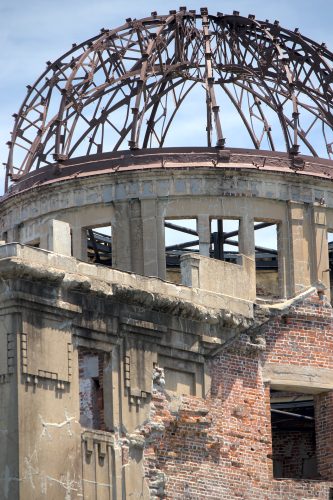
Stone cladding on the Atomic Bomb Dome with the brick and mortal underside revealed by the bomb. (Joy Photo / Michael Farrell)
The Dome’s Architecture and Design
The Hiroshima Prefectural Commercial Exhibition Hall’s design was part of a wave of European-style buildings that became popular at the end of the Meiji and early Taisho eras. Travelers can still see intact contemporary structures today, such as Tokyo Station Marunouchi Building (1914) and Osaka Central Public Hall (1918).
Letzel’s design incorporated a mix of European architectural influences present in Central Europe at the time. Design philosophies such as Neo-Renaissance and Secessionism contributed visual elements including the iconic dome, symmetry, the heaviness of the walls, unusually large windows and repeated geometric motifs. Though today’s structure is gutted, these patterns can still be observed on the ruin.
Surviving Hiroshima’s Reconstruction
After the war ended, Hiroshima began dealing with the question of what to do with the remains of the old city. It was a complicated time full of hardship and strong emotions. The dome had been renamed Hiroshima Prefectural Industrial Promotion Hall in 1933, but now locals called it “Genbaku Dome” — Atomic Bomb Dome — pronounced “Gen-ba-ku Do-meh.”
There were two schools of thought about what to do with the ruins of the Dome. One side wanted to preserve it as a memorial, while the other side wanted to demolish it. For the latter group, the Dome evoked painful memories. They were also concerned about safety because the crumbling ruin had become a hazard.
Curiously, this debate continued long after Peace Memorial Park was established in 1954. At the time, the park’s lead designer, Kenzo Tange, intentionally used the ruined Dome as a key symbolic feature in the central south-to-north line that visually connected the Dome with the Peace Memorial Museum and the Cenotaph for Atomic Bomb Victims. Despite this, however, the future of the Dome was uncertain.
The debate intensified over the years as the city recovered and people discussed how to best communicate the tragic experiences of the survivors and their families. This topic gained further poignancy in the 1960s as heightened Cold War tensions threatened global nuclear armageddon.
It was during this time that public opinion in favor of keeping the Dome increased dramatically. This culminated on July 11, 1966, when the Hiroshima City Council passed a resolution to preserve the building.
“Preserving the Atomic Bomb Dome is not only a responsibility to our future generations,” wrote Hiroshima Mayor Shinso Hamai in his call for donations to save the Dome on Nov. 1, 1966. “But it is a natural mission in our good conscience as fellow members of the human race. In other words, we are not preserving this as a remnant of resentment and hostility, but as a symbol of our remorse as part of the human family, and of our prayers for peace.”
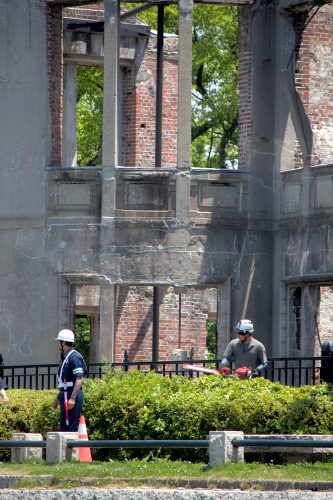
Crews maintaining the grounds around the Atomic Bomb Dome. A steel support is visible inside the Dome’s windows and white streaks reveal where cracks were filled in. (Joy Photo / Michael Farrell)
Preserving the Atomic Bomb Dome
The fundraising campaign was started with the goal of collecting ¥40 million. Support for the project was so strong that the city collected ¥66,197,816 (roughly equal to $1.9 million today) from more than 1.3 million donations raised across the world.
Preservation work began in 1967 and continued off and on over the decades until the most recent update in 2020. To keep the Dome in the same condition it was after the nuclear bombing, minimal steel reinforcement was added. You can see the steel bars today holding up the walls from the inside. Epoxy resins and mortars were used to fill cracks. Less visibly, synthetic waterproofing compounds were applied to prevent rain from further eroding the structure.
The Dome’s Symbolism Today
In 1996, the Dome was declared a UNESCO World Heritage site despite the official reservations of China and the United States. China was concerned the monument would distract from Japan’s atrocities against other Asian nations. The United States was concerned the monument would be interpreted in isolation from the context of the war Japan started in the Pacific.
UNESCO, however, accepted the site under Cultural Criterion VI, which at the time described places that are “directly or tangibly associated with events or living traditions, with ideas, or with beliefs … of outstanding universal significance.” In this case, that event of outstanding universal significance was the first atomic bombing, and the corresponding idea was peace.
In the words of the UNESCO World Heritage Convention site, “[The Atomic Bomb Dome] symbolizes the tremendous destructive power, which humankind can invent on the one hand; on the other hand, it also reminds us of the hope for world permanent peace.”
(Joy Photo / Michael Farrell)
Getting There
The Atomic Bomb Dome is one of the easiest sites in Hiroshima to visit. Take Hiroden tram line 2 or 6 from Hiroshima Station to Genbaku Dome-mae Station. The flat fare is ¥240 for adults and ¥120 for children 6 and older. Children below elementary school age ride for free.
The Atomic Bomb Dome is immediately visible on the left once you arrive at Genbaku Dome-mae Station.
However, if you plan to explore Peace Park as well, we recommend you delay seeing the Atomic Bomb Dome and take the Maple Loop bus from Hiroshima Station to the park’s main entrance on the opposite side of the park. The south-to-north path is the way the park’s designer, Kenzo Tange, expected visitors to experience the park.
After Visiting
The Atomic Bomb Dome is a sobering tourist site. However, lighter parts of the city are just a few minutes’ walk away in Gate Park, opposite the Hiroden tram tracks from the Dome. Grab a Japanese-Italian lunch at Goodspoon. This restaurant serves pasta and stone-oven pizza topped with its own house-made Italian cheeses. After filling up on pasta and cheese, grab a drink and chill out with 33 domestic cats at nearby Cat Café MOFF SHIMINT HIROSHIMA. If you are traveling as a family, 5-Days Children’s Cultural Science Museum is on the northern side of the park. Admission is free to experience dozens of hands-on science experiments and a two-story indoor play structure that would make the cats at MOFF jealous of your kids.
Interested in Learning More?
Visitors seeking deeper historical information may wish to consult the Hiroshima Peace Memorial Museum, UNESCO World Heritage Centre records and Hiroshima City archival material.
- Address
- 1-10 Otemachi, Naka Ward, Hiroshima City, Hiroshima Prefecture, JAPAN
04 Orizuru Tower (おりづるタワー)
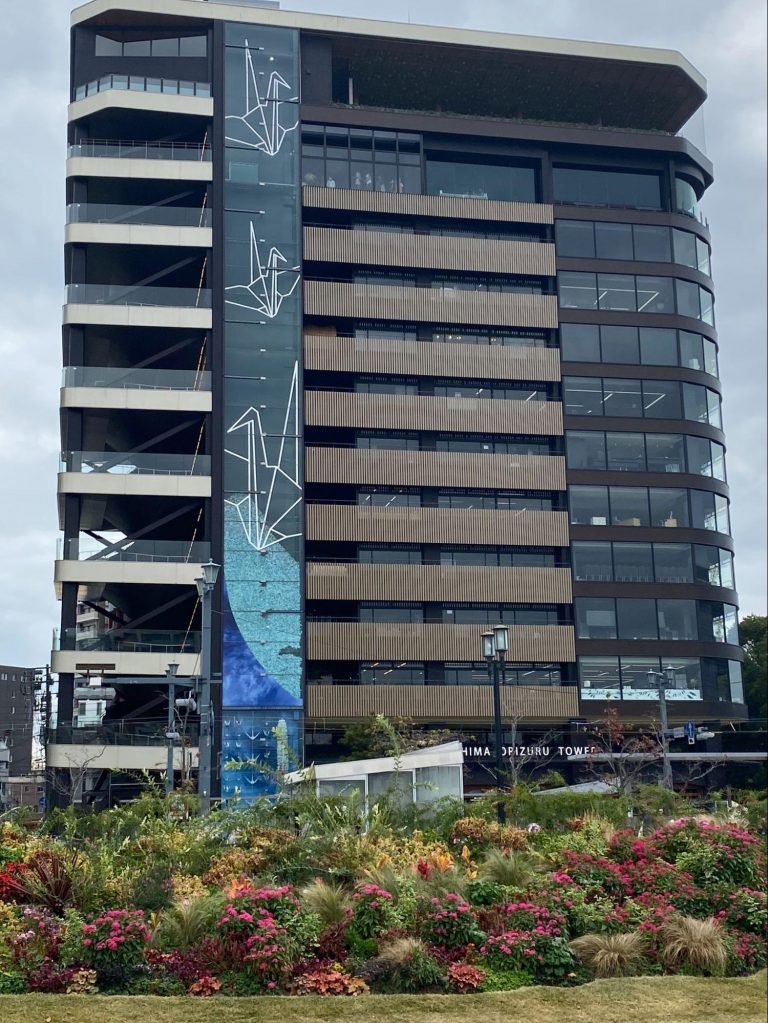
HIROSHIMA ORIZURU TOWER is a tourist attraction located next to the Atomic Bomb Dome. The north walls of the building are decorated with illustrations of ‘Orizuru’ paper cranes, which symbolize peace. The building also occasionally plays host to seasonal events. The first floor has a café and souvenir shop, and the 12th floor is “ORIZURU SQUARE,” where visitors can try their hand at making paper cranes. On the rooftop, there is an observation deck called “HIROSHIMA HILLS,” where you can enjoy a panoramic view of Hiroshima City and spend time relaxing.
The most attractive part of HIROSHIMA ORIZURU TOWER is the spectacular view of Hiroshima from the rooftop observation deck, from which you can enjoy a breathtaking view of the the Wolrd Heritage A-bomb Dome Site, Peace Memorial Park, Hiroshima Castle, and other parts of the city. The observation deck is covered, so you can enjoy the view even in the rain. Also, at the “ORIZURU SQUARE” on the 12th floor, you can enjoy making ‘Orizuru’ paper cranes. You can then throw your ‘Orizuru’ into the “ORIZURU WALL.”- a distinct glass display filled with paper cranes and the hopes and wishes that accompany them from all around the world!
- Address
- 1-2-1 Otemachi, Naka Ward, Hiroshima City, Hiroshima Prefecture, JAPAN
05 Oyster Ship Kanawa (かき船かなわ)
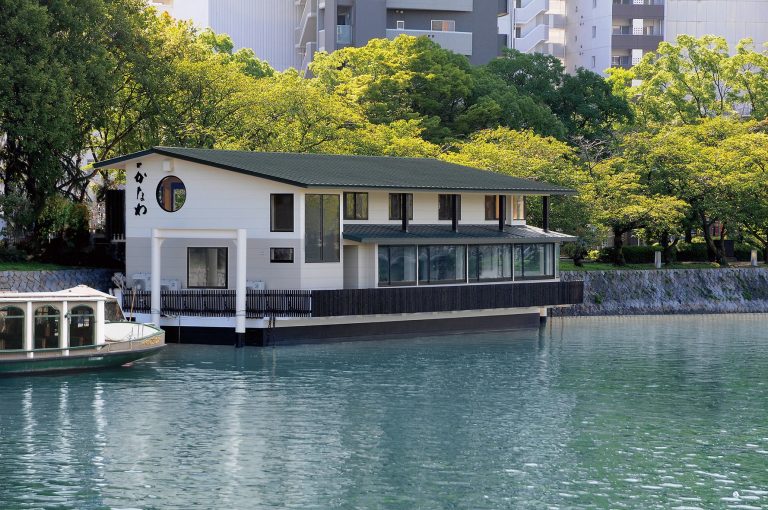
The Oyster Ship Kanawa, floating on the Motoyasu River in Peace Park, is one of the few restaurants in Hiroshima where you can eat oysters on a boat. Seto (on the first floor) offers simple oyster dishes such as fried oysters and grilled oysters, while Waku (on the second floor) offers custom-made oyster course meals to suit your budget and taste. Please note that both Seto and Waku require reservations up to one week in advance for some courses.
- Address
- 1 Otemachi, Naka Ward, Hiroshima City, Hiroshima Prefecture, JAPAN
06 Hondori Shopping Street (本通商店街)
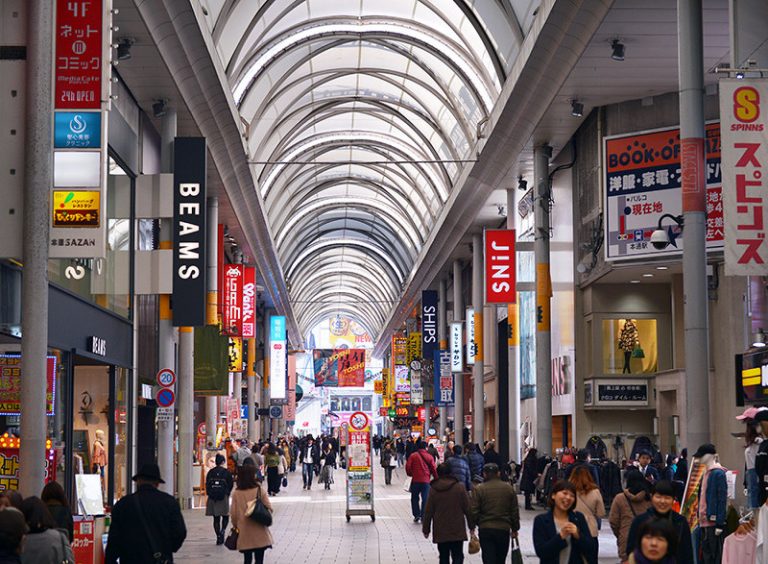
The bustling downtown area called Hondori is named after the pedestrian-only arcade shopping street that symbolizes the city. This shopping street is lined with clothing stores representing Japan and countries around the world. At night, the neon lights of izakaya (Japanese pubs) and pubs come on all at once. Ramen specialty stores and sushi restaurants with counter seating are open until midnight. Nearby, Okonomimura is a collection of restaurants specializing in Hiroshima’s special okonomiyaki.
- Address
- Hondori, Naka Ward, Hiroshima City, Hiroshima Prefecture, JAPAN
Transportation: Shukkeien-mae [Hiroden Streetcar #9, ~3 minutes; ~10 minutes on foot]
07 Shukkeien (縮景園)
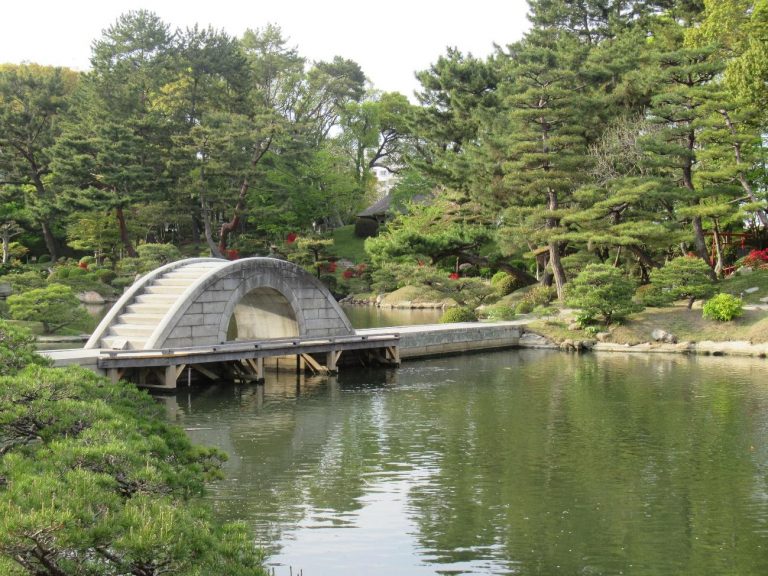
Shukkeien is a Japanese garden located next to the Hiroshima Prefectural Art Museum. The garden was ordered to be built during the Edo Period in the year 1620 by the the Feudal Lord of Hiroshima at the time, Asano Nagaakira. The design of this historic Japanese garden was made by Ueda Soko, the famous tea ceremony master. In 2020, the garden celebrated its 400th anniversary. The garden is filled with a variety of flowers and trees that bloom in every season of the year, allowing visitors to experience the beauty of Japan’s four seasons. If you visit the park in combination with the Hiroshima Prefectural Art Museum, you can get a discount on both admission fees.
(Entry fee)
[Garden only]
General admission – ¥260
High School/University student
¥150
Elementary/Junior High School
student – ¥100
(Garden & Museum set)
General admission – ¥610
High School/University student
¥350
※ For students and senior
citizens, please present
identification to verify your age
such as your passport, or
school ID, at reception before
entering the garden.
- Address
- 2-11 Kaminobori-cho, Naka Ward, Hiroshima City, Hiroshima Prefecture, JAPAN
08 Hiroshima Prefectural Art Museum (広島県立美術館)
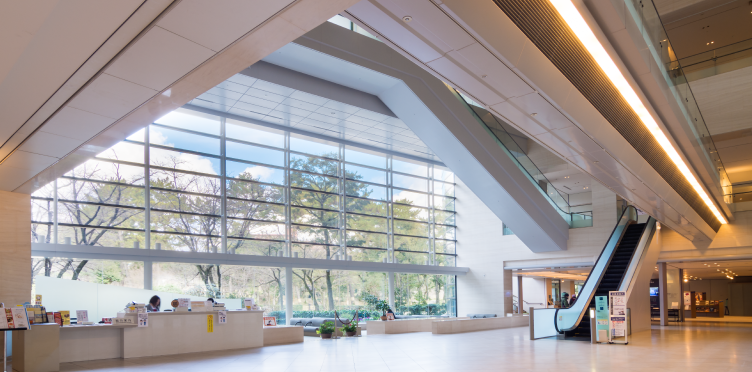
Located in the center of Hiroshima City, the museum is adjacent to the Shukkeien, a national scenic beauty with abundant greenery. From the lobby and restrooms, you can enjoy the seasonal scenery of the Shukkeien, which was built as a feudal garden for the Asano family, lords of the Hiroshima domain. The museum is also home to a wide variety of artworks, including the “Imari Bowl with Design of Flowers and Plants in Color” and “Itsukushima” (Important Cultural Property), artworks related to Hiroshima by Ai Mitsu, Entsuba Shozo, Hirayama Ikuo, etc., Japanese and Asian Crafts including folk art works by Kawai Takujiro and Hamada Shoji, Central Asian dyeing and weaving, as well as metalwork. The collection includes over 5,000 works (including those deposited) under the theme of “Art of the 1920s and 1930s,” such as Salvador Dali’s “Dream of Venus” and Isamu Noguchi’s “Reminiscence.” The collection is changed four times a year and introduced in exhibitions. Volunteer guides from the Tomo no Kai provide easy-to-understand information about the works.
In addition, the Special Exhibition Room holds about six special exhibitions a year. Many events such as lectures and concerts are held in conjunction with the special exhibitions.
- Address
- 2-22 Kaminobori-cho, Naka Ward, Hiroshima City, Hiroshima Prefecture, JAPAN
Transportation: Hiroshima Station [Meipuru~pu Bus Green Route, ~12 minutes; ~15 minutes on foot]
09 OKOSTA Okonomiyaki Cooking Studio (オコスタ お好み焼き体験スタジオ)
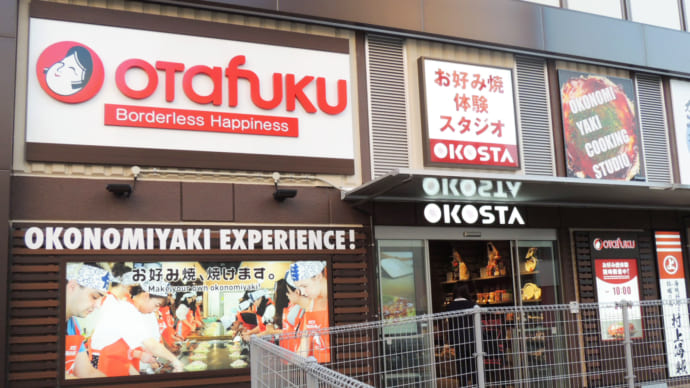
The OKOSTA Okonomiyaki Cooking Studio is a facility dedicated to the experience of cooking Okonomiyaki. It is located in the “ekie” shopping center built right into Hiroshima Station. Okonomiyaki is a homemade dish originating in Hiroshima, made of flour, eggs, cabbage, and other ingredients cooked in the shape of a Mille-feuille. At the OKOSTA Okonomiyaki Cooking Studio, you can learn how to make delicious Okonomiyaki from scratch with the help of a professional Okonomiyaki chef. Of course, when you finish, you can eat the Okonomiyaki you made right there in the studio.
- Address
- 1-2 Matsubara-cho, Minami Ward, Hiroshima City, Hiroshima Prefecture, JAPAN
Browse a wide variety of souvenirs from Hiroshima Prefecture before returning to your place of accommodation and calling it a night.
Hiroshima Station (広島駅)
2-37 Matsubaracho, Minami Ward, Hiroshima City, Hiroshima Prefecture, JAPAN
Hiroshima Peace Memorial Park: A Walk Through
1-1 Nakajimacho, Naka Ward, Hiroshima City, Hiroshima Prefecture, JAPAN
Atomic Bomb Dome: From Commercial Center to Peace Icon
1-10 Otemachi, Naka Ward, Hiroshima City, Hiroshima Prefecture, JAPAN
Orizuru Tower (おりづるタワー)
1-2-1 Otemachi, Naka Ward, Hiroshima City, Hiroshima Prefecture, JAPAN
Oyster Ship Kanawa (かき船かなわ)
1 Otemachi, Naka Ward, Hiroshima City, Hiroshima Prefecture, JAPAN
Hondori Shopping Street (本通商店街)
Hondori, Naka Ward, Hiroshima City, Hiroshima Prefecture, JAPAN
Shukkeien (縮景園)
2-11 Kaminobori-cho, Naka Ward, Hiroshima City, Hiroshima Prefecture, JAPAN
Hiroshima Prefectural Art Museum (広島県立美術館)
2-22 Kaminobori-cho, Naka Ward, Hiroshima City, Hiroshima Prefecture, JAPAN
OKOSTA Okonomiyaki Cooking Studio (オコスタ お好み焼き体験スタジオ)
1-2 Matsubara-cho, Minami Ward, Hiroshima City, Hiroshima Prefecture, JAPAN