
Itineraries 2day
Complete Tour of Hiroshima City
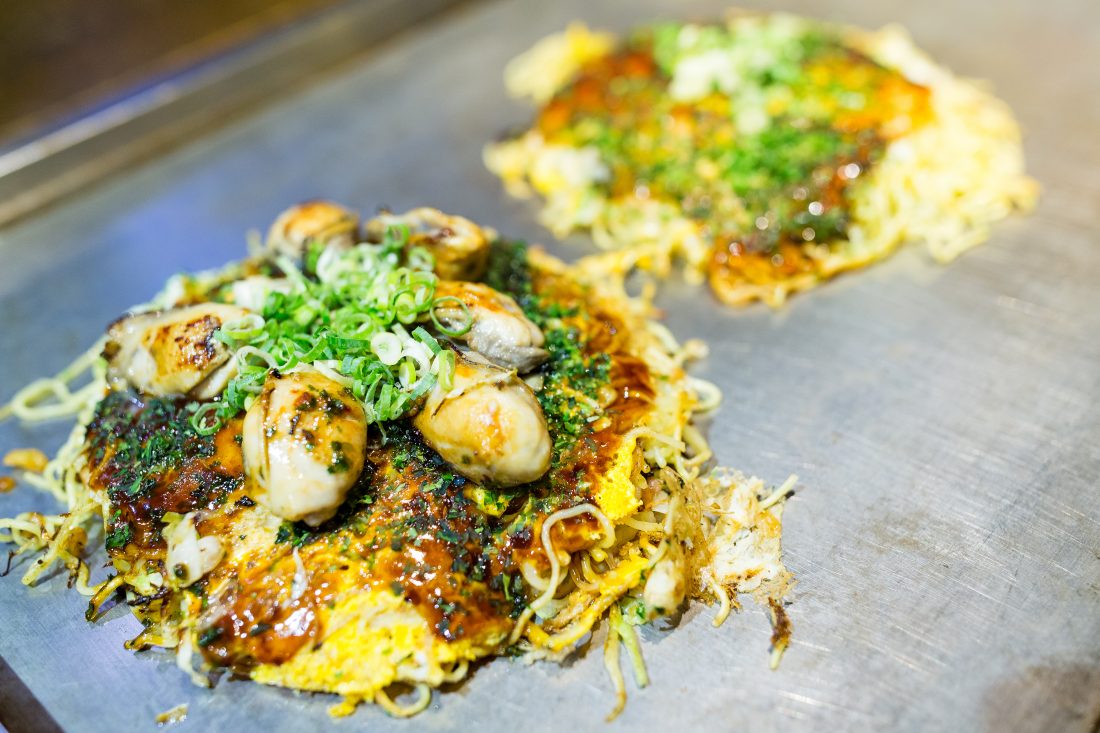
A packed, full itinerary for those bold enough to experience as much of Hiroshima City as possible in one night and two days. Visit both the major attractions and also the lesser-known ones off the beaten track.
Day 1
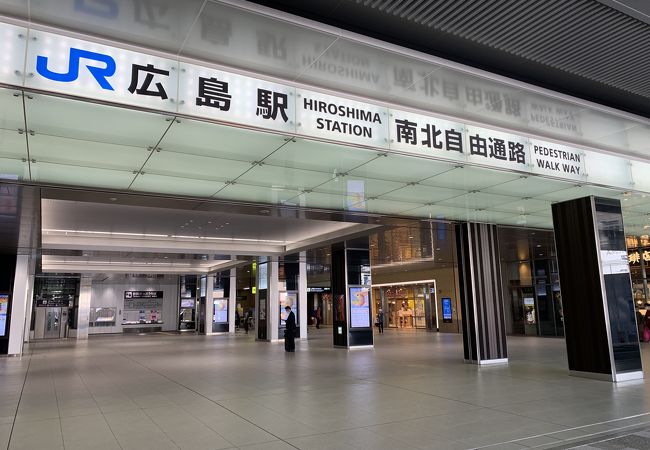
01 Hiroshima Station (広島駅)
Hiroshima Station is the bustling transportation hub of our peaceful city, and one of the principal entertainment hubs as well. All JR lines in the city stop here, and from here, people can take numerous buses and streetcars anywhere in the city, or even out of town. The ekie shopping complex located inside the station building also has no shortage of restaurants and souvenir shops to keep visitors busy for hours.
- Address
- 2-37 Matsubaracho, Minami Ward, Hiroshima City, Hiroshima Prefecture, JAPAN
Transportation: Hiroshima Castle [Meipuru~pu Bus Orange OR Lemon Route, ~6 minutes]
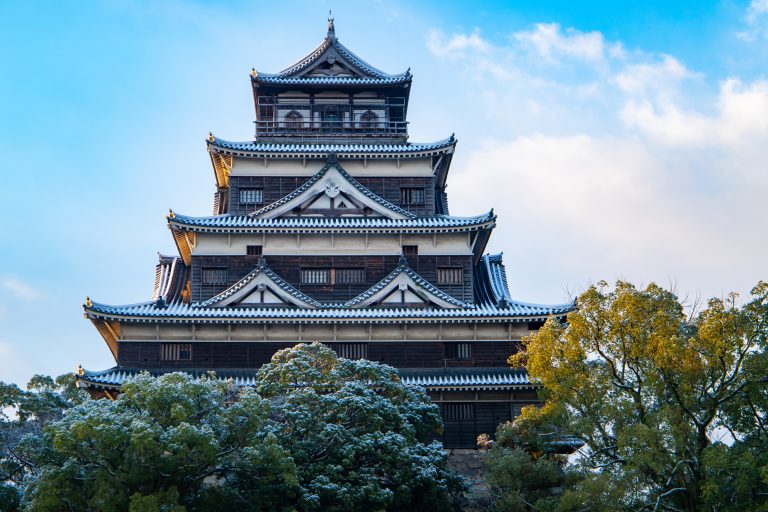
02 Hiroshima Castle (広島城)
Hiroshima Castle was built in the year 1599 by Hiroshima’s most powerful warrior and leader at the time, Mori Terumoto. The castle featured a five-story Castle Tower, a Honmaru Palace, and a moat that flows like a river. Unfortunately, both the Castle Tower and the Honmaru Palace were destroyed by the atomic bombing in 1945, and only the Castle Tower has been reconstructed. The castle tower now houses the Hiroshima Castle Museum, which exhibits materials related to Hiroshima’s history, the Mori family, local folklore, and natural history.
(Entry fee)
18+ – ¥370
Senior citizen – ¥180
High School student – ¥180
Junior High School student
or under – Free
※ For students and senior
citizens, please present
identification to verify your age
such as your passport, or
school ID, at reception when
purchasing your ticket.
- Address
- 21-1 Motomachi, Naka Ward, Hiroshima City, Hiroshima Prefecture, JAPAN
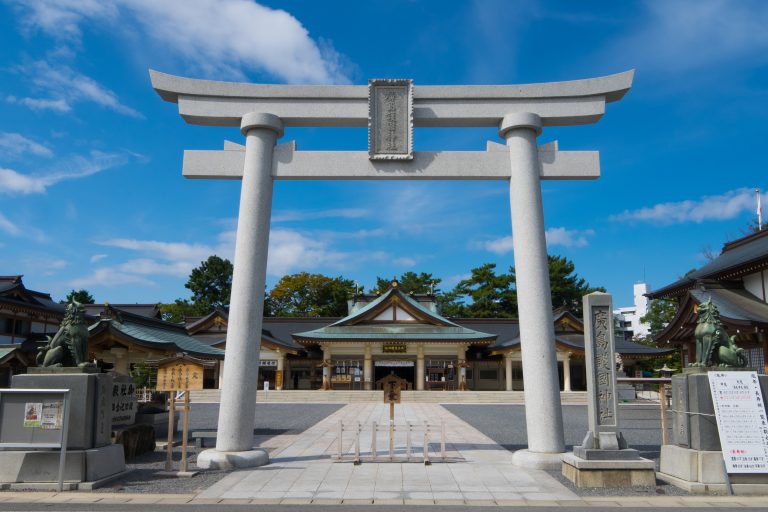
03 Hiroshima Gokoku Shrine (広島護国神社)
The Hiroshima Gokoku Shrine is located on the site of Hiroshima Castle, and is the largest shrine in the city center. Various festivals are held at the shrine, including the Especially 600,000 people visit the shrine in January As Hatsumoude (first visit of the new year) . Another popular festival is the Tondomatsuri. Held on January 15, every year it attracts many people who come to see the huge bonfires to pray for good health and family safety. If you are lucky, you might also see a wedding ceremony in the traditional Japanese kimono style, however you will have to watch from a distance.
- Address
- 21-2 Motomachi, Naka Ward, Hiroshima City, Hiroshima Prefecture, JAPAN
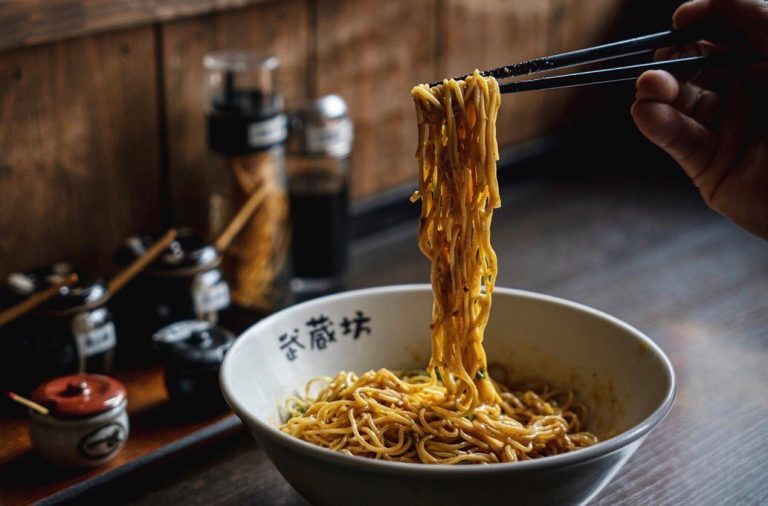
04 Musashibō (武蔵坊)
Musashibo is a chain restaurant in Hiroshima City that sells “shiru-nashi tantanmen,” or Dandan noodles without broth. Originally a Chinese recipe, Dandan noodles became a hit in Japan, and countless restaurants toiled to perfect their own twist on the Sichuan classic. Hiroshima’s variant has amassed its fair share of fame with its lack of broth and abundance of piquant spices, and the Musashibo branches are never far from any shopping center downtown.
- Address
- 5-12 Fujimi-cho, Naka Ward, Hiroshima City, Hiroshima Prefecture, JAPAN
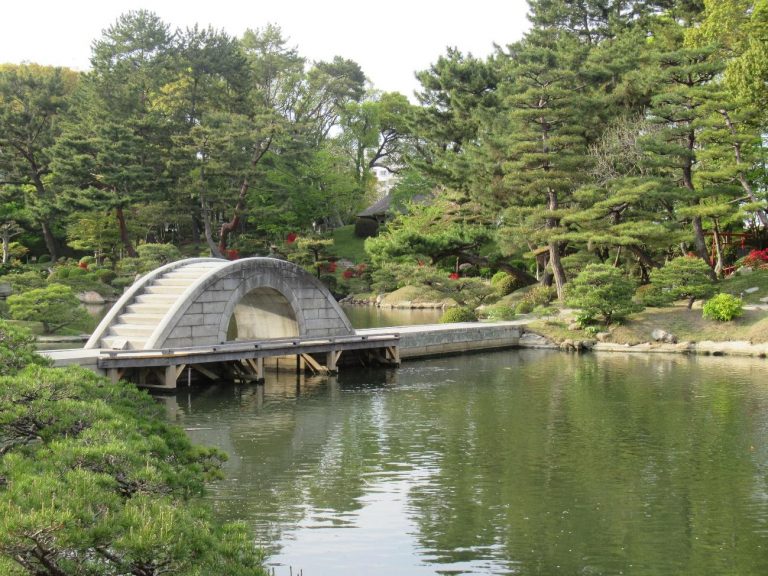
05 Shukkeien (縮景園)
Shukkeien is a Japanese garden located next to the Hiroshima Prefectural Art Museum. The garden was ordered to be built during the Edo Period in the year 1620 by the the Feudal Lord of Hiroshima at the time, Asano Nagaakira. The design of this historic Japanese garden was made by Ueda Soko, the famous tea ceremony master. In 2020, the garden celebrated its 400th anniversary. The garden is filled with a variety of flowers and trees that bloom in every season of the year, allowing visitors to experience the beauty of Japan’s four seasons. If you visit the park in combination with the Hiroshima Prefectural Art Museum, you can get a discount on both admission fees.
(Entry fee)
[Garden only]
General admission – ¥260
High School/University student
¥150
Elementary/Junior High School
student – ¥100
(Garden & Museum set)
General admission – ¥610
High School/University student
¥350
※ For students and senior
citizens, please present
identification to verify your age
such as your passport, or
school ID, at reception before
entering the garden.
- Address
- 2-11 Kaminobori-cho, Naka Ward, Hiroshima City, Hiroshima Prefecture, JAPAN
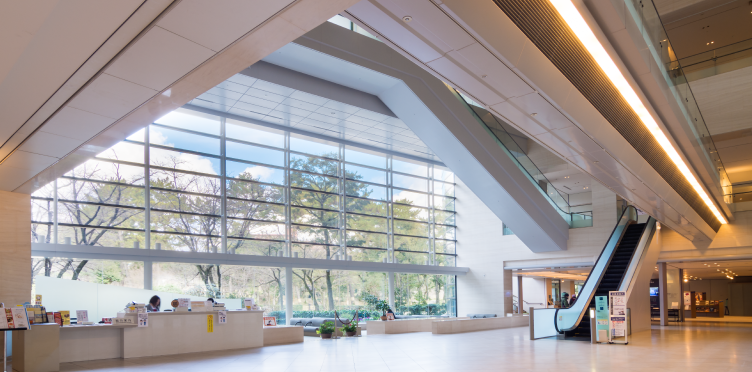
06 Hiroshima Prefectural Art Museum (広島県立美術館)
Located in the center of Hiroshima City, the museum is adjacent to the Shukkeien, a national scenic beauty with abundant greenery. From the lobby and restrooms, you can enjoy the seasonal scenery of the Shukkeien, which was built as a feudal garden for the Asano family, lords of the Hiroshima domain. The museum is also home to a wide variety of artworks, including the “Imari Bowl with Design of Flowers and Plants in Color” and “Itsukushima” (Important Cultural Property), artworks related to Hiroshima by Ai Mitsu, Entsuba Shozo, Hirayama Ikuo, etc., Japanese and Asian Crafts including folk art works by Kawai Takujiro and Hamada Shoji, Central Asian dyeing and weaving, as well as metalwork. The collection includes over 5,000 works (including those deposited) under the theme of “Art of the 1920s and 1930s,” such as Salvador Dali’s “Dream of Venus” and Isamu Noguchi’s “Reminiscence.” The collection is changed four times a year and introduced in exhibitions. Volunteer guides from the Tomo no Kai provide easy-to-understand information about the works.
In addition, the Special Exhibition Room holds about six special exhibitions a year. Many events such as lectures and concerts are held in conjunction with the special exhibitions.
- Address
- 2-22 Kaminobori-cho, Naka Ward, Hiroshima City, Hiroshima Prefecture, JAPAN
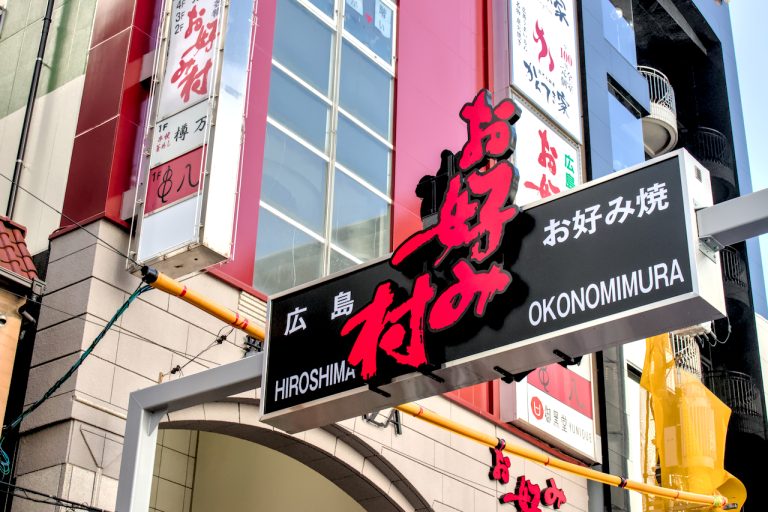
07 Okonomimura – Hiroshima’s Cultural Okonomiyaki HQ
Hiroshima’s Okonomimura, “Okonomi Village” in English, is a seven-story building near Parco filled to the brim with vendors selling the exact same product: okonomiyaki and teppanyaki with alcoholic beverages and soft drinks. Pretty much every store inside has a history behind it, and while some establishments’ okonomiyaki may taste better than others’, you won’t find a terrible okonomiyaki here. Lots of locals swing by during lunch breaks or on the way home from work, and some undoubtedly have found a store that they swear by.
Heritage Okonomiyaki Shops
The modern seven-story building is the cultural headquarters of Hiroshima style okonomiyaki, a dish the locals like to
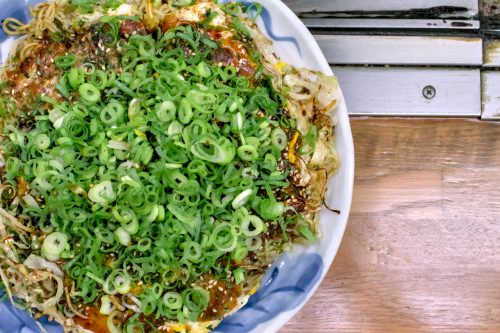
The “Tabete Minsai-yaki” okonomiyaki from Kaeruttei. Owner, Reiko Hirata, says they use Marubayashi noodles. Marubayashi is a Hiroshima-based noodle company that has been making noodles since 1948. (Joy Photo / Michael Farrell)
call “Hiroshima’s soul food.” It is the direct descendant of the 1950s era street-food bazaars that once filled Nishi Shintechi Square—the modern Alice Garden plaza, right next to Okonomimura. Back then, up to 50 food stands filled the square selling mostly okonomiyaki on griddles pulled out of the rubble.
War Reconstruction Food
Okonomiyaki is the city’s reconstruction food. It grew out of the ashes of the atomic bomb as people scrounged to reassemble their lives and put food on the table. After the bomb, as lives started coming back together, people started innovating on a popular pre-war snack known as issen yoshoku—literally “one hundredth of a yen Western food.” Issen yoshoku was a flour-based batter cooked with dried shrimp, onions and various condiments. On top of this, locals began layering whatever they had on hand. In fact, the name “okonomiyaki” translates to “fried whatever-you-like.” With wheat flour plentiful from U.S. aid, wheat soba noodles became a popular addition. Cabbage, a source of vitamin C and an easy vegetable to grow, also became an essential ingredient. Eventually strips of pork were added along with eggs and a thick, brown sauce.
A solace and a rock in hard times, okonomiyaki was massively popular, becoming synonymous with reconstruction and Hiroshima’s enduring spirit. “[Nishi-Shintenchi Square] was lively until late at night, with people coming after work, taxi drivers, and newspaper workers,” Kyoko Okita told the Chugoku Shimbun in 2023. Okita, 82 when she spoke to the paper, helped out at the original Rei-chan okonomiyaki stall, now located in Hiroshima Station.
Birth of “Okonomimura”
It was during this time that the writer, Minoru Kida, saw the vibrant scene of glowing food stall tents clustered together in Nishi-Shintenchi Square and exclaimed, “It’s just like an okonomi village,” and the name was born.
However, in 1965 Nishi-Shintenchi Square was closed to street vendors to crack down on unauthorized shops and late-night noise. The shops needed a place to go. Many of them moved into the first Okonomimura building, built the same year. It quickly became a hit and even attracted school groups and visitors from other cities when they came to tour Hiroshima.
Due to safety concerns, the original building was closed in 1990. The current building, Shintenchi Plaza, opened in 1992
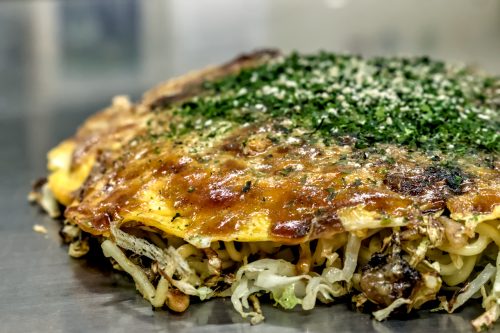
Close up of “The Hiroshima Special” from Sarashina. Sarashina’s okonomiyaki is unique for using fish powder and dried seaweed to season their okonomiyaki. (Joy Photos / Michael Farrell)
in the same spot.
Not Just Okonomiyaki
just as the original street food bazaar included a variety of restaurants, not all the shops in Okonomimura are okonomiyaki shops. The 1st floor includes an oyster bar, an izakaya and a beef bowl shop. The upper floors typically house izakayas. However, as the core has always been okonomiyaki, the 2nd through 4th floors are filled with 25 different okonomiyaki shops, some of which, like Sarashina (founded in 1951), can trace their origins to the original street food stands in Nishi-Shintenchi Square.
Currently, the 6th and 7th floors of Shintenchi Plaza do not have active businesses.
Celebrating 60 Years of Okonomiyaki
In 2025, Okonomimura celebrated its 60th anniversary — carrying forward a legacy of survival, ingenuity, community, love and joy from the survivors of the unimaginable.
For Travelers Short on Time
If your travel plans don’t take you into downtown Hiroshima, and you still want to try Hiroshima style okonomiyaki, there are many options around Hiroshima Station, like Rei-chan, a Shintenchi original shop, located on the 1st floor of the station’s Ekie Dining area. And then there is Okonomi Story Ekimae Hiroba, a modern recreation of the old okonomiyaki street food stands. It can be found on the 6th floor of the Hiroshima Full Focus Building across from Hiroshima Station.
Additional reporting by Kevin Peng
- Address
- 5-13 Shintenchi, Naka-ku, Hiroshima 730-0034 Hiroshima Prefecture
Lodging: Hiroshima Washington Hotel
Day 2
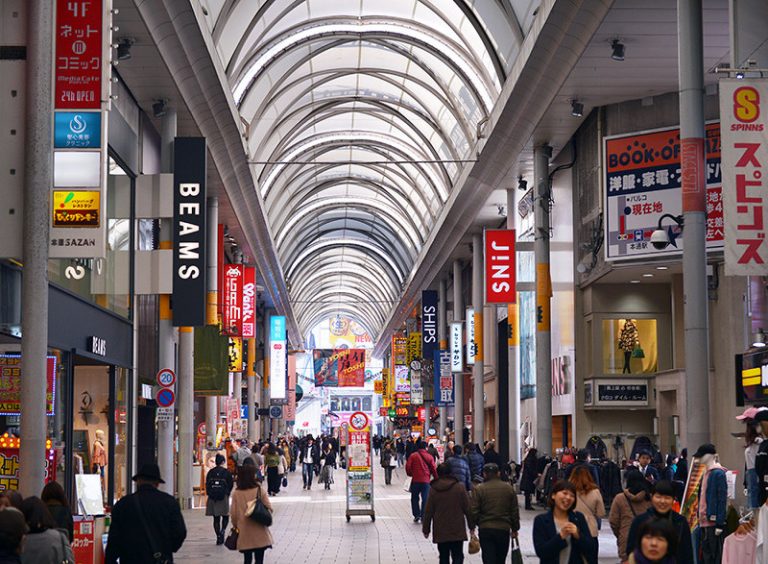
01 Hondori Shopping Street (本通商店街)
The bustling downtown area called Hondori is named after the pedestrian-only arcade shopping street that symbolizes the city. This shopping street is lined with clothing stores representing Japan and countries around the world. At night, the neon lights of izakaya (Japanese pubs) and pubs come on all at once. Ramen specialty stores and sushi restaurants with counter seating are open until midnight. Nearby, Okonomimura is a collection of restaurants specializing in Hiroshima’s special okonomiyaki.
- Address
- Hondori, Naka Ward, Hiroshima City, Hiroshima Prefecture, JAPAN
Transportation: Genbaku Dome-mae [Hiroden Streetcar #1, 2, or 6, ~5 minutes]
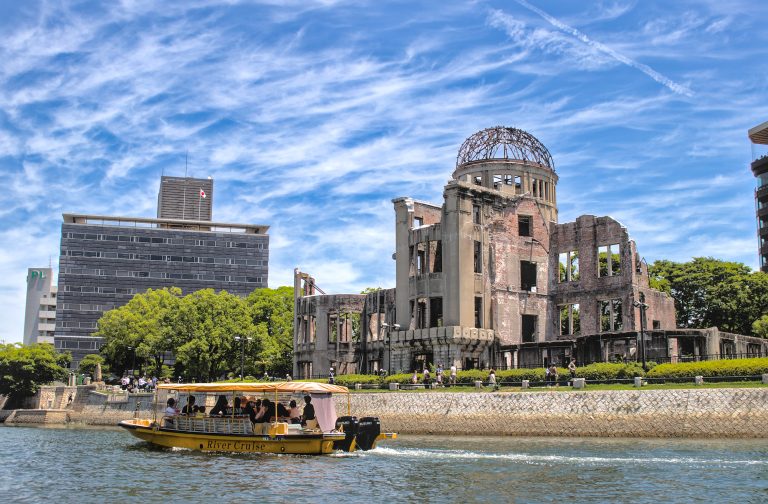
02 Atomic Bomb Dome: From Commercial Center to Peace Icon
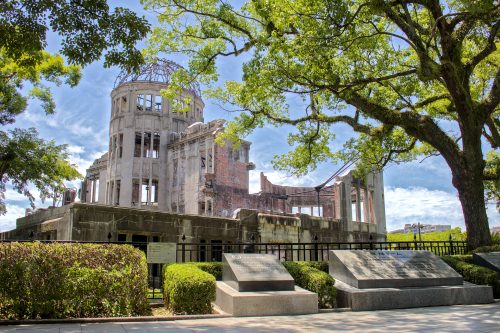
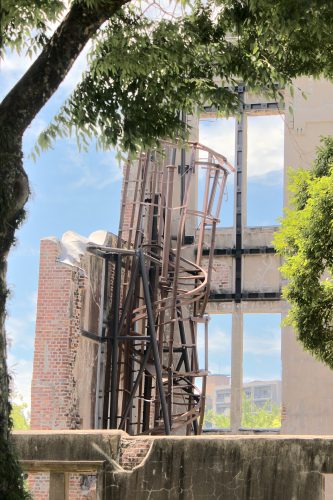
More than a ruin, Hiroshima’s Atomic Bomb Dome is a surviving fragment of the city that existed before Aug. 6, 1945. On that day at 8:15 a.m., Little Boy, a uranium bomb, exploded 160 meters (525 feet) southeast of the building and 600 meters (1,970 feet) above the ground. The blast from the bomb came down through the building’s roof and all three floors. Everyone inside was killed. However, its downward trajectory allowed some of the stone walls and steel frames to remain intact.
The Dome survived the bombing, but its survival afterward was far from certain.
(Joy Photo / Michael Farrell)
Before the Atomic Bomb
Built in 1915 by Czech architect Jan Letzel, the Atomic Bomb Dome was known by many names over the decades. It was originally called the Hiroshima Prefectural Commercial Exhibition Hall.
At the time, Japan was in love with European architecture. The industrial West was seen as prosperous, scientific and technologically advanced. European architecture was a statement of Japan’s modern development. Made of stone-clad brick and mortar with some steel framing and copper roofing, the Hiroshima Prefectural Commercial Exhibition Hall was one of the fancier, more distinguished buildings in the city — an icon of Hiroshima’s growing prosperity and modernity.
It was used to sell local goods, exhibit art and promote new products. Most famously, it is where baumkuchen was first introduced to Japan. Karl Juchheim, a former World War I prisoner of war in Japan, exhibited the German “king of cakes” at Hiroshima’s landmark exhibition hall in 1919. Today, baumkuchen is a popular gift found in supermarkets and department stores across Japan.
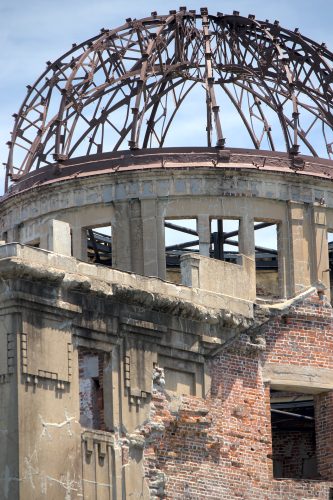
Stone cladding on the Atomic Bomb Dome with the brick and mortal underside revealed by the bomb. (Joy Photo / Michael Farrell)
The Dome’s Architecture and Design
The Hiroshima Prefectural Commercial Exhibition Hall’s design was part of a wave of European-style buildings that became popular at the end of the Meiji and early Taisho eras. Travelers can still see intact contemporary structures today, such as Tokyo Station Marunouchi Building (1914) and Osaka Central Public Hall (1918).
Letzel’s design incorporated a mix of European architectural influences present in Central Europe at the time. Design philosophies such as Neo-Renaissance and Secessionism contributed visual elements including the iconic dome, symmetry, the heaviness of the walls, unusually large windows and repeated geometric motifs. Though today’s structure is gutted, these patterns can still be observed on the ruin.
Surviving Hiroshima’s Reconstruction
After the war ended, Hiroshima began dealing with the question of what to do with the remains of the old city. It was a complicated time full of hardship and strong emotions. The dome had been renamed Hiroshima Prefectural Industrial Promotion Hall in 1933, but now locals called it “Genbaku Dome” — Atomic Bomb Dome — pronounced “Gen-ba-ku Do-meh.”
There were two schools of thought about what to do with the ruins of the Dome. One side wanted to preserve it as a memorial, while the other side wanted to demolish it. For the latter group, the Dome evoked painful memories. They were also concerned about safety because the crumbling ruin had become a hazard.
Curiously, this debate continued long after Peace Memorial Park was established in 1954. At the time, the park’s lead designer, Kenzo Tange, intentionally used the ruined Dome as a key symbolic feature in the central south-to-north line that visually connected the Dome with the Peace Memorial Museum and the Cenotaph for Atomic Bomb Victims. Despite this, however, the future of the Dome was uncertain.
The debate intensified over the years as the city recovered and people discussed how to best communicate the tragic experiences of the survivors and their families. This topic gained further poignancy in the 1960s as heightened Cold War tensions threatened global nuclear armageddon.
It was during this time that public opinion in favor of keeping the Dome increased dramatically. This culminated on July 11, 1966, when the Hiroshima City Council passed a resolution to preserve the building.
“Preserving the Atomic Bomb Dome is not only a responsibility to our future generations,” wrote Hiroshima Mayor Shinso Hamai in his call for donations to save the Dome on Nov. 1, 1966. “But it is a natural mission in our good conscience as fellow members of the human race. In other words, we are not preserving this as a remnant of resentment and hostility, but as a symbol of our remorse as part of the human family, and of our prayers for peace.”
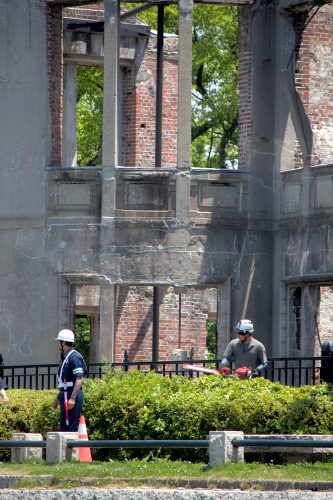
Crews maintaining the grounds around the Atomic Bomb Dome. A steel support is visible inside the Dome’s windows and white streaks reveal where cracks were filled in. (Joy Photo / Michael Farrell)
Preserving the Atomic Bomb Dome
The fundraising campaign was started with the goal of collecting ¥40 million. Support for the project was so strong that the city collected ¥66,197,816 (roughly equal to $1.9 million today) from more than 1.3 million donations raised across the world.
Preservation work began in 1967 and continued off and on over the decades until the most recent update in 2020. To keep the Dome in the same condition it was after the nuclear bombing, minimal steel reinforcement was added. You can see the steel bars today holding up the walls from the inside. Epoxy resins and mortars were used to fill cracks. Less visibly, synthetic waterproofing compounds were applied to prevent rain from further eroding the structure.
The Dome’s Symbolism Today
In 1996, the Dome was declared a UNESCO World Heritage site despite the official reservations of China and the United States. China was concerned the monument would distract from Japan’s atrocities against other Asian nations. The United States was concerned the monument would be interpreted in isolation from the context of the war Japan started in the Pacific.
UNESCO, however, accepted the site under Cultural Criterion VI, which at the time described places that are “directly or tangibly associated with events or living traditions, with ideas, or with beliefs … of outstanding universal significance.” In this case, that event of outstanding universal significance was the first atomic bombing, and the corresponding idea was peace.
In the words of the UNESCO World Heritage Convention site, “[The Atomic Bomb Dome] symbolizes the tremendous destructive power, which humankind can invent on the one hand; on the other hand, it also reminds us of the hope for world permanent peace.”
(Joy Photo / Michael Farrell)
Getting There
The Atomic Bomb Dome is one of the easiest sites in Hiroshima to visit. Take Hiroden tram line 2 or 6 from Hiroshima Station to Genbaku Dome-mae Station. The flat fare is ¥240 for adults and ¥120 for children 6 and older. Children below elementary school age ride for free.
The Atomic Bomb Dome is immediately visible on the left once you arrive at Genbaku Dome-mae Station.
However, if you plan to explore Peace Park as well, we recommend you delay seeing the Atomic Bomb Dome and take the Maple Loop bus from Hiroshima Station to the park’s main entrance on the opposite side of the park. The south-to-north path is the way the park’s designer, Kenzo Tange, expected visitors to experience the park.
After Visiting
The Atomic Bomb Dome is a sobering tourist site. However, lighter parts of the city are just a few minutes’ walk away in Gate Park, opposite the Hiroden tram tracks from the Dome. Grab a Japanese-Italian lunch at Goodspoon. This restaurant serves pasta and stone-oven pizza topped with its own house-made Italian cheeses. After filling up on pasta and cheese, grab a drink and chill out with 33 domestic cats at nearby Cat Café MOFF SHIMINT HIROSHIMA. If you are traveling as a family, 5-Days Children’s Cultural Science Museum is on the northern side of the park. Admission is free to experience dozens of hands-on science experiments and a two-story indoor play structure that would make the cats at MOFF jealous of your kids.
Interested in Learning More?
Visitors seeking deeper historical information may wish to consult the Hiroshima Peace Memorial Museum, UNESCO World Heritage Centre records and Hiroshima City archival material.
- Address
- 1-10 Otemachi, Naka Ward, Hiroshima City, Hiroshima Prefecture, JAPAN
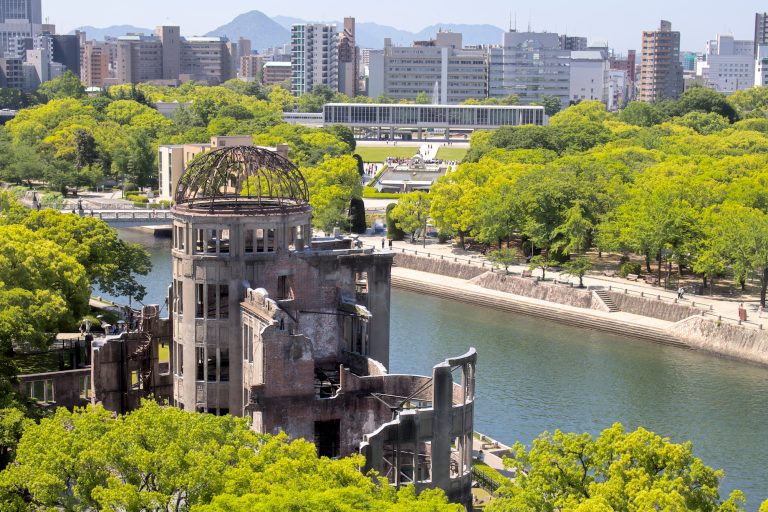
03 Hiroshima Peace Memorial Park: A Walk Through
Located in the heart of the city, Hiroshima Peace Memorial Park stands at the intersection between radical loss and unimaginable suffering, but also astonishing forgiveness and hope for the future.
Peace Park is Hiroshima’s monument to the use of the first atomic bomb against a human population on the morning of Aug. 6, 1945. It honors the 140,000 who were dead by December. It memorializes the lost city. It celebrates peace and boasts the city’s amazing revival. At the same time, it educates visitors about the horrors of nuclear weapons in the hope that the epitaph written on the Cenotaph for the Atomic Bomb Victims can be realized:
“Let all the souls here rest in peace; for we shall not repeat the evil.”
The Monuments & Symbolism
Walking through Peace Park is like walking through a cemetery, a war memorial, a museum and a sacred religious site all at once. The park’s 122,100 square meters (~30 acres) are dotted with museums, preserved buildings that endured the blast, funerary structures and a variety of monuments focused on the park’s central message of peace.
The Main Entrance
While most people arrive from Genbaku Dome-mae Station on the northern side of the park and move south, the rhetorical design of the park is meant to be experienced from the south moving north.
The park’s designer, Kenzo Tange, organized the key structures of the park along a central north-south axis, with the main entrance on the southern side of the park.
Tange expected people to arrive at the park along Heiwa Odori (Peace Boulevard), the tree and peace-monument-lined east-west road that cuts across the city.
(Joy Photo / Michael Farrell)
The Statue of Mother and Child in the Storm
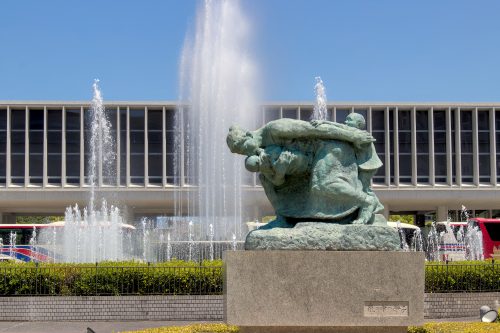
From there, one comes to a wide courtyard facing the street. Here you encounter the Statue of Mother and Child in the Storm. A woman with one arm clutches a small child to her chest while she hunches over to help an older child get on her back.
The Fountain of Prayer & Hiroshima Peace Memorial Museum
Behind the woman, the Fountain of Prayer sprays 11 tons of water per minute up to a height of 10 meters (~33 feet). Water is a common theme in the park for multiple reasons. One of the major intentions behind the water is tied to the thirst of the victims. Symbolically, the fountain offers victims something many desperately sought in their final moments. The intense heat of the bomb left countless people severely burned, dehydrated and pleading for water. After watching badly injured victims die soon after drinking, some survivors mistakenly came to believe the water itself had killed them and withheld it from the thirsty. Many later carried deep guilt over those decisions.
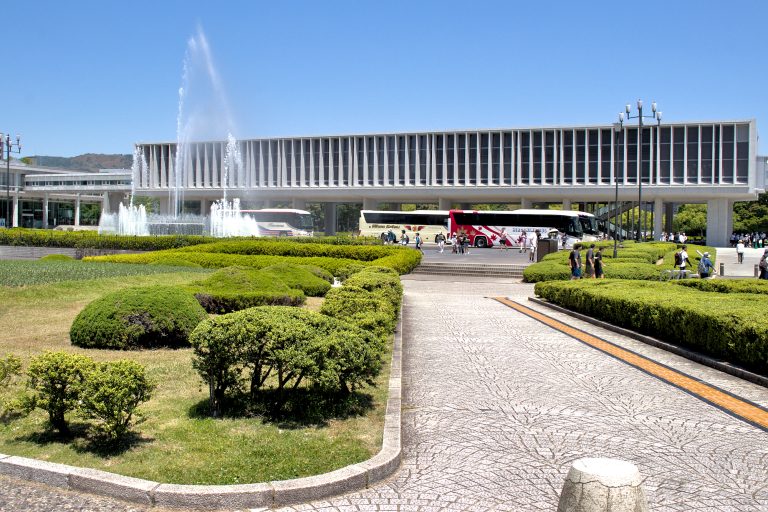
Beyond the fountain, the ribbed structure of Hiroshima Peace Memorial Museum spreads out before you. The museum is a great example of postwar Modernist Japanese architecture. Designed by Tange, the influence of Modernist architects like Le Corbusier can be seen in features like the concrete pillars (pilotis) that hold up the building. In the postwar period, many Japanese architects embraced Modernism as part of a broader national reconstruction effort tied to ideas of peace, internationalism and technological progress.
(Joy Photo / Michael Farrell)
Cenotaph for the Atomic Bomb Victims
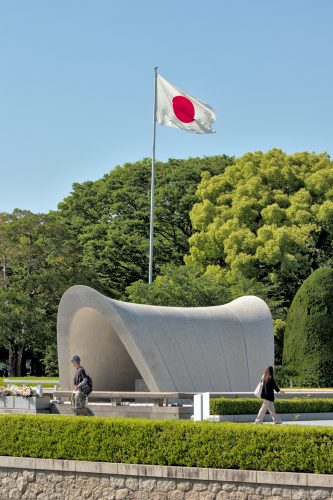
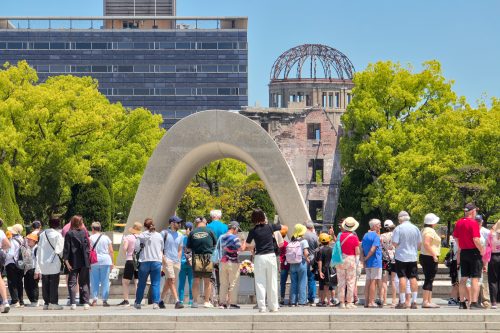
Pass under the museum’s reinforced concrete pilotis and you come to a large lawn with a central path north along the main park axis. This path takes you to the Cenotaph for the Atomic Bomb Victims. The cenotaph operates like a gravestone for all the victims. Designed under Tange’s park plan, the cenotaph’s saddle-shaped arch evokes ancient Japanese funerary forms, particularly the house-shaped haniwa associated with Kofun-period tombs in the fifth century.
Under the Cenotaph is a stone chest that houses the 130 volumes that make up the Hiroshima Atomic Bomb Victims Registry. The list includes American POWs, Koreans, Taiwanese and other non-Japanese residents present during the bomb. It contains 349,246 names. One volume is intentionally left blank for all the unknown victims.
Ceremonial Center
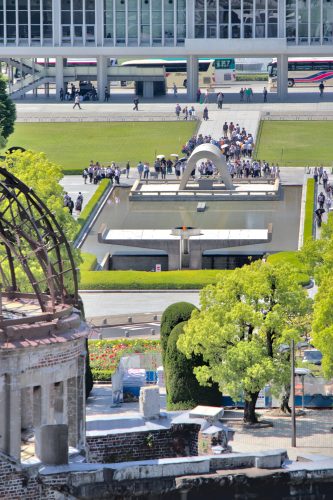
The lawn and cenotaph are the ceremonial heart of the park. This is where the city solemnly gathers every Aug. 6 to remember the bombing. It is also where visiting dignitaries pay their respects. For example, in 2019, Pope Francis prayed for the dead, listened to survivors and condemned nuclear weapons in a Peace Gathering at the cenotaph. In 2023, when Hiroshima hosted the Group of Seven (G7) Summit, the G7 leaders offered flowers and prayed at the cenotaph before planting cherry trees along the eastern side of the lawn.
(Joy Photo / Michael Farrell)
Pond of Peace & Flame of Peace
Looking through the arch of the Cenotaph, you’ll see the still waters of the Pond of Peace leading up to the Flame of Peace—symbols rich with meaning. In Japanese religious and funerary traditions, water symbolizes the dividing line between the living and the dead. It is also used for ritual purification before entering holy places. Consequently, the Pond of Peace can be interpreted as a ritual boundary between the land of the living and the dead while also providing purification for the souls forced to cross. The Flame of Peace, meanwhile, represents the threat of nuclear war. It is kept perpetually burning until global nuclear disarmament is achieved.
Atomic Bomb Dome
Lastly, looking beyond the pond and the flame, one sees the twisted ruin of the Atomic Bomb Dome preserved as it was just after the bomb exploded. Before the bomb, it was called the Hiroshima Prefectural Industrial Promotional Hall. Though clearly visible from the cenotaph, it lies on the other side of the Motoyasu River. The steel-frame and masonry building was designed by Czech architect Jan Letzel and built between 1914 and 1915. First called the Hiroshima Prefectural Commercial Exhibition Hall, it was originally used to promote new commercial and industrial products.
For example, one of the most popular baked goods in Japan today is baumkuchen. You can find this German cake in most supermarkets, and it is commonly bought as a gift for special occasions. Karl Juchheim, the future founder of Kobe’s famous Juchheim Co., Ltd., introduced the sweet to Japan in 1919 at an expo held at Hiroshima Prefectural Commercial Exhibition Hall. In stark contrast, today’s ruin serves as a reminder of the devastating power of nuclear weapons.
Hiroshima National Peace Memorial Hall for the Atomic Bomb Victims
To the right of the center axis, a memorial for the atomic bomb victims lies under the earth. Descend the stone stairs and move counterclockwise, as if backward through time, down a sloped passage mixed with the ground soil. Inside Hiroshima National Peace Memorial Hall for the Atomic Bomb Victims, visitors are invited to learn more about the victims and the terrible power of the atomic bomb while being given space to digest and pray.
At the very bottom, inside the Hall of Remembrance, one finds a 360-degree diorama of what Hiroshima looked like from the hypocenter right after the bomb. The image is made out of 140,000 tiles, each one representing one of the victims who died by the end of the year. Other facilities include a Special Exhibition Area, a library where you can read over 140,000 survivor memoirs and obituaries, and a wall display that continually rotates through portraits of the victims and their names.
Hiroshima Peace Memorial Rest House
Just north of Memorial Hall lies another surviving structure from before the blast. Built in 1929, Hiroshima Peace Memorial Rest House was Taishoya Kimono Shop at the time of the bombing. It was restored and reopened in July 2020 as a tourist information center and rest area. Inside, one can find a gift shop, a café and a piano that survived the atomic bombing. Two major park tours also operate out of this building: a VR tour where people can see what the park looked like before the bomb as they explore the park, and a cycling tour that connects the park to atomic bomb sites around the wider city. There is also a museum display in the basement where the late Eizo Nomura, the closest known survivor to the hypocenter, survived the atomic blast.
Children’s Monuments
(Joy Photo / Michael Farrell)
Children’s Peace Monument
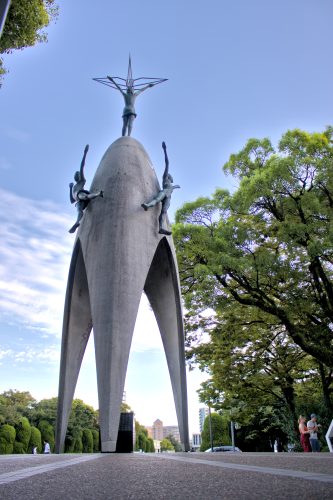
Just to the left of the south-north line connecting the Atomic Bomb Dome to the Statue of Mother and Child in the Storm is the Children’s Peace Monument. It stands just across the road from the Flame of Peace.
On top of the monument, above a small bell tower, a little girl holds a large paper crane above her head. Flanking the figure, a boy and a girl fall to the sides with their hands held out as if to catch something. Under the bell tower, the Japanese inscription reads, “This is our cry, this is our prayer: for building peace in the world.”
The girl at the top represents Sadako Sasaki, a 12-year-old who died in 1955 from radiation-induced leukemia. Hoping for recovery, Sasaki followed a Japanese folk tradition that if you folded 1,000 paper cranes, you would be granted a wish. Sadly, despite completing more than 1,000 cranes, she passed away.
Today, paper cranes are folded by children across Japan and the world in honor of child victims like Sasaki. These cranes are displayed in glass cases behind the monument as a plea that no child should ever have to endure nuclear war. An estimated 10 million paper cranes are offered every year.
While visiting, you can also fold your own cranes and donate them to the case as a prayer for peace.
Memorial Tower Dedicated to Mobilized Students
On the route to the Atomic Bomb Dome, after crossing the Motoyasu Bridge, lies another memorial to children killed in the war. The Memorial Tower Dedicated to Mobilized Students lists the names of 6,874 students age 12 and older who died in the war both from the atomic bomb and from air raids across Japan. They died while mobilized by the government to fill vacant jobs as the country ran out of adults who could work.
According to city records, at the time of the atomic bombing, at least 9,111 children were deployed in the city demolishing buildings to make firebreaks in case of conventional bombing. Around 6,300 of the deployed students died in the blast.
Adjacent Monuments
Circle around to the west after visiting the Atomic Bomb Dome. Cross the T-shaped Aioi Bridge, the bomber’s original target, and enter the wooded side of the park to see the Clock Tower, ring the Peace Bell, pray for the dead at the Cenotaph for Korean Victims and the Atomic Bomb Memorial Burial Mound. This last monument contains the ashes of 70,000 unidentified victims who were discovered all across the city. Some have since been identified, currently leaving 67,566 individuals still unknown.
Before and After the Bomb
Before the atomic bombing, the area now known as Peace Memorial Park was known as Nakajima District. It was a lively and bustling place filled with homes, shopping, industry, clinics, restaurants, a theater, temples, government offices and more. It is estimated that 6,500 people lived in Nakajima at the time the atomic bomb exploded. At the time, the population of Hiroshima as a whole was estimated to be around 350,000 people.
On Aug. 6, 1949, the “Hiroshima Peace Memorial City Construction Law” was enacted, and the land that was Nakajima District was dedicated to become Peace Memorial Park.
Shortly after this, architect Kenzo Tange’s design for Peace Memorial Park was selected out of 145 proposals. His pivotal idea was aligning the museum, cenotaph and the Atomic Bomb Dome on a central axis. Construction began in the early 1950s and was completed April 1, 1954.
Over the decades, additional monuments were added by various groups seeking consolation, peace and the repose of the dead.
One of the most recent additions is a bust of Mahatma Gandhi donated by India in 2023. The bust can be found on the path down the eastern side of the Motoyasu River on the edge of the park.
(Joy Photo / Michael Farrell)
Beat the Crowds and the Heat
Peace Park receives over a million visitors every year. In 2025, Peace Memorial Museum, a part of the park grounds, broke records with 2,003,718 visitors in one fiscal year.
To skip the large crowds and enjoy the best weather, note that the park is busiest on weekends and during the week between 11 a.m. and 3 p.m. This is also when the sun is especially intense in summertime.
Getting There
To experience the park as Tange imagined, you need to arrive at the southern entrance. This is not as easy on public transportation as taking the Hiroden tram from Hiroshima Station to Genbaku Dome-mae Station. But to experience the park as originally intended, it is worth the extra effort.
The easiest route to Peace Park’s main entrance is via the red Maple Loop (Meipuru-pu) bus. The tourist-focused bus leaves Hiroshima Station and arrives at “The Peace Memorial Park (Hiroshima Peace Memorial Museum)” stop in 15 minutes. The basic fare is ¥240, and buses leave approximately every 15 minutes from 9 a.m. until 6 p.m. You can read more about the Maple Loop and see its exact schedule on our transportation guide.
What to Do After
The park presents serious themes and evokes hard questions and emotions that take time to process. You can spend a whole day exploring and meditating in Peace Park. Some take two.
Here are some things you can do to decompress during your journey.
Get a traditional Japanese bento lunch at Kuroben, just a five-minute walk away, and eat it silently beside the river while listening to the sounds of nature. The Motoyasu River is lined with benches on both banks, giving visitors a place to sit and enjoy a light picnic—a perfect space to decompress in nature.
For those who prefer vegan or halal options, a block and a half east from the statue of Gandhi is Chidiya Kanak, one of the city’s most beloved Indian restaurants. You can order your food to go and eat it at the park or eat in at the restaurant. The gentle earth tones, rich wooden flooring and calming lighting make a relaxing atmosphere to enjoy a meal and contemplate.
If you need a break from the heaviness, have some fun finding souvenirs for the people you love on nearby Hondori, the city’s most famous covered shopping street. The street is lined with souvenir shops like Country Cat and lately has become a hot spot for gachapon shops.
Alternatively, blow off steam at Cafe Hybrid, a retro gaming café, or enjoy a yogurt frappe at Chichiyasu Parlor, a café built around the 140-year-old local yogurt brand.
- Address
- 1-1 Nakajimacho, Naka Ward, Hiroshima City, Hiroshima Prefecture, JAPAN
04 Hiroshima Peace Memorial Museum: What to Know Before You Visit
Hiroshima Peace Memorial Museum is more than a collection of artifacts related to the first atomic bombing. It is a tightly controlled narrative with a rhetorical end.
Quick Facts
- ▪️Admission: ¥200 (Adults), ¥180 (High Schoolers), Free (Junior High and below).
- ▪️Time Needed: One to three hours or more depending on how deep you want to go.
- ▪️Reservations: Needed for expanded museum hours at the start and end of the day. Needed all day between August 8 and 16.
- ▪️Best Times to Visit: 7:30 to 9 a.m. / ~4:30 p.m. to half an hour before closing / 11 a.m. to 3 p.m. is the most crowded.
- ▪️Emotional Impact: High
- ▪️Suitability for Children: Contains graphic and disturbing content.
- ▪️Location: Hiroshima Peace Memorial Park / Downtown Hiroshima
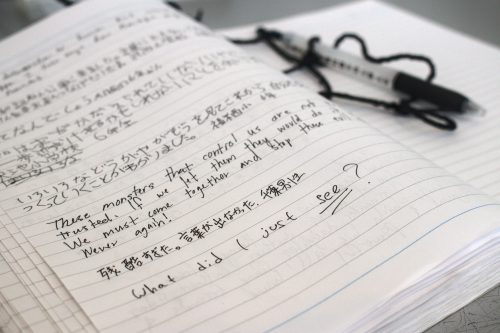
Visitors leave messages about their feelings in Peace Memorial Museum’s guest book. (Joy Photo / Michael Farrell)
A Museum with a Narrative Structure
Depending on the season, hundreds to thousands of people move pensively through the dark halls of Hiroshima Peace Memorial Museum. Some wipe away tears. Others hold their hands to their mouths in shock. Most walk through in silent reflection as they discover in graphic and sobering detail what happened in Hiroshima when the atomic bomb exploded on August 6, 1945.
While visitors can casually wander between classical works of art at Hiroshima’s Museum of Art or Five Days Children’s Cultural Science Museum, that is not how people move through Peace Memorial Museum. This museum immediately grabs you and takes you on an emotionally wrenching journey one exhibit room at a time. The layout along with the crowds direct your movement forward. Backtracking can feel like swimming upstream. Moreover, each exhibition room builds on the content of the last, forming a coherent picture of what the city and its people endured. Structured more like a novel than an encyclopedia, the organization is designed to facilitate the core message of the museum: “No more Hiroshimas.”
Peace Memorial Museum: Revised Edition
Following a major renovation and redesign completed in April 2019, the museum places the impact of the bomb on the city and its people front and center. While the former exhibit was known for graphic recreations of mutilated bodies, the current exhibit relies on a narrative structure told through historical images, A-bombed artifacts, the belongings of victims and the testimonies of survivors.
The exhibit is crafted for maximum emotional impact as it leads visitors from what the city was like before the bomb to the explosion at 8:15 a.m., then on through the aftermath and the consequences for the survivors. It concludes with the science of nuclear weapons, the historical events leading up to the bomb, the history of Hiroshima’s recovery, and the nuclear abolition movement today.
Peace Memorial Museum’s Main Building rises behind The Statue of Mother and Child in the Storm at the main entrance to Hiroshima Peace Memorial Park. (Joy Photo / Michael Farrell)
Entering the Museum
Approaching from the outside, one can’t help noticing the distinctive architecture of the museum designed by famed architect Kenzo Tange in 1949. Le Corbusier-inspired pillars (called pilotis) hold the ribbed Main Building roughly six meters (~19.5 feet) over the park. It rises above nearby tour buses and shades neat groups of school children seated on the pavement while they wait for directions from their teachers.
Upon walking in, visitors are directed to reserved or unreserved ticket lines. Those who did not make a reservation (which can be done through the museum website) arrive at automated ticket machines. Adults drop in ¥200 or use an e-payment and a ticket is printed on receipt paper.
At 11 a.m. in mid June, the floor is busy but not crowded. Natural light pours in from the wall-sized windows of the East Building.
A look to the left shows a group at the main desk renting audio guides for ¥500. The guides, resembling old music players with wired headphones and a shoulder strap, explain the exhibit as you walk through. Available in 15 languages, they hold 70 minutes of content activated by QR codes found throughout the museum.
A security guard invites visitors to scan ticket barcodes at a terminal before ascending a long escalator to the main exhibit. The lighting instantly darkens and becomes creamy as the exhibit begins.
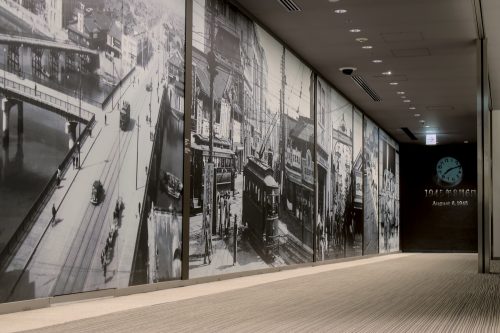
Scenes from 1930s Hiroshima cover the walls of the hall leading to the August 6, 1945 exhibition room. (Joy Photo / Michael Farrell)
Hiroshima Before the Bomb
At the top of the escalator, visitors come to a long hall with five ceiling-to-floor-sized photos of Hiroshima in the 1930s. The old city stands as big as if you had traveled back in time and witnessed it through a shop’s large windows.
Upon arrival, visitors are immediately drawn to the first image. “Is that the dome?” asks a boy to his father after their family glides up. The photo, apparently taken from the top of a tall building, shows Hiroshima’s former Nakajima District, the area now known as Peace Memorial Park. A trolley rolls over the bridge that a couple of decades later will be the Enola Gay’s target for the atomic bomb. And on the left along the Motoyasu River, standing intact, is Hiroshima Prefectural Industrial Promotion Hall, today’s Atomic Bomb Dome.
Most skim through the rest of the photos while on their way to the next exhibition room. A few are stopped by a photo of a young teacher posing with his elementary school class at the end of the display.
The size of the photos naturally encourages people to walk closer to the opposite wall so they can take it all in. However, in doing so they miss out on the captions. They are written in small text in the narrow space between the pictures. The captions describe historic scenes from well-known parts of the city that many tourists pass on their way to the museum like the intersection at Kamiyacho and Hondori Shopping Street.
In 15 minutes approximately 100 visitors passed through. Nobody stopped to read the captions.
Several walked through wearing audio guides. However, the first entry in the audio guide does not start until the next exhibit.
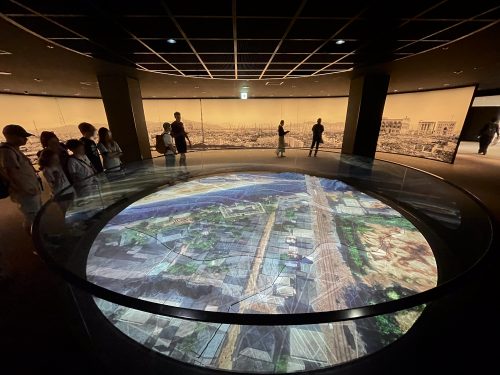
Visitors watch a recreation of the atomic bomb fall on Hiroshima. (Joy Photo / Michael Farrell)
August 6, 1945
The already dim lights get darker in the next exhibition room. Most people head for the center of the room where a circular, digital display on the floor simulates the dropping and explosion of the atomic bomb. People stand transfixed. The audible conversation of the last section is reduced to silence and whispers. Many stay and watch the tragedy unfold multiple times. Others leave for the next exhibit.
Meanwhile, the wall-sized image that wraps around the display is the least deeply examined. It is another ceiling-to-floor photo. This one is a panoramic photo of the destroyed city as taken from the hypocenter by the U.S. Army in 1945. It is the same image memorialized inside Hiroshima National Peace Memorial Hall for the Atomic Bomb Victims, a museum deeper in the park. The image covers much of the Nakajima District seen in the last exhibit. A thoughtful comparison of the two images reinforces the dramatic effects of the atomic bomb on the city.
From here, one passes down a long, dark corridor into the Main Building.
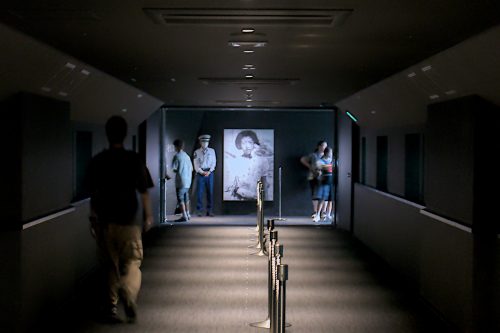
Visitors pass through a long dark hall to get to the permanent exhibits in the Main Building. (Joy Photo / Michael Farrell)
Reality of the Bombing
The Main Building is where visitors really slow down. It contains the museum’s core exhibits divided into four sections: “Devastation on August 6,” “Damage from Radiation,” “Cries of the Soul,” and “To Live.”
The arrested movement begins right away as visitors are stopped in their tracks by the photos of Yoshito Matsushige, a photojournalist for Hiroshima’s Chugoku Shimbun (which is still in publication). Matsushige miraculously survived the bomb and immediately went outside to take pictures. Matsushige was the only person to capture the situation on film immediately after the bombing. Other photographers were present, but the scenes were so horrific they couldn’t bring themselves to press the shutter.
In the museum, people start pausing in front of pictures and captions. After looking deeply, an older man shakes his head.
The photos themselves only reveal half the story. The emotional depth comes from the quotations.
One set of quotes injects sounds into the scene the photos create. People shouting, “Help me!” and “Water please!” A “half-crazed” mother holds her small child, calls its name repeatedly and cries, “Open your eyes! Open your eyes!”
Another quote shows you what the photographer decided not to. Matsushige wrote this about a group of victims he photographed:
“Their hair was scorched and frizzy. Their faces, arms, backs, legs — their whole bodies were badly burnt. Blisters had burst and sheets of burnt skin hung from them like rags.”
From here until the end of the exhibit, visitors are confronted with about 500 artifacts that cannot be understood on their own. Some visitors have audio guides, but most do not. These visitors have to read. Most do.
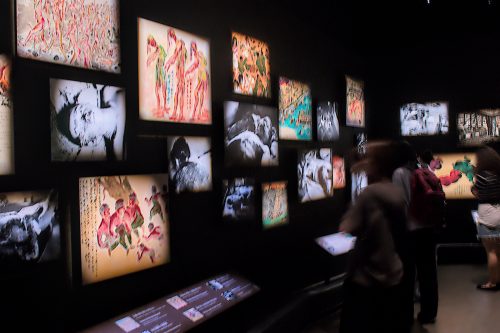
Photos and paintings from survivors shine from the wall in one of the most graphic displays at the museum. (Joy Photo / Michael Farrell)
Graphic Content
Few go through the next set of exhibits quickly. More than previous sections, the Main Building’s graphic content warning to parents and educators becomes relevant. They advise “parents and teachers prep children well and pay close attention to their response.”
A large crowd of visitors stares at a wall of photographs and artwork from survivors. The naked, burned and mutilated forms of human beings in the most dire situations glow from those images illuminated in the dark room from behind. The vividly colored paintings give context for the lack of color in the black-and-white photographs.
Across the hall lie collections of twisted, sheared, fused and melted architectural materials.
Less people stand and linger around the center exhibit. There lie the shredded school uniforms of 22 children aged 12 and 13 who died in agony from severe burns. The children’s names and 18 of their photos are displayed next to the case.
A tall man stifles tears while looking at the list.
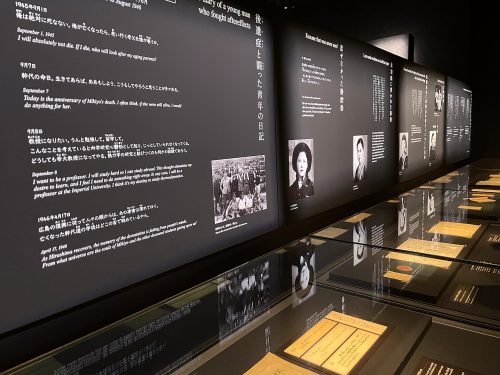
Written materials are on display such as diary entries of survivors of the atomic bombing in Hiroshima. (Joy Photo / Michael Farrell)
Dense Reading
The amount of reading needed to understand what you see increases, further slowing down lines of visitors.
“Cries of the Soul” gets deeper into the stories of the victims. The line of visitors curves to the left past portraits of victims and display cases of their abandoned belongings.
It is 2 p.m. The crowd is getting thicker as people start arriving from lunch.
Fewer visitors take a deep look at the glass display case in the center. It holds a corroded tricycle and a helmet that belonged to 3-year-old Shinichi Tetsutani who, though 1,500 meters from the hypocenter, died from severe injuries and burns. The photo behind the case shows Shinichi with his older sister Michiko, who was trapped in their burning house.
In the next room, people pause over diary entries of victims, people who survived but suffered from crushing loss, severe health issues, and struggles for basic day-to-day survival.
Among these is the story of Sadako Sasaki, who was a toddler when the bomb detonated yet developed leukemia two months before her 12th birthday. Hoping that her prayer for healing would be granted, she folded over 1,000 paper cranes. She died 11 months later in 1955. Her classmates erected the park’s Children’s Peace Monument in her memory. Some of Sasaki’s paper cranes are on display at the museum.
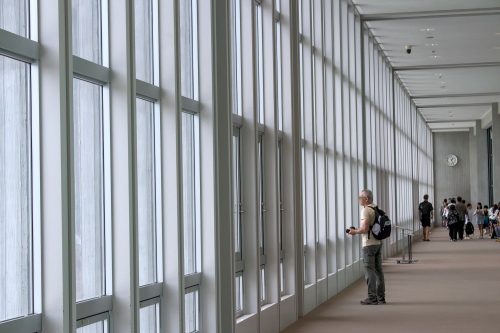
A man looks out at Peace Memorial Park in the north-facing gallery at Peace Memorial Museum. (Joy Photo / Michael Farrell)
In the Light of Peace Park
When visitors emerge from the main exhibit, they come to a long gallery with tall windows. The room stretches the length of the main building on the side facing Peace Park. After emerging from the visually and emotionally dark exhibit, the open space and natural light provide needed relief.
Some walk straight through to the other side. Others sit on the padded benches checking their phones. A handful notice the expansive view over Peace Park and take out their cameras. In the distance, school groups take turns getting their photo taken in front of the Cenotaph for the Atomic Bomb Victims. Behind it lies the Pond of Peace and the Flame of Peace. Beyond them rises the Atomic Bomb Dome. In the original design of the park, this is where people were expected to explore after visiting the museum. After learning about what happened, visitors can better understand the rest of the park.
There is much more to this space than a place to rest and watch the park, though. Along the back wall, some unobtrusive posters illustrate the construction history of the museum. Halfway down the hall directly opposite the Cenotaph is a map of the park, and opposite the map rises a roughly 3.5 meter (12 ft) high bronze map of Nakajima District.
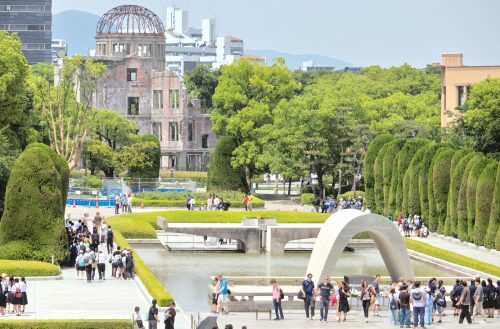
The view of Peace Park from the north-facing gallery windows of the Main Building of Peace Memorial Museum. (Joy Photo / Michael Farrell)
Not Finished Yet
The Main Hall of Peace Memorial Museum can take anywhere from 30 minutes to three hours to complete, depending on how deep you want to go, how fast you can read, and how crowded it is.
Emerging from the dimly lit exhibit feels like coming out of the cinema after an emotional film. However, the story is not over yet. Down the hall, back in the museum’s East Building, are even more exhibits, enough to fill another hour or two.
In total, one should reserve two to five hours to explore the entire museum.
For those who start exploring between 10 and 11 in the morning, the gallery is where many start facing logistical hurdles and basic human needs like lunch. However, there are no cafés or restaurants inside the exhibit area. Many rush through the rest of the museum on their way to their next meal, their next train, or to see the rest of Peace Park before they run out of time.
This is intentional on the part of the museum. The exhibits that follow, while important, are not as impactful as the main exhibit. Before the 2019 renovation, people passed through these sections first. However, this meant that people often ran out of time in the main exhibit and rushed through the most important part.
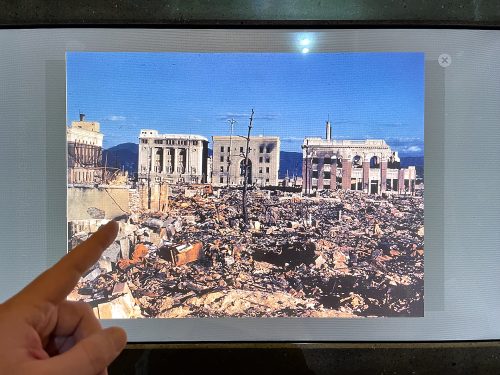
A color photo of Hiroshima’s condition after the atomic bombing as seen from an interactive screen in the Dangers of Nuclear Weapons exhibit on the third floor of the East Building. (Joy Photo / Michael Farrell)
Rushing Through: What You Miss
Just as you arrive back in the East Building, there is a lounging area on the left with a large TV screen. This is the A-bomb Survivor Video Testimonies section. In contrast to the crowded main exhibit, no more than a dozen people are lounging. Only seven of them actively watch the testimony playing on the screen. Invisible from the main walkway, at the far end of the lounge, a hallway cuts right along the outside wall. It is just after the restrooms. Along that corridor are individual booths for watching video testimonies.
Continuing straight, you end up in a wide hall dedicated to explaining the dangers of nuclear weapons and the nuclear abolition movement. Most visitors are making their way along the wall reading the many exhibit plaques. Fewer are taking advantage of the interactive media table in the center of the room where visitors can find unique media like color images of the city after the destruction.
The final permanent exhibition area explores Hiroshima’s history from the start of the war through its recovery and its mission to build a peaceful world. The layout is identical to the previous exhibit with most of the content on the walls and a touch-screen media table in the center. However, a frequently overlooked feature is a slide-show projected high on the wall over the main displays. Scenes from Hiroshima’s growth and return to life flicker across the wall, revealing scenes of the old Hiroshima Station, a survivor running a street stall, and more.
Back on the ground floor, you can find a special exhibition hall. There is also a gift shop and a café. The café sells ¥500 ice cream flavors such as matcha, black sesame and banana chocolate milk. One wall is lined with a variety of drink vending machines. Hiroshima souvenirs like paper crane magnets can also be bought. At 3 p.m., all the café tables are taken and people are sitting outside along the wall on benches.
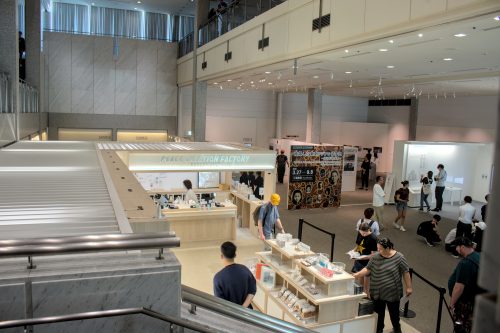
Peace Memorial Museum’s gift shop (Joy Photo / Michael Farrell
Getting There
Depending on the experience you are aiming for, there are multiple ways to get to Peace Memorial Park from Hiroshima Station.
The most direct way is to take the Maple Loop bus. This is the best choice for people on a tight schedule or who want to experience Peace Memorial Park the way the architect designed it to be experienced. From 9 a.m. to 6 p.m., a bus leaves about every 15 minutes. The routes are different, but they all lead to the Peace Memorial Park (Hiroshima Peace Memorial Museum) bus stop in about 15 minutes.
If you want to explore Peace Park and save the museum for last, take Hiroden Tram Line 2 or 6 to Genbaku Dome-mae Station. The northern end of Peace Park is on your left as you pull into the station. The museum is on the southernmost end of the park.
If you intend to go shopping in Hondori before visiting the museum, take Hiroden Tram Line 2, 6 or 1 to Hatchobori Station. Hondori is one block south. If you explore walking west along Hondori, you’ll eventually end up at Peace Park. Bear in mind that the 850-meter walk to the Peace Park from the eastern end of Hondori takes 12 minutes without distractions and crowds.
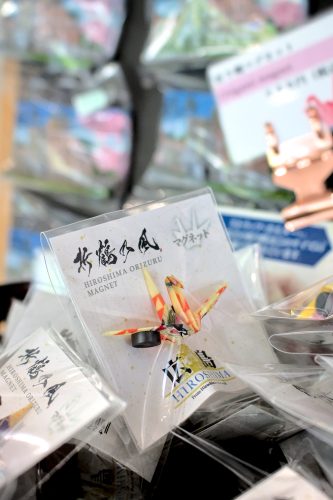
Souvenirs on sale at the first floor café at Peace Memorial Museum. (Joy Photo / Michael Farrell)
Quick Lunch Nearby
If you get lost in the story of the museum and skip lunch, here are some nearby stops to refuel before continuing your exploration of the park.
Most eateries near Peace Memorial Museum close between lunch and dinner. However, a few have more flexible hours while also having great food.
Five minutes to the south is Hiroshima Tsukemen & Abura Soba Karapokkuru. Open from 11 a.m. to 10 p.m., this second story shop specializes in tsukemen, a local style of brothless ramen served with a spicy noodle dipping sauce. The menu is in English and the prices are reasonable by local standards.
For a lighter meal, around the corner is Wildman Bagel — one of Hiroshima’s highest rated bagel shops. With over 15 flavors of bagels like Zunda Pepper Cheese, Matcha and Black Bean, and Iyokan with Lemon Cream Cheese, the selection here breaks North American expectations of what a bagel is. There is no seating, but nearby Peace Park has many shaded benches and trash bins. Wildman is open from 9 a.m. to 5 p.m.
Open Hours
Peace Memorial Museum’s Hours change seasonally. It is closed from Dec. 30 to 31 and in the middle of February. Admission ends 30 minutes before closing.
▪️Dec. to Feb.: 7:30 a.m. to 6:00 p.m.
▪️March to July: 7:30 a.m. to 7:00 p.m.
▪️Aug.: 7:30 a.m. to 8:00 p.m.(to 9:00 p.m. on Aug. 5 and 6)
▪️Sept. to Nov.: 7:30 a.m. to 7:00 p.m.
- Address
- 1-2 Nakajima-cho, Naka Ward, Hiroshima City, Hiroshima Prefecture, JAPAN
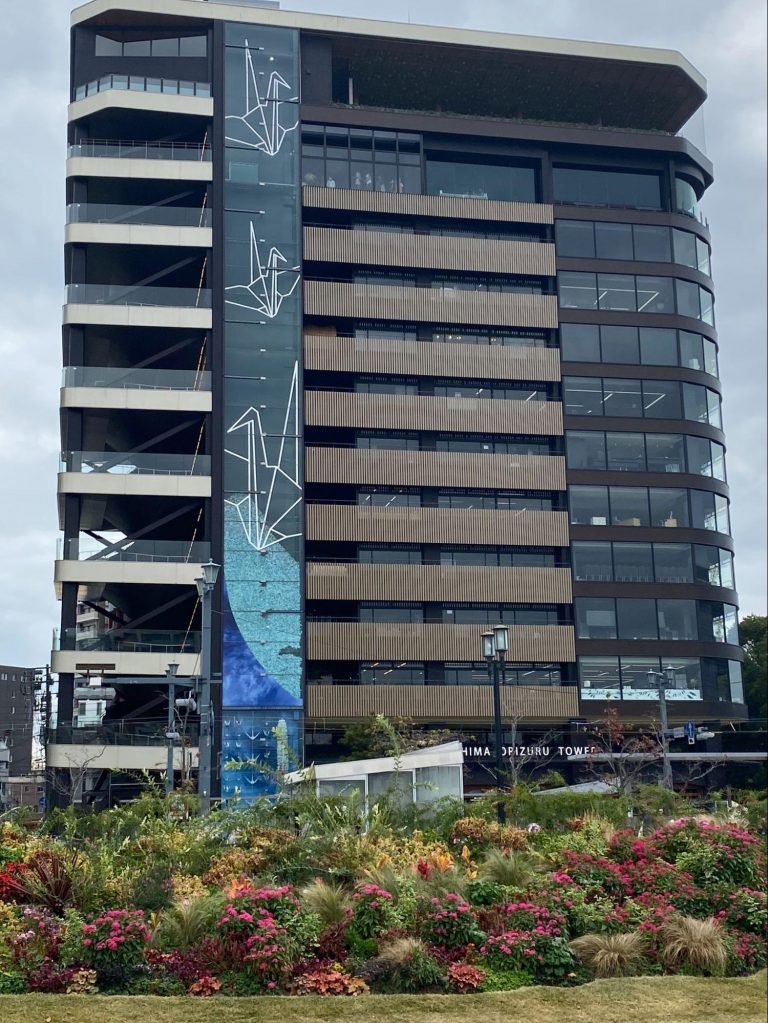
05 Orizuru Tower (おりづるタワー)
HIROSHIMA ORIZURU TOWER is a tourist attraction located next to the Atomic Bomb Dome. The north walls of the building are decorated with illustrations of ‘Orizuru’ paper cranes, which symbolize peace. The building also occasionally plays host to seasonal events. The first floor has a café and souvenir shop, and the 12th floor is “ORIZURU SQUARE,” where visitors can try their hand at making paper cranes. On the rooftop, there is an observation deck called “HIROSHIMA HILLS,” where you can enjoy a panoramic view of Hiroshima City and spend time relaxing.
The most attractive part of HIROSHIMA ORIZURU TOWER is the spectacular view of Hiroshima from the rooftop observation deck, from which you can enjoy a breathtaking view of the the Wolrd Heritage A-bomb Dome Site, Peace Memorial Park, Hiroshima Castle, and other parts of the city. The observation deck is covered, so you can enjoy the view even in the rain. Also, at the “ORIZURU SQUARE” on the 12th floor, you can enjoy making ‘Orizuru’ paper cranes. You can then throw your ‘Orizuru’ into the “ORIZURU WALL.”- a distinct glass display filled with paper cranes and the hopes and wishes that accompany them from all around the world!
- Address
- 1-2-1 Otemachi, Naka Ward, Hiroshima City, Hiroshima Prefecture, JAPAN
Transportation: Hiroshima Station [Hiroden Streetcar #1, 2, or 6, ~11 minutes]
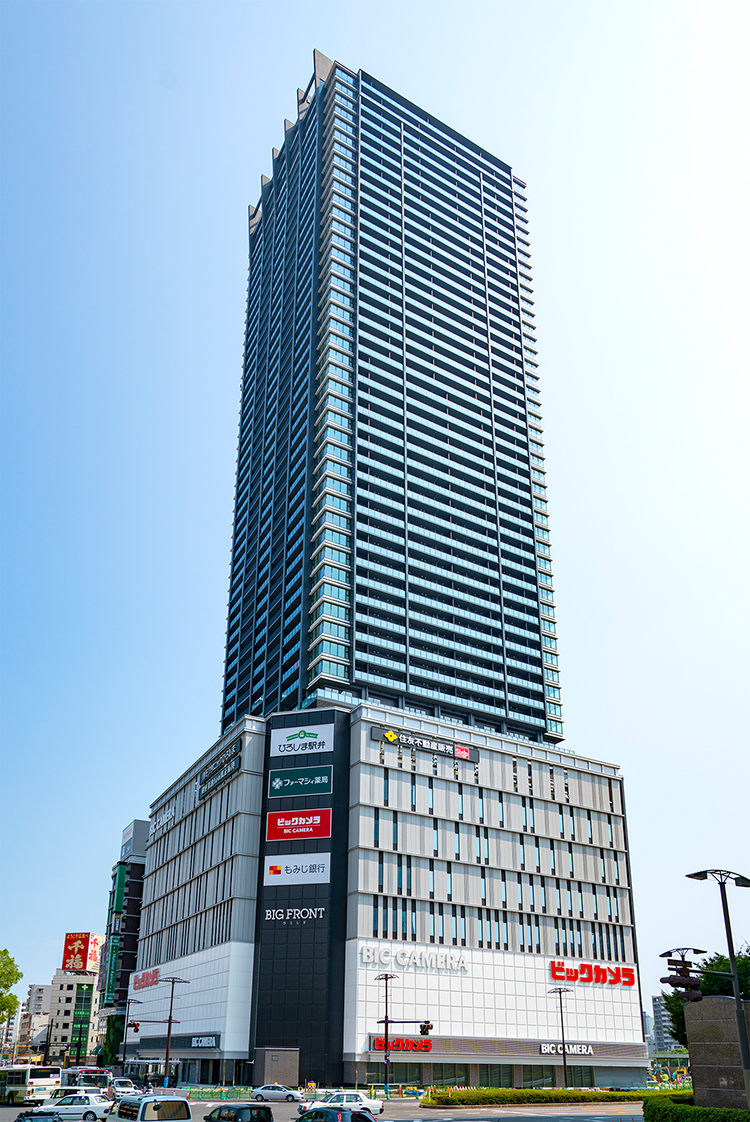
06 BIG FRONT Hiroshima (ビッグフロントひろしま)
BIG FRONT Hiroshima is a colossal skyscraper that sits opposite EkiCity by Hiroshima Station and the Fukuya department store. While it boasts several restaurants, a convenience store, a hotel, and more, the first thing to draw visitors’ eyes will undoubtedly be Bic Camera, a renowned electronics retailer loved by folks within and without Japan. Bic Camera extends into the basement, where it is connected to an underground passage that leads to Hiroshima Station as well as the aforementioned EkiCity and Fukuya.
- Address
- 5-1 Matsubara-cho, Minami Ward, Hiroshima City, Hiroshima Prefecture, JAPAN
07 Edion TSUTAYA Electrics (エディオン蔦屋家電)
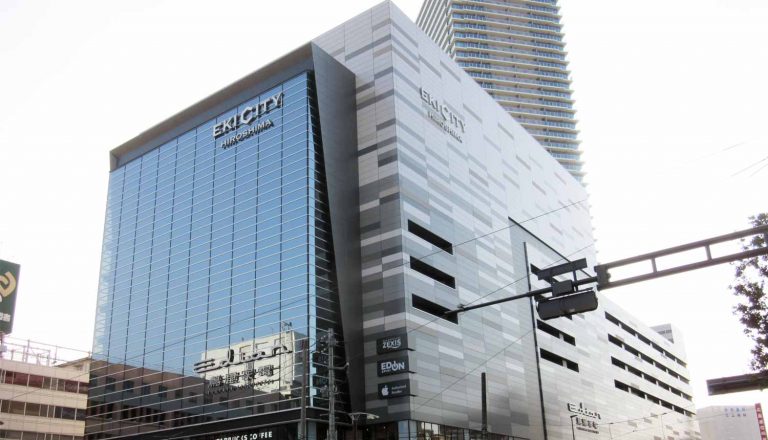
Edion Tsutaya Electrics is a complex store that is part of EKICITY, a shopping center adjacent to Hiroshima Station. There are restaurants on the first floor, which also shares space with a bookstore. On the upper floors, customers can find electronics and other home appliances.
- Address
- 3-1-1 Matsubara-cho, Minami Ward, Hiroshima City, Hiroshima Prefecture, JAPAN
08 Mazda Zoom-Zoom Stadium (マツダズームズームスタジアム)
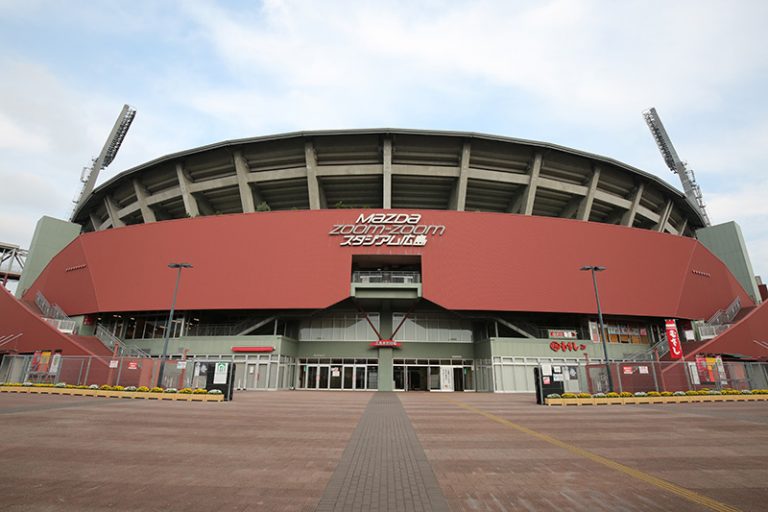
The Mazda Zoom-Zoom Stadium is the home of the Hiroshima Toyo Carp, Hiroshima’s professional baseball team. Famous Carp players include former team member Hiroki Kuroda, who played for the New York Yankees, and Kenta Maeda, who is currently playing for the Minnesota Twins. 2020 marks the 70th anniversary since the team was founded. The Mazda Zoom-Zoom Stadium opened in 2009 and is the second generation of the original stadium. It is a place where you can watch baseball games and enjoy great food and shopping at the team’s original souvenir stores.
[Admission fee (unreserved
seating)]
High School students and
above – ¥1,900
Elementary/Junior High School
students – ¥900
※ Depending on the game, it
is possible that tickets will sell
out.
- Address
- 2-3-1 Minamikaniya, Minami Ward, Hiroshima City, Hiroshima Prefecture, JAPAN
Watch a baseball game if there is one; if there is no game that day, at least check out the grounds.
Grab some last-minute grub and souvenirs before catching your train to your next destination.
Hiroshima Station (広島駅)
2-37 Matsubaracho, Minami Ward, Hiroshima City, Hiroshima Prefecture, JAPAN
Hiroshima Castle (広島城)
21-1 Motomachi, Naka Ward, Hiroshima City, Hiroshima Prefecture, JAPAN
Hiroshima Gokoku Shrine (広島護国神社)
21-2 Motomachi, Naka Ward, Hiroshima City, Hiroshima Prefecture, JAPAN
Musashibō (武蔵坊)
5-12 Fujimi-cho, Naka Ward, Hiroshima City, Hiroshima Prefecture, JAPAN
Shukkeien (縮景園)
2-11 Kaminobori-cho, Naka Ward, Hiroshima City, Hiroshima Prefecture, JAPAN
Hiroshima Prefectural Art Museum (広島県立美術館)
2-22 Kaminobori-cho, Naka Ward, Hiroshima City, Hiroshima Prefecture, JAPAN
Okonomimura – Hiroshima’s Cultural Okonomiyaki HQ
5-13 Shintenchi, Naka-ku, Hiroshima 730-0034 Hiroshima Prefecture
Hondori Shopping Street (本通商店街)
Hondori, Naka Ward, Hiroshima City, Hiroshima Prefecture, JAPAN
Atomic Bomb Dome: From Commercial Center to Peace Icon
1-10 Otemachi, Naka Ward, Hiroshima City, Hiroshima Prefecture, JAPAN
Hiroshima Peace Memorial Park: A Walk Through
1-1 Nakajimacho, Naka Ward, Hiroshima City, Hiroshima Prefecture, JAPAN
Hiroshima Peace Memorial Museum: What to Know Before You Visit
1-2 Nakajima-cho, Naka Ward, Hiroshima City, Hiroshima Prefecture, JAPAN
Orizuru Tower (おりづるタワー)
1-2-1 Otemachi, Naka Ward, Hiroshima City, Hiroshima Prefecture, JAPAN
BIG FRONT Hiroshima (ビッグフロントひろしま)
5-1 Matsubara-cho, Minami Ward, Hiroshima City, Hiroshima Prefecture, JAPAN
Edion TSUTAYA Electrics (エディオン蔦屋家電)
3-1-1 Matsubara-cho, Minami Ward, Hiroshima City, Hiroshima Prefecture, JAPAN
Mazda Zoom-Zoom Stadium (マツダズームズームスタジアム)
2-3-1 Minamikaniya, Minami Ward, Hiroshima City, Hiroshima Prefecture, JAPAN