
Now & New
re:Dine Hiroshima: Trying Pacela’s New Food Court
Let me be forthright: as aesthetically appealing as I find the Pacela shopping center, it has always been limited in terms of the quantity and quality of its stores, especially when it comes to dining options. Many visitors to Pacela may develop their favorite eateries, but like it or not, one that stood out among the others was Miss Hoa, a Vietnamese restaurant on the mall’s sixth floor. With exotic dishes from various Southeast Asian countries, a gorgeous interior that had customers crossing over a manmade pond, and awesome window views of the outdoor terrace and Hiroshima Castle, no other restaurant was Miss Hoa’s equal. When it moved to a new location a couple of years ago, the space lay empty, the storefront the exact same except for the name missing from the sign. For a brief period, it was temporarily used as a bar on certain nights when sports matches were played on the big screen on the outdoor terrace. I used to pass by that space in the mall thinking it was such a waste of space, knowing that whatever would replace Miss Hoa had some immense shoes to fill.
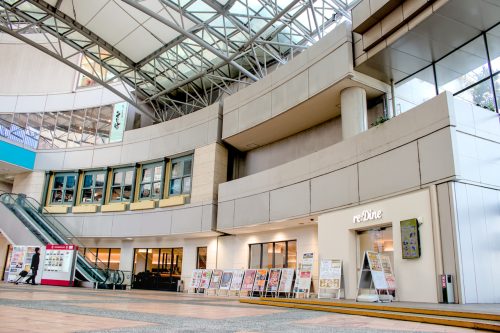
re:Dine Hiroshima is located on the sixth floor of Pacela. (Joy Photo / Michael Farrell)
On November 1st, 2025, Miss Hoa’s true successor finally debuted as re:Dine Hiroshima: not one, not two, but ten eateries in the same space! Out of those, six places sold meals and the remaining four specialized in desserts and drinks. Most of the food for sale is Japanese cuisine, but there is still quite a lot of diversity between the establishments, with entrées ranging from spicy noodles to pork cutlets, featuring Western cuisine such as hamburgers as well as what might be the most stereotypical Japanese food imaginable: kaisen-don (raw seafood rice bowls). As for dessert, re:Dine Hiroshima has a wide variety of options, including—but not limited to—candied apples, croffles, baby castella, and warabimochi (brackenstarch dumplings) covered in kinako (dried soybean powder).
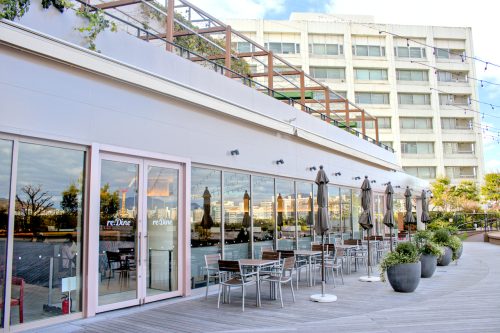
Window and patio seats are great when the weather is. (Joy Photo / Michael Farrell)
Perhaps what’s more innovative than cramming ten restaurants into the space of one is the ordering system in place. While the staff of ten restaurants each have their own space for cooking, the customers need not approach the counter to order. In fact, the staff ask that the customers not approach any counter and simply be seated at a table, where diners scan QR code with a smartphone to read the menus and place their orders. Staff members of the respective eateries will then bring the food and drink directly to the customers’ tables. This is a convenience as it prevents long lines from forming in front of the eateries but may be a hassle to someone whose smartphone is low on battery or somebody who wants to see bigger words and pictures on a printed menu. Unfortunately, the only printed materials are advertisements for seasonal, limited-time, or recommended items; those who wish to see full menus are stuck looking at their devices. Best of all, these restaurants come and go on a periodic basis, so diners will have different options when they visit re:Dine in different seasons.
The Joy in Hiroshima team chose to visit re:Dine on a weekday afternoon in the middle December as a group of six, so we were seated in the back where bigger tables were available. We found it appropriate to sample the food from six different places for maximum diversity and minimum burnout, then combine our opinions of each item after sharing the food. Once again, because the tenant stores inside re:Dine cycle constantly, this is a reminder that the food we tried that day may no longer be available by the time you visit.
29LaB BURGER (Pronounced “Niku Labo Burger”)
The number 29 is often associated with meat in Japan since the Japanese word for meat (肉 – niku) sounds like a combination of 2 (二 – ni) and 9 (九 – ku). Fun fact: the 29th day of every month is jocularly called Meat Day (肉の日 – niku no hi), with the ninth being February’s Meat Day (on leap years, February has two Meat Days). That being said, this hamburger establishment prides itself on its image as a carnivorous laboratory where experimentation with creative burger combinations is its selling point. Since it was our first time at this food court, we went with a safe but guaranteed delicious option: the Niku Labo Cheeseburger! Gaze upon it in shock and awe, as it has enough melted cheese and grease to have “The Star-Spangled Banner” playing in any diner’s head.
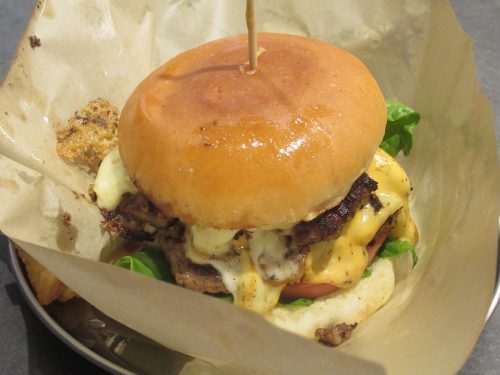
The 29 LaB Cheeseburger with all its glorious ingredients. (Joy Photo / Kevin Peng)
In addition to looking tantalizing, our first impression was that the cheeseburger was rather large by Japanese standards. At least, that’s what we would have said a few years ago, as burger joints around Japan have started serving bigger burgers on average (though are still dwarfed by an average American burger). However, it’s what’s on the taste buds that counts, so the team collectively dug in and was not disappointed. The beef patty was moist with a chargrilled taste, and the cheese that was melted to the meat was as gooey and rich as expected. If we took this baby across the Pacific Ocean, it might even hold its own against burgers found in American pubs.
グラトーニ (Gratoni)
I’m going to go out on a limb and say the name of this restaurant is probably a portmanteau of the French word gratin and the Italian pasta rigatoni. In addition to serving up rigatoni gratin as per its name, this restaurant also specializes in pizza and is the token Italian restaurant of re:Dine. Today, we had the pleasure of trying the Wagyu Gratoni, which contains macaroni, Japanese domestic beef, lots of cream, and a layer of melted cheese on top.
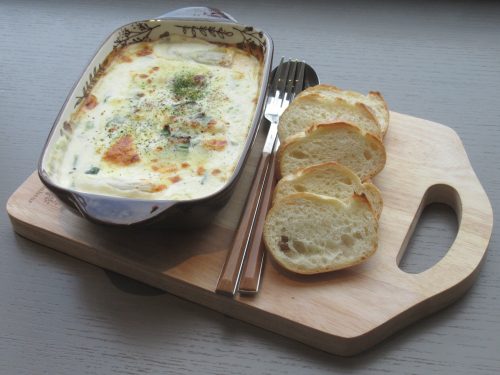
The creamy, cheesy Wagyu Gratoni was a classic pick. (Joy Photo/Kevin Peng)
This dish was as gooey as—if not gooier—than the cheeseburger from 29 LaB Burger. When our American journalist Michael picked up the first bite with a fork, the cheese stretched so far he had to use his hand to wrap the string of cheese around the fork before eating!
When asked about the flavor, Michael commented that the gratoni was super creamy and reminded him of a homecooked Western meal. A couple of other noteworthy facts were the appropriate portion size and the inclusion of baguette slices on the side, so diners can enjoy gratoni in more ways than one. Dip them into the cream sauce, top a slice with cheese and wagyu for a micro-pizza, make a Lunchables-esque rigatoni sandwich; do whatever your hungry heart desires!
TANTAN
Now we’re heading over to Asia, where we tried TANTAN’s malatang (麻辣燙 – “numbingly spicy soup”) noodle soup, originally a dish from Southwest China with a Japanese twist. What I found great about this place was that diners can choose from many different types of noodles when ordering: regular ramen-style noodles, harusame (春雨 – glass noodles), taitaimen (太帯麺 – “fat belt noodles”), which are wider than Italian tagliatelle and clear like harusame, and finally, toshomen (刀削麺 – knife-cut noodles). We went with taitaimen, which was served in a bowl of malatang alongside other ingredients such as shrimp, bok choy, and pork belly, to name a few.
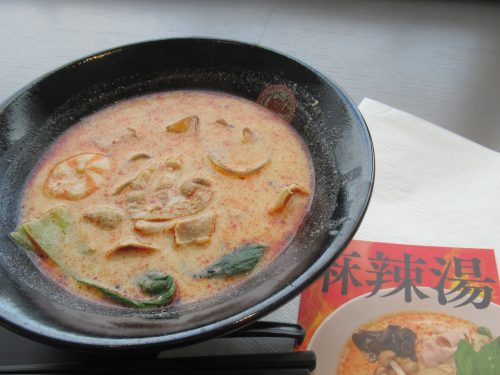
Red hot oil floats at the top of the seemingly numbingly spicy broth. (Joy Photo/Kevin Peng)
Despite the name, we didn’t really find the soup all too spicy; it was obviously toned down to cater to the Japanese palate. However, the unsurprising mildness didn’t distract too much from the taste, which we believe ranked above the gratin but below the burger. One issue we noticed with the staff was that employees seemed to be free to style their fingernails however they want, which may become a hygiene issue if acrylic nails are long enough to dip into the soup when the server arrives with the food.
Moment of Joy: Food Runway
Although we were seated at the back of the food court with nothing but incandescent lights to brighten up our lunch, we were allowed to move to the window seats for photography’s sake. Not only did we get stunning views of the Pacela terrace in broad daylight, but the radiant sunlight allowed us to put on a fashion show of sorts featuring what we ordered. One by one, the dishes were carried over to the counter seats by the window where they could strut their stuff. Taking photos of the colorful entrées and desserts was just as fun as eating them afterward at our original table.
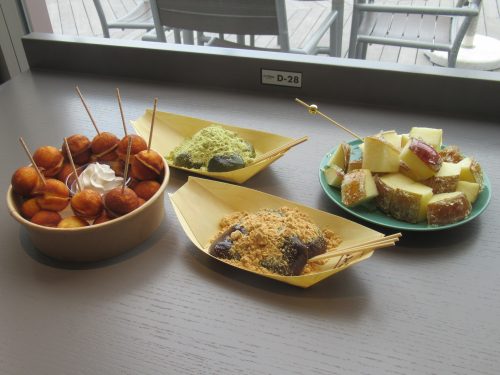
All four desserts on a counter catwalk. (Joy Photo/Kevin Peng)
Take Your Pick!
We got dessert from three different establishments: ORIGAMI, which specializes in crêpes and baby castella, Ringo no Himitsu Kichi (りんごの秘密基地 – “The Apple’s Secret Base”), dishing out apple everything-you-can-imagine, and Warabimochi Motoko, a shop dedicated to warabimochi (わらび餅 – brackenstarch dumplings). Naturally, this high diversity in dessert also resulted in a rich diversity of opinions but let us begin with the least impressive item: ORIGAMI’s baby castella.
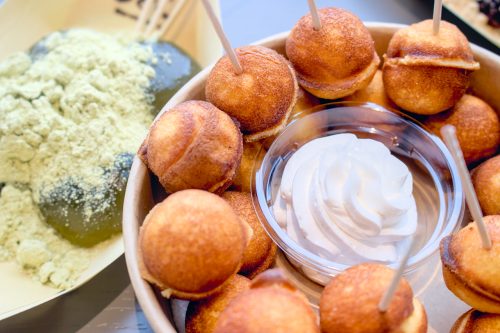
Baby castella cakes with whipped cream from Origami. (Joy Photo / Michael Farrell)
Baby castella is a festival favorite among locals all over Japan because the tiny cakes are cheap, tasty, shareable, and come in a portable paper bag so you can snack on them anywhere. Just to jazz it up a little bit, we paid a little bit extra for some whipped cream for dipping. Unfortunately, the taste of these baby castella did not live up to the cutesy, bell-shaped look common to the snack. The cakes themselves were dry, and while the whipped cream would add moisture, the whipped cream provided by the store was too hard to consistently stick to the baby castella, even when jamming one into the cream with a pick. It’s safe to say that one could find a better experience with baby castella at a regular Japanese festival, so a crêpe from ORIGAMI may be a safer bet.
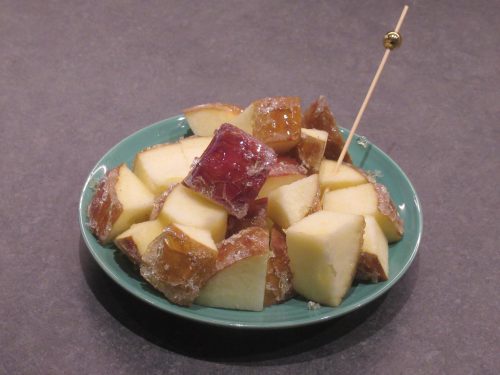 Diced candied apples are served with this fancy pick. (Joy Photo / Kevin Peng)
Next up were the diced candied apples, which are also eaten with picks. Most people around the world may be accustomed to eating candied apples right off the stick, but cutting one up and serving it on a plate with picks makes it not only easier to eat, but easier to share as well. While this dessert may not scream “Japanese” or exotic,” the Joy in Hiroshima team determined that the candied apples from “The Apple’s Secret Base” were the best dessert that day. In addition to candied apples, this place also sells apple pie, apple tea, and sundaes featuring candied apples topped with vanilla soft serve ice cream. Customers can return to re:Dine again and again, always able to enjoy apples in a different way.
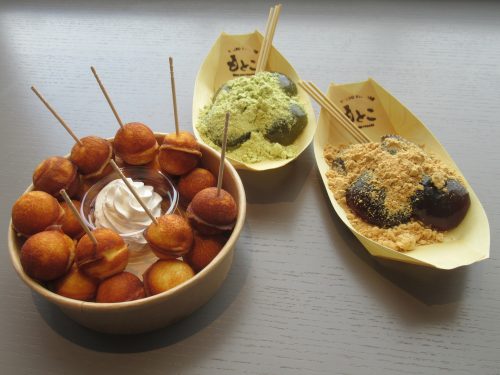
Two flavors of warabimochi are on the right, with the store logo on the trays. (Joy Photo / Kevin Peng)
Last but not least were the warabimochi, and we ordered two different flavors to compare and contrast them. Warabimochi Motoko produces four flavors of their coveted confection: clear San’onto sugar, brown muscovado sugar, green matcha, and purple sweet potato. We went for the brown and green ones; each covered in a variety of kinako (soybean powder) that matches the color of the treat.
These spherical, translucent, jiggly warabimochi were truly something else. Warabimochi are more commonly polyhedral in shape and while gelatinous, typically don’t wiggle as much when disturbed. It was a hard call to make, but we ultimately declared the candied apples the winner as these warabimochi were a bit difficult to stab and lift up with the provided picks and dry kinako can cause quite a bit of coughing. Speaking of dry, though, this eatery also sells milk tea and other beverages—hot and iced—filled with their warabimochi so diners can slurp their desserts on the go!
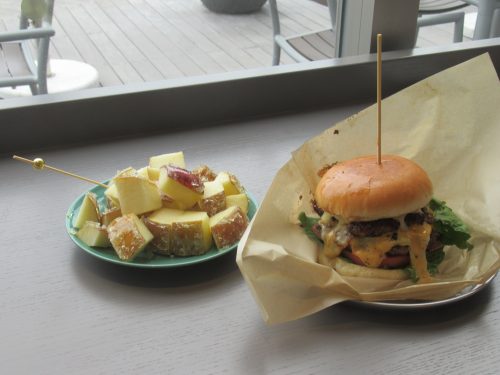
Here are our two winners from our great sampler! (Joy Photo / Kevin Peng)
To sum it up, re:Dine Hiroshima may not have fully filled the shoes of Miss Hoa, but this unique and stylish food court is the best use of that space that Pacela shoppers have seen in a while. The cheeseburger and candied apples may have been the winners in our book this time around, but re:Dine has enough options to justify subsequent visits for the four remaining establishments: the authentic Wa Bistro Sakura (和Bistroさくら), which specializes in Japanese seafood recipes, the humorous Calories Are Justice (カロリーは正義), which serves up fried foods galore, the slightly healthier Menryu (麺龍 – “Noodle Dragon”), which prides itself on Hiroshima-style tsukemen (ramen without soup dipped into a dish of spicy sauce), and the trendy mari mari, which sells croffles (half-sized waffles with the texture of croissants) and açai bowls. Just remember that these were the ten stores we encountered at the time of writing, so your experience may vary based on when you visit.
On top of that, re:Dine has an excellent location, being right beside the outdoor terrace on the sixth floor as well as the escalator leading to the seventh floor, where the Hiroshima Motomachi Aquarium only recently opened. Visitors who are keen on exploring the sea in the middle of Hiroshima City would do well to take a quick dive into re:Dine before or after their educational excursions!
Written by the Joy in Hiroshima Team